Rohan Paul (@rohanpaul_ai) · 10/12/2026, 21:31:54
Eric Schmidt: AI May Hit Capital Wall Before Power Wall as Trillion-Dollar Debt Costs $60B Annually
Former Google CEO Eric Schmidt argues that the primary constraint on AI expansion may be capital availability rather than energy supply. Citing estimated costs of $50 billion per gigawatt, he notes that scaling to 10 GW requires half a trillion dollars, a burden only a few entities can bear. Schmidt highlights the US capital market's unique ability to finance such infrastructure but warns that investors will eventually demand clear ROI.
SOURCE COVERAGEFull Original Report
Rohan Paul (@rohanpaul_ai) · 2026-10-12 13
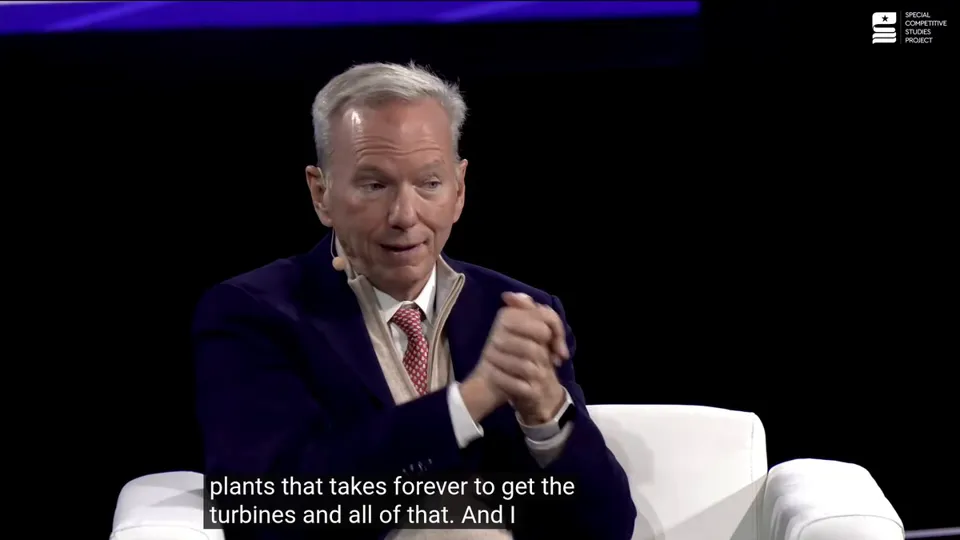
Ex Google CEO, Dr. Eric Schmidt: AI may hit a money wall before it hits a power wall.
Perf per watt had a good run. At 6%, a trillion in debt costs $60B a year.
"The real limit to AI is not energy; it is actually cash. When you add up the cost of these things, if you take round numbers, say $50 bn per gigawatt, then 10 gigawatts is half a trillion dollars.
How many companies, countries, and so forth can hand an industry a trillion dollars of capital? Very, very few. The Chinese could certainly do it. I do not know if they are doing it, but I am going to try to find out.
In America, there are people who hope that is going to happen. It is interesting that you can finance these things because the brilliance of the American capital market allows us to borrow that kind of money. For example, the Europeans cannot do this, which they are sort of sore about."
Full video from 'Special Competitive Studies Project' YT channel ( link in comment)
↳ 引用 @rohanpaul_ai (Rohan Paul): Broadcom CEO Hock Tan says capital, not chips, memory or power, may become AI’s biggest constraint.
inancing is harder to fix, because data centers and chips get paid for years before they earn anything, and higher bond yields raise that cost.
Intel CEO Lip-Bu Tan named the same pressure, calling “capital and the cost of capital” the front-line challenge and saying people will eventually want to see ROI.
Neither sees demand cooling soon, and Hock Tan said compute demand outstrips supply and could stay that way through 2029, possibly into 2030.