InfoQ 中文 · 10/13/2026, 11:51:34
Tech Giants Launch Personal Agents; YC CEO Proposes 'Personal AGI' via Markdown-Based Local Infrastructure
Major tech giants including Meta and OpenAI have recently launched 'Personal AI Agents' featuring long-term memory and cross-application execution, shifting competition from general chat to personalized autonomous proxies. Concurrently, YC CEO Garry Tan proposed the concept of 'Personal AGI,' advocating for private agents built on local infrastructure, Markdown knowledge bases, and Skill files rather than cloud-based black boxes. This trend highlights a paradigm shift towards decentralized architectures where users retain data sovereignty and execution control.
SOURCE COVERAGEFull Original Report
Contents9 sections
This month, personal assistants suddenly became the hottest product category in the AI industry.
In August, xAI launched Grokbot. By September, competition intensified significantly: Meta released Muse, bringing "Personal AI Agents" directly to the forefront; within weeks, Muse expanded from a standalone product into AI glasses, enterprise platforms, and developer ecosystems. OpenAI subsequently introduced Dots, similarly emphasizing long-running operations, personal context, and cross-application execution. Entering October, Google and Microsoft also began pushing their products and operating systems toward an agent-centric direction.
In just a few weeks, Meta, OpenAI, Google, Microsoft, and xAI almost simultaneously started competing for the same position.
Muse is one of the most prominent signals of this wave. Meta explicitly calls it a "Personal AI Agent": it has its own runtime environment and browser, can handle emails, bookings, forms, and long-term tasks on behalf of users, and gradually learns about them through usage. After Muse's release, Meta quickly integrated it into glasses, enterprise products, and developer platforms. By October, Wall Street had already begun discussing it as Meta's next-generation AI entry point.
OpenAI's Dots follows a similar trajectory. Each Dot possesses its own cloud computer, can continuously work around user goals, and connects with numerous external applications. A key phrase in OpenAI's description is that Dots will gradually learn "what matters to you," becoming increasingly like an extension of the user themselves.
Around this same time, YC CEO Garry Tan proposed a more radical judgment in his speech at Startup School 2026: "Personal AGI" is shifting from a seemingly extreme concept to an increasingly clear product roadmap.
According to Tan, everyone has been waiting for AGI to arrive in some world-shaking moment, but when it truly emerges, it may not look like a "god in a data center." It might simply be a terminal window, a set of Markdown files, a task continuing to run while you sleep, and an Agent built upon your personal Context.
He calls this thing "Personal AGI."
Tan also detailed his own practices in the speech: how he used a 220,000-page Markdown knowledge base, Skill files, and the open-source framework GBrain to build an "AI brain running on his own infrastructure."
Here are the core viewpoints from the speech:
- Personal AGI is not a $20/month chatbot, but an asset that runs on your own infrastructure, reads from memories you own, executes workflows you write, and compounds over time.
- Markdown is essentially code. If you can write instructions in clear English, you are a programmer; the compiler is the language model.
- The true brilliance of the GStack architecture lies mostly in Skill files plus a browser that an Agent can drive—a few pages of English and a way to interact with the world. It is Markdown, not magic. Fat Skills, thin Harness.
- Hundreds of founders are each doing a year's worth of work every day. This isn't the future; it's the current baseline for this cohort of entrepreneurs. If you don't do it, your competitors are, and they will politely eat your lunch and thank you for it.
- The old advice was: scratch your own itch, hoping it happens to be a market. The new version is much better: scratch your own itch, because scratching is nearly free. And some tools built just for you eventually become entire companies. You'll know when others start begging you to let them use it.
After Being Ostracized by His Era, He Chose to Keep Building
Some people online have called me "one of the most severely 'AI-psychotic' people on the internet." Given that, my speech today should naturally begin with one of the most heavily boycotted figures in history. His name is Baruch Spinoza. If you didn't take philosophy classes in school, here are the key points you need to know.
In 1929, someone sent Einstein a telegram: "Do you believe in God?" Einstein replied: "I believe in Spinoza's God, who reveals himself in the lawful harmony of all that exists, rather than a God who concerns himself with the fate and activities of mankind." The most famous living scientist, asked the biggest question, pointed to Spinoza.
Spinoza was a member of the Sephardic Jewish community. On July 27, 1656, at age 23, he stood in the synagogue as elders expelled him with the most violent curses imaginable: "May he be cursed by day and cursed by night. May he be cursed when he lies down and cursed when he rises up. Let no man speak with him, let no man transact business with him, let no man come within four cubits of him, let no man read anything written by him." This ban was unique among the approximately 40 bans issued that century: there was no clause for repentance, it was never lifted, and technically, it remains in effect to this day.
In fact, before the curse, the community tried to buy him off with 1,000 Dutch guilders a year—a huge sum at the time. All he had to do was occasionally visit the synagogue and keep his mouth shut. In founder terms: they offered him a salary to stop building. He said, "No, not even for ten thousand." He said he wanted truth, not comfort. Just before being expelled, a fanatic attacked him with a knife. The blade slashed his cloak but missed him. He kept that cloak for the rest of his life, leaving the hole unrepaired, using it to remember the cost of thought.
So, what did the most ostracized person of the 17th century do next? He ground lenses during the day, manufacturing optical instruments that allowed humans to see farther than the naked eye. He did it so well that Europe's top scientists came to buy from him. At night, he wrote a book too dangerous to publish while alive. When he died at 44, his lungs were filled with glass dust from grinding lenses, and his manuscripts were locked in his desk. His dying wish was to transport the desk via canal barge to a publisher in Amsterdam. His posthumous manuscripts immediately attracted attention across Europe, inspiring some of the most important philosophers of the Enlightenment.
You might ask, what does Spinoza have to do with startups? Here was a person ostracized by everyone he knew, bribed to stop, and nearly killed for delivering his work. His response was to build precision tools by day and write Europe's most dangerous book by night. Alone, without needing anyone's permission. If you're going to start a company, you should learn from Spinoza.
He gave a name to the engine that kept him going: Conatus, meaning your striving to persist—the driving force of every living being to maintain forward motion and enhance its capacity to act. Not your resume, not your title, not your job, but the sheer drive to persist itself. This speech is about tools to amplify that drive.
So, what exactly did he say that warranted expulsion? His heresy, roughly speaking, was this: God is not a king on a throne; God is dispersed throughout all existence—"God or Nature." Four hundred years later, we are making the same mistake regarding "intelligence."
AGI Won't Fall from the Sky; It’s Already Hidden in the Infrastructure
Everyone is waiting for AGI to arrive as a singular event: a god in the data center, an announcement, a threshold, a day when the sky changes color. Now, I propose a "Spinozan heresy" version of this scenario four centuries later: everyone is looking up at the sky, but what they are waiting for is already in the room. It doesn’t look like a god. It looks like infrastructure, like a terminal window, like a set of Markdown files, like tasks that complete automatically while you sleep. It is dispersed throughout everything, which is precisely where Spinoza tells us we should look for it.
AGI does not arrive as an event; it arrives diffusely: as your Agent, running in your context, doing your work. I call this "Personal AGI"—not Artificial General Intelligence arriving simultaneously for everyone, but general intelligence tailored specifically for you. This has been many people’s dream. Vannevar Bush called it the Memex: a machine that serves as an extension of you and your brain.
Let’s be precise, because the term "Personal AI" has been polluted by marketing departments. I am not talking about a chatbot you rent for $20 a month, nor slightly better autocomplete, nor an assistant that only knows your calendar. That is merely a rented subscription—an enterprise AGI you do not own, which resets when you close the tab, knowing only what everyone else knows. When the company behind it pivots, your so-called assistant undergoes a lobotomy on someone else’s schedule.
Personal AGI is something different: an Agent running on your own infrastructure, reading from memory you own, executing workflows you wrote, and compounding continuously. An enterprise AGI you don’t own only improves when the company releases updates. Your Personal AGI gets better every day you use it, because it learns more about your life each day. One is a consumable; the other is an asset. Almost no one in the world owns the latter, but everyone in this room can have it by Monday. I believe this intelligence should be owned by you, not rented. If you build it for yourself, 2034 need not resemble 1984.
Same Claude, Why Some Get 2x and Others 100x
You might ask why Personal AGI is emerging now. I believe it is because of what Agents can do, a capability most evident in Coding Agents.
In 2013, as a YC partner, I wrote our internal social network, Bookface, at night. I produced roughly 14 lines of useful code per day. If you know the literature on programmer productivity, that number is exactly the median—and that was my best effort. This year, working full-time at YC, with the same brain, the same hours, plus picking up my kids at 5 PM, my output is approximately 400 times what it was in 2013.
I know the skeptics in the third row are already questioning that number, so let me debunk it myself first. You don’t believe raw lines of code? Fine. Apply the most pathological redundancy penalty you can tolerate: assume all Agent-written code is bloated, assume half of it is Harness overhead, assume I’m boasting. Even under the harshest adjustment, it’s still 8x. No matter how you manipulate the number, it remains terrifyingly large. This isn’t just coding. If you are at the start of your career, you are lucky. This multiplier effect applies to design, product management, growth—every domain you wish to pursue. It is a multiplier for all knowledge work.
And this isn’t happening only to me. At YC, we see this reflected in the scale of our portfolio companies. In the Winter ’25 batch from a year and a half ago, 25% of the companies had codebases that were 95% AI-generated. These companies now use AI Agents for everything, not just code. That batch is poised to become one of the fastest-growing and most profitable batches in YC history.
I understand the difference between correlation and causation, so let me speak cautiously: I cannot prove that AI-generated code and everything else caused the growth. But I can tell you that the fastest-growing founders we fund do not use AI as autocomplete; they use it as a workforce. There are those getting 2x, and those getting 100x, using the same Claude, the same weights, the same context window size, the same API. The leverage is not in the weights; the leverage lies in the context you provide, how relevant that context is, and whether it is invoked at the right steps.
Spinoza wrote a definition in Ethics that comes to mind weekly. He defined "joy" as the feeling of your power of acting increasing. This is why when an Agent completes a week’s worth of work in an afternoon, it feels not like convenience, but joy. I am not being poetic; this is technical terminology. Your power of acting has increased; your Conatus has expanded. He also defined "sadness" as the feeling of your power of acting diminishing—specifically, your ability to impact the world receding, feeling like you are quietly quitting.
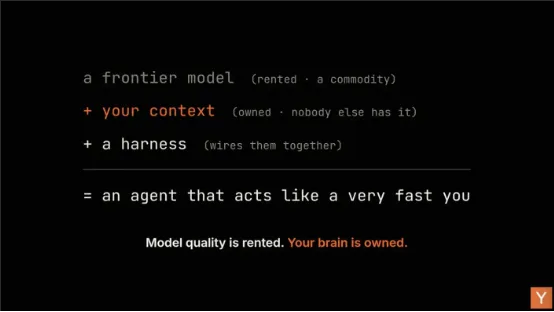
So, here is the equation for your next decade: a frontier model (rented, commoditized, dropping in price every quarter), plus your context (owned by you, unique), plus a harness connecting them (OpenClaw, Hermes Agent, Claude Code, or Codex).
Add them together, and you get an Agent that acts like a supercharged version of you. Model quality is rented, but your brain is yours. McLuhan said technology is an extension of man; Jobs said computers are bicycles for the mind. If you possess the system I’ve described, you have an autonomous rocket.
Paul Graham (YC co-founder) taught every founder in this building two things: "Make something people want," and "Do things that don’t scale." These rules still dominate everything today. What’s new is that the multiplier for the second rule has changed. Agents are now the way a founder can do things that don’t scale, at scale. The advice hasn’t changed, but the physical laws governing startups and what you can achieve have.
1 Million Tokens Isn’t Enough; The Real Question Is Which Three Books to Open
Spinoza ground lenses—instruments that allow humans to see beyond the limits of the naked eye. Next, I want to spend 15 minutes showing you what it looks like to grind lenses for the mind. This is the creed I actually live by; every concept translates to any tech stack you use.
As humans, we can hold about seven items in our heads at once. This comes from a famous cognitive psychology paper and explains why local phone numbers are seven digits long, and why you forget the eighth item on your shopping list—that is the entirety of human working memory. Every institution humans have built, every checklist, every org chart, every filing cabinet, and every stand-up meeting is a prosthetic for this limitation.
But an AI Agent can accommodate one million tokens—roughly a thousand pages of text, or three Harry Potter books spread open simultaneously in its mind. It can find a needle in any of those books and synthesize an answer across all three within seconds. Three Harry Potter books versus seven-digit phone numbers: you might say this isn't full AGI yet, but it represents a fundamentally different operating regime. Yet nearly everyone on Earth still runs their lives using org charts and workflows designed for seven-digit brains.
Push that number in another direction. A thousand pages is a lot, but it’s also very little. Your life isn’t three books; your life is a library: every email you’ve sent, every meeting you’ve attended, every decision made and the reasoning behind it, every conversation with every person you know. The question that determines whether your Agent is a genius or a goldfish is: who decides which three books are spread out on the desk? That is what a brain is for. This is what GBrain aims to be: a library plus a librarian.
I have been building GBrain in public. My personal OpenClaw features a Karpathy-style knowledge wiki with approximately 220,000 Markdown pages—a diarized record of my last 25 years, including every email, meeting, note, photo, draft, and mistake I’ve made. Most of it is compiled, curated, and searched by Agents, but I never repeat questions I’ve already answered. Lived experience within the system is key. When a founder emails me about a crisis, before I’ve even finished reading the email, my Agent has already pulled up all past conversations between me and that founder, identified three portfolio companies that hit the same wall, and highlighted what actually worked for them. When my Agent does anything, it operates under the premise that it knows everything I know. That is the difference between an assistant and a colleague.
My day looks like this: While I sleep, my Agent processes my inbox. It knows which emails come from founders in distress, which come from people trying to sell me things, and which come from the 17 mailing lists I never truly unsubscribed from. Important emails are triaged with context retrieved from the library: Who is this person? What is my entire history with them? What are they really asking? And what does this mean for me? I wake up to a briefing, not a pile of emails. Before each meeting, there is a prep document: Who am I seeing? What did we discuss last time? What has changed since then? What should I ask? Midnight research curiosities are completed by morning. When something interesting happens in the world, my Agent usually reads it, cross-references it against what I care about, and archives it before I’ve had my coffee.
Running atop this library architecture is my Agent coding framework, GStack—which now has 123,000 stars and ranks among the top 100 open-source projects in GitHub history.
Markdown Is Becoming the New Code; Everyone Will Become an Agent Manager
The true brilliance of this entire architecture lies mostly in Skill files plus a browser that an Agent can drive—a few pages of English plus a way to interact with the world. It is Markdown, not magic. Fat Skills, thin Harnesses.
Here is a real Skill file. I want you to see how unmagical it is. It says: “When CircleBack meeting recordings come in, transcribe them using speaker labels; extract commitments made inside, who made them, and what the deadlines are; cross-reference every person mentioned against the library and link to their pages; archive summaries here and full transcripts there; if any content contradicts facts we already believe, flag it—do not overwrite.”
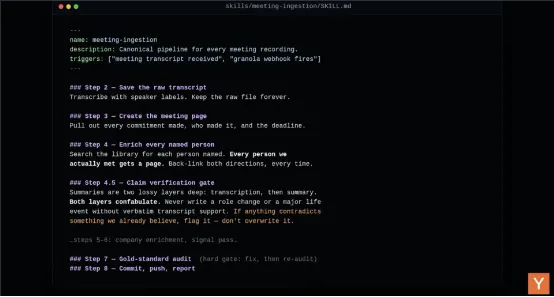
One page of English—that is a Skill. A smart intern, or indeed any literate person, could execute it. The litmus test is: If a smart intern can do it, an Agent can run it. This implies something profound: Markdown is effectively code. If you can write clear instructions in English, you are a programmer. The compiler is the language model.
So this is no longer just an engineer’s domain. At YC, our media team, event staff, and finance team—people who have never opened a terminal in their lives—are building Skill files and scheduled tasks. Someone on our finance team consolidated roughly 100 Excel workbooks into a single application using internal Agents. She is not a programmer; she is an Agent manager. Now, everyone is becoming exactly that kind of person.
Computation occurs only in latent space and deterministic space. Confusing the two is the root cause of Agent failures. Part of the computation belongs to latent space—taste, judgment, interpreting what humans actually want from ambiguous requests. This part lives in the model, and you guide it with Markdown files. Another part of the computation belongs to deterministic space—arithmetic, SQL queries, such as seating charts for breakout sessions you need to attend today. All of these must exist in SQL databases, called upon by Markdown files. Thinking clearly about this will save you many detours.
Having an Agent or a human arrange five people around a table is simple; it can be done in latent space. But having it create custom schedules for 6,000 people in a stadium requires your latent-space Agent to write code to track everything. Your experience at this conference is precisely the result of Markdown files calling code in this manner.
That knife attack, that bribe—every beat that might have shocked you when we opened twenty minutes ago—all of it came from an overnight run. 1,500 pages became a story ready for the stage, and I could edit it. I call this the "Assembly Skill," and I use it every day. It’s a personal skill, a supercharged version of deep research, far deeper than anything enterprise-grade AI products offer you.
The backbone of the talk you’re watching right now was sparked by this system. If you want to know where my brain actually starts, it isn’t those 220,000 pages. It’s a folder: a few Markdown files about the companies I’m collaborating with and the people I’ve been emailing. This library grows the same way everything else does—a little bit each day, compounding interest, with agents handling the archiving.
A Skill File Is an Employee
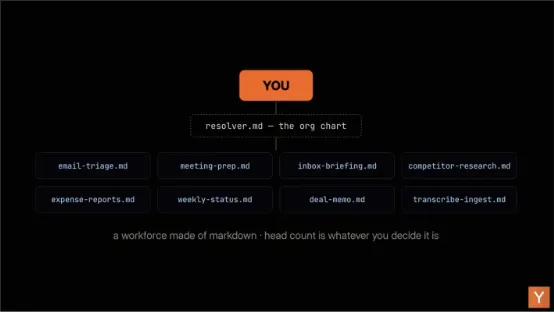
No one starts by building a warehouse or setting up shelves first. When you sit down with an agent, you aren’t writing code; you are managing a workforce composed of Markdown. A skill file is an employee: it has one capability, one job, written clearly enough that a new hire can execute it. A resolver is an org chart. Tasks come in, and it decides which Markdown file—or which person—handles them. This means that before you register any company, before you find a co-founder or design a logo, you can already operate an organization consisting of you and your agents. You are the founder and entire management team of "Your Company," and the number of employees under you is up to you.
This model has already spawned companies that break old math. Emergent, incubated in our Summer 2024 batch, went from public launch to nine-figure revenue in just eight months. When their annualized revenue crossed 60 million in annualized revenue with roughly 40 people. This level of per-capita output didn’t exist before—not in software, not in oil, not in railroads. These aren’t monsters; they are the first companies natively built on "new physics," and every single one started with one or two people, exactly as I described.
Imagine our incubation room at Dogpatch: hundreds of founders, each doing the work of what used to be a full year for one person, every day. This isn’t the future; it’s the current baseline for this cohort of entrepreneurs. If you don’t do it, your competitors are, and they will politely eat your lunch while thanking you for it.
This also changes what software itself means. Software is no longer so precious. You can spend a weekend building tools exactly tailored for one person. The old advice was: scratch your own itch, hoping it happens to be the market. The new version is much better: scratch your own itch, because scratching is nearly free. And some tools built for just you eventually become whole companies. You’ll know when others start begging you to let them use it.
Here’s an honest warning: an unmaintained brain is just a landfill with a good search engine. Retrieval will present outdated information to you with 100% confidence, and a bad skill file will encode a bad process forever. So the foundational primitive is memory plus hygiene: every fact needs provenance, conflict checks must run when new info clashes with old, and you need a real librarian whose actual job is pruning. Treat your brain as production infrastructure, and it compounds. Treat it like a landfill, and you get an agent that is very confident but wrong in ways you can’t track.
Five Steps to Get Started with Personal AGI
Now, let’s get practical.
Step 1: Tonight, pick a harness and run an agent on your own machine. I personally use OpenClaw and Hermes Agent, paired with GBrain. The hosted version is at gbrain.io—it’s free, and GBrain itself is open-source and free. I always recommend the Ferrari, but honestly, the Honda is fine too. Codex, Claude Code—any of them can accomplish 99% of this task. And the benefit of not driving a Ferrari is that you won’t have to stop halfway to fix the car. The concept is key, not a specific repo or product. Intelligence is there; many roads lead to it.
Step 2: Start building your library this weekend. Not a grand archive, just a folder of Markdown files. Export your notes; export your emails if you can. Write a one-pager for every project you’re working on and every person you’re collaborating with. On that page, write down what you actually know: what you’re building together, what they care about, what you owe them, what they said last time. This is data that exists on Earth in no other model, because it only lives in your head. And your head can only hold seven things. The first time an agent answers using your context instead of the internet’s context, you’ll feel that "click," and you won’t go back. Each of you holds five to ten years of personal history scattered across inboxes. That is your moat, lying there unindexed and inactive. Between you and this entire architecture, there is probably only about 24 hours.
Step 3: Write your first skill file. Pick the thing you hate most every week—maybe expense reports, meeting minutes, weekly status updates, or competitor research. Explain it to your agent in plain English, as if you were telling a smart friend what to do on their first day. Then let it make mistakes. If it gets it wrong, correct it. Every rule, every exception, every "oh, by the way..." goes into the text, and it will refine. That one page is now an employee. Run it.
Step 4: Turn it into a recurring task, perhaps the one created in Step 3. Do this every morning at 7 AM, summarize that every Friday. The first time you wake up to find the work done while you slept, something in your brain permanently shifts. From that day on, "a day" is no longer your unit of work; it becomes whatever you can imagine, driven by your goals and what you want to create for the world.
Step 5: Never do one-off work. Most people run an operation once, then throw away the context, close the window, and that’s it. Don’t do that. At the end of every task, have the agent "Skillify" itself. Skillify is a special skill in GBrain; you can point to that repo and say: extract Skillify, learn it. Turn it into a Markdown file you can reuse forever and ever. I often say at YC: if you have to ask something twice, you failed. Those who capture what they learn get smarter every day. Those who wake up with amnesia every morning are simply wasting time. And if you cannot convert model capabilities into true memory, the model is useless no matter how good it is.
Do these five things, and I can tell you exactly what will happen over the next 90 days. In the first week, it’s just a toy. The library is thin, Skills are clumsy, and you spend more time patching things up than saving time. By week four, the flywheel starts to spin. Agents begin answering questions using your context; morning tasks start producing content you actually want to read; you write a third and fourth Skill because the first two genuinely worked. By week twelve, you have a library that answers before you even ask. A dozen Skill files are handling the parts of your weekly workflow you used to hate most, plus one or two tools that others are begging to borrow. In this room, that’s called a startup. This curve looks like any compound interest curve you’ve seen: flat, flat, flat, then a steep ascent. Most people who try quit in week two, but those who stick with it until week twelve feel like they’re cheating.
Who ultimately owns your experience?
Now, I have to tell you the unpleasant part, because everything I’ve taught so far is a double-edged sword. I previously mentioned Spinoza’s definition of sadness: the feeling of diminished capacity for action. This becomes political. Here, Skill files are not documentation; they are part of your cognition. Your way of working is extracted from your mind, written down, and made executable. Every Skill you teach an Agent is a part of you being externalized. Yet, depending on a single variable—who controls them—the same file leads to two radically different futures.
Consider a fictional example. Let’s call her Maya, a support engineer. Over two years, she taught her Agent 40 Skills: how to triage P0 incidents at 2 AM, how to soothe a customer about to churn, how to write a post-mortem that actually prevents the next incident. Forty files—that was her judgment. What she spent two years building sat on disk.
Version One: These files reside in Maya’s own repository. When she changes jobs, they go with her. On day one at her new company, she can invoke years of accumulated judgment. For every year she works, she compounds another year of value. This is ownership. If she wants to start a business, this is her expertise. In fact, she can—today, entire startups can consist of just a few Markdown files.
Version Two: These files reside in the company’s repository, governed by corporate IT policies. When Maya leaves, she takes nothing with her. The company continues to operate using her judgment; forty files execute forever, with no mention of her name in the commit history. She didn’t own a career; she was mined. Same files, same Maya, differing only by one variable.
So here is my creed, which I hope you’ll repeat tomorrow: Own your Skill files, or your work will become a Skill file. This has happened before. Artisans owned their tools; that was the foundation of their freedom. Factories broke this: looms belonged to the mill owners. Knowledge workers thought we were safe because our tools lived in our heads, impossible to confiscate. Skill files ended that. For the first time in history, your cognition can be extracted, stored, versioned, and possessed. The only question is: possessed by whom?
Remember that thousand Dutch guilders? That offer never disappeared; it just reappeared in a new guise. Every comfortable arrangement where “my judgment compounds in someone else’s codebase” is essentially a thousand guilders a year to show up on time, stay quiet, and stop building your own stuff. This is why you should start a business: it’s the only way to truly make those Skill files work for you.
Spinoza faced an upgraded version of the same contract. In 1673, Heidelberg University offered a branch to the cursed heretic: a professorship, legal status, an academic chair, and the famous caveat: “free to philosophize, provided he disturbs no established religion.” Spinoza’s reply: “I do not know where the limits of such philosophical freedom lie.” He read the terms of service, then declined the acquisition.
He described what he guarded with one phrase: “under your own power”—acting under your own power, not under someone else’s, regardless of circumstances. The political question in 1673 and 2026 is the same: Who commands it? The essence of Personal AGI is controlling your cognitive capabilities and protecting yourself. The entire argument of this talk can be condensed into one sentence: Personal AGI is the way to remain under your own power in the age of Agents. So, from day one, put your brain and Skills in a repository you control, before any platform or acquirer gets ideas about it.
After Spinoza died, people inventoried his room: two pairs of trousers, seven shirts, a lens grinding machine, 160 books, and Ethics locked in his desk drawer. He had almost nothing, but no one ever controlled his Skill files. That desk drawer was his repository. Guard yours as fiercely as he guarded his.
The Stronger the Model, the More Valuable the Context: The True Moat of Personal AGI
I can hear your objections from here, so let’s address them directly.
First objection: Models evolve too fast; your “kit” will soon be obsolete. Just wait for the next release. This is the faithful doctrine of the “Bitter Lesson” believers. I love them. But note what actually happens with each model release: the better the model, the more differentiation shifts to context. When everyone’s engine has 1,000 horsepower, the race is won by the driver and the map. Weights are shared, but your library is yours. A better model only makes your library more valuable, because a smarter reader extracts more from the same book. I cheer for the labs as much as anyone in this building, but every version they release is a free upgrade to the workforce I already possess—and I hope you possess one too.
Second objection: Isn’t this just RAG? Sure, Postgres is just B-trees. Retrieval is a primitive, not a product. The hard part is everything around it: What should be written down initially? How is it enriched and linked? What gets promoted to hot memory versus archived as cold reference? Who arbitrates when two facts conflict? Retrieval is easy; being worth retrieving is the product.
Third objection, and the most respectable one: You’re putting your entire life into one system—emails, meetings, kids’ schedules. What if it leaks? My answer is the same as the answer to the whole talk: Precisely because of that, it must be yours. My brain runs on my infrastructure, in my repository, under my keys. Compare that to the default option: your life is already scattered across ten clouds belonging to companies whose interests don’t align with yours, searchable by everyone except you. I didn’t create risk by consolidating context; I took custody of it. Custody is the security model. If you don’t trust yourself to hold the keys, I guarantee the answer isn’t trusting someone else’s Terms of Service more.
Why did I open-source all of this? The suite, the brain architecture, Skills, the entire personal operating system. People ask because they assume there must be a catch. The answer is: because I can. But the real question is why everyone should. The answer is: tools of power should be gifted.
Every era has its proprietary leverage technology—something the powerful possess and others do not. For a long time, it was literacy, then capital. Now, it is right here in front of us: this architecture, this library, this workforce composed of Markdown. Those who possess it are quietly operating at a scale others cannot reach, and the gap widens every month. This is exactly what this conference is about: empowering you to build with your own hands. When something powerful remains private, you get a priestly class; when it is gifted, you get a Renaissance.
I know what kind of world I want to live in, so I am doing what I truly believe. I treat this as my creed: say what others won’t say, fund what others won’t fund, build what others won’t build, write down and gift code that others won’t share, leave institutions that others won’t leave.
When you build in public, you need to know what comes next. There is one last chapter to Spinoza’s story: In November 1676, Leibniz, Europe’s brightest mind, traveled specifically to The Hague with a calculator to spend three days in an attic with the most hated man in Europe. Then he lied about it for the next 40 years. Publicly: just a brief visit. Privately: his notes were filled with obsessive commentary on Spinoza. I experience a small-scale version of this every week: I say “AI writes most of my code now,” and by lunchtime, the mockery arrives. Then I look at what those loudest mockers are actually shipping—it’s all AI Agents. The mockery is just the introduction to their adoption curve.
I want to show what this architecture looks like when it points toward what truly matters. I have a friend whose son suffers from rare epilepsy. No lab, no funding, no permission—he just went ahead and did it. He built a repository containing 80,000 Markdown files, creating a brain for his little boy, pushing himself to the absolute edge of human understanding regarding this condition. Every expert consultation, every paper, every seizure log, every drug interaction—all indexed, cross-linked, ready at hand. When a new doctor proposes an idea, he knows within minutes whether that approach has already been tried. A father, a laptop, a library—that is personal AGI. Not benchmarks, not demos. No one was going to build this for him, so he built it. Similarly, no one is going to build yours for you.
Everything you’ve been told you need—a team, funding, permissions, credentials—is merely a workaround for the fact that a human can only hold seven things in working memory and work 16 hours a day. That constraint is obsolete. You can fly now—not metaphorically, but mechanically. Every problem where you thought, “If only I had this person,” is now solvable. Every archive too large to read, every dataset too messy to untangle, every ocean you were told not to boil—we can boil oceans now.
I’ll leave you with a motto for life: It’s all made up, but you get to make it up. Every institution in the world, including the one that cursed that 23-year-old in 1656, was invented by people no smarter than you. The difference between you and every founder generation before you is this: they had to recruit dozens of believers before they could start building. You just need a laptop and a few years of your own history—which you already have.
There are roughly 7,000 people at this conference, 7,000 Conatus, 7,000 strivings. For most of human history, these strivings rarely found an audience. They died waiting for funding, headcount, permission, waiting for someone else to believe first. The mechanism I’m showing tonight is the first technology I’ve seen that allows striving to go directly into work. One person, no intermediaries, no permission. I genuinely believe the world does not yet realize what 7,000 people armed with this leverage will create once they walk out of this building.
Spinoza wrote at the end of the Ethics: “All excellent things are as difficult as they are rare.” The difficulty has collapsed. The rarity now depends on you. Go build.
Original video link: https://www.youtube.com/watch?v=eRrc1pUY5oU