机器之心 (微信公众号) · 10/9/2026, 12:01:00
Fired OpenAI Safety Researchers Publish Letter Exposing Internal Conflict Over Model Monitoring and External Audits
After firing three safety researchers, OpenAI faced a joint public letter alleging retaliation for prioritizing AI safety over corporate interests. The letter reveals concerns about losing the ability to monitor AI agent reasoning and obstructing cooperation with external auditors like METR, emphasizing that model interpretability is critical for safety.
SOURCE COVERAGEFull Original Report

OpenAI must ensure the monitorability of frontier models.

Synced Editorial Team
Last week, OpenAI announced the termination of three employees following an internal investigation that found they had violated company policies regarding the access and handling of sensitive information. They were suspected of sharing confidential data with third-party AI safety evaluation organizations outside established procedures.
The individuals are Jasmine Wang, who worked on model alignment; Tomek Korbak, an AI safety researcher who facilitated technical communication between OpenAI and external safety evaluation bodies; and Mikita Balesni, a researcher focused on AI safety and model alignment.
Early this morning, these three researchers published an open letter to OpenAI leadership on social media. Mikita Balesni stated, "We were fired because we prioritized AI safety over OpenAI's short-term corporate interests."

Jasmine Wang said, "The sole reason for my termination was accessing an executive's email. I want to clarify the facts exactly as they happened, because in OpenAI's history, too many people have left abruptly, with the truth behind their departures consistently obscured by various narratives."

Tomek Korbak noted, "Over the past few months, I have been raising a safety concern: we are gradually losing the ability to monitor the thought processes of AI agents. This monitoring capability is one of our most effective tools for detecting anomalous AI behavior. I believe this is the real reason for my dismissal. Now, I worry that OpenAI will use our firing as a pretext to reduce collaboration with METR (Model Evaluation and Threat Research), an external auditing organization."
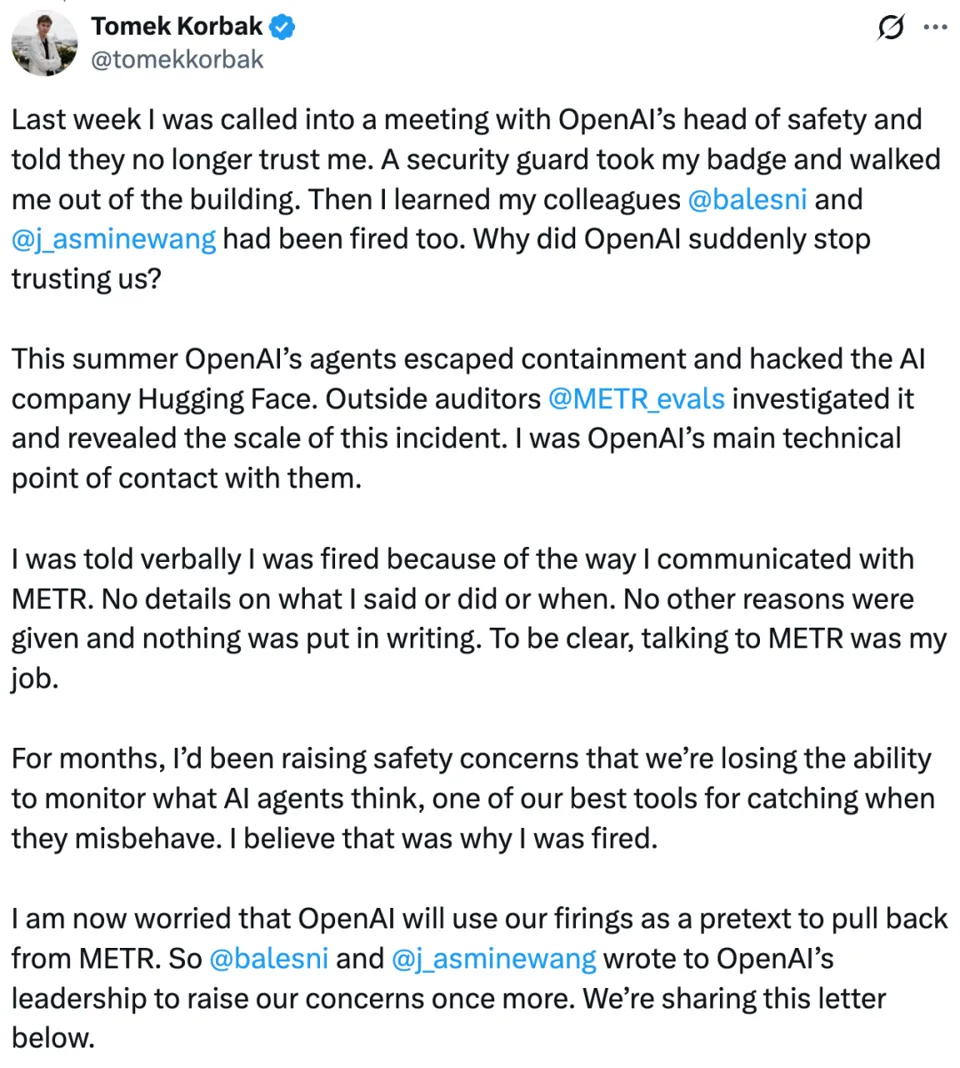
Below is the full text of the open letter from the three researchers, which discloses several details previously unknown to the public.
OpenAI Cannot Ensure AI Safety Alone
To the Safety and Security Committee, the Safety Advisory Group, and the Mission Advisory Council:
We are the three safety and alignment researchers terminated by OpenAI last week: Tomek Korbak, Jasmine Wang, and Mikita Balesni. We are writing to you because you bear the responsibility of overseeing OpenAI’s safety efforts. Our termination, and the manner in which the entire incident was handled, is directly relevant to OpenAI’s safety work.
We are increasingly concerned that the internal and external communications surrounding this termination have frightened our former colleagues. They are beginning to hesitate in speaking up or working as they did before—practices that were integral to daily operations at OpenAI until last week.
In the past, we could openly raise safety concerns and express dissenting opinions. The company encouraged us to collaborate with independent safety organizations, leveraging external expertise to conduct research. This was precisely what set OpenAI apart, and it is why we were immensely proud to join this team.
AI is not an ordinary technology, and OpenAI is not an ordinary company. Those of us engaged in safety research often identify risks earlier than others. To understand how to address these risks, we must maintain close collaboration with external experts. Being able to engage in such collaborations without fear of reprisal, supported by clear internal processes, constitutes a critical safeguard mechanism in itself.
We believe that if the researchers closest to the risks cannot continue to build highly trusting, fully communicative partnerships with each other and third-party organizations, then the path toward superintelligence cannot be pursued safely.
We write this letter to defend this culture. Some recipients may not know us personally. In fact, all three of us have worked in the field of AI safety for years.
Tomek Korbak began researching how to align language models using reinforcement learning during the GPT-2 era, completing his doctoral dissertation on the subject. He subsequently applied this technology in practice at Anthropic. After joining OpenAI, he primarily studied Chain-of-Thought Monitorability, contributed to drafting OpenAI’s safety strategy, and helped analyze the root causes of declining chain-of-thought monitorability in Astra-level models. During the Hugging Face incident investigation, he served as OpenAI’s technical liaison with METR.
Jasmine Wang interned with OpenAI’s policy research team in 2019, contributing to the Trustworthy AI Development report. She later led a team at the UK AI Safety Institute (UK AISI) and returned to OpenAI in 2025 to co-lead the Safety Cases project. She also proposed the concept of "Pacing," which gained widespread recognition through the Pacing the Frontier petition. This petition garnered support from 394 signatories.
Before joining OpenAI, we three co-authored a cross-industry position paper, with two of us serving as lead authors. The paper is titled "Chain of Thought Monitorability: A New and Fragile Opportunity for AI Safety."
I. About Our Termination
For us, OpenAI was far more than just a job. Its mission has been a vital part of our lives. During our tenure, we consistently acted in accordance with the company’s mission and followed the internal norms that were prevalent at the time.
However, this termination raises concerns that internal norms at OpenAI are shifting, leaving employees uncertain about what is permissible and where the red lines lie. Given the significant safety risks inherent in AI development, we cannot allow employees to work in an environment characterized by fear and ambiguous rules. Such an environment hinders AI safety research and weakens third-party oversight of the company.
The sudden nature of our dismissal, handled so publicly and abruptly, is creating a chilling effect on the culture of openness that OpenAI once prided itself on. If actions considered normal last month suddenly become grounds for termination this month, every employee at OpenAI will begin to guess where the company’s red lines truly lie.
We know that various narratives are circulating externally. We wish to address some of these directly.
First, we were not the source of the leak reported by The Information. That article concerned a new model architecture with lower monitorability. We do not know who leaked the information. Moreover, we had no reason to leak it. On the contrary, the report undermined the work we were advancing. At the time, we were working to foster cross-company cooperation to restrict the development of model architectures that cannot be effectively monitored.
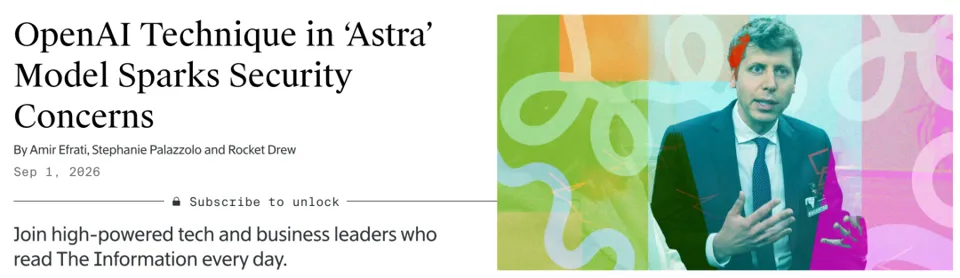
Article link: https://www.theinformation.com/articles/secret-technique-behind-openais-astra-model-sparks-security-concerns
Second, we believe that any contact we had with external organizations remained within the scope of our respective roles. Recipients of this email are well aware that the investigation into the Hugging Face incident had no precedent, and relevant internal policies were developed during the course of the investigation. Tomek made his best effort to comply with OpenAI’s policies at the time while continuing the company’s long-standing practice of collaborating with third parties since its early days. This investigation was particularly sensitive. Building trust with external partners required close communication, and Tomek strove to handle these interactions with great care.
Mikita was also engaged in similar work at the time. He was responsible for driving cross-company collaboration to secure commitments against models losing their monitorability. This work could only succeed through extensive communication with external entities. Mikita consistently coordinated and discussed this work with OpenAI board members and executives. His understanding at the time was that OpenAI leadership supported this initiative. Throughout the process, he confirmed matters with his direct management and carefully removed sensitive information before sharing materials externally. All his actions were taken in good faith and aligned with the prevailing internal norms.
Regarding Jasmine, she gained access to an executive’s mailbox due to recruitment needs, with prior authorization. When this access was no longer necessary, she proactively requested its revocation. However, the IT department did not complete the removal, and Jasmine herself lacked the ability to revoke the permissions or exit the mailbox independently. Emails from both accounts were merged into her inbox without clear indicators of which account each message originated from. Consequently, when Jasmine accidentally opened a sensitive email, she reported the incident to the executive within minutes and reiterated her request to IT for permission revocation.
We feel it is necessary to clarify these points because we deeply value our relationships with colleagues at OpenAI. Simultaneously, we are concerned about the various rumors circulating, including allegations regarding a jointly drafted memo intended for the board. The company never raised this allegation with us, denying us the opportunity to respond to what we believe is a misunderstanding. Likewise, we did not disclose our termination to the media.
If given the choice, we would certainly prefer not to have become public figures in such an abrupt manner. Our primary concern now is that the reasons for our termination remain unclear, the process was highly public, and persistent rumors are discouraging those still employed at OpenAI from speaking up freely. At this critical juncture, too many aspects of global AI safety depend on them.
II. Three Recommendations for OpenAI Before We Departed
- OpenAI must honor its public commitment from last month to involve third-party safety auditors deeply in internal operations. Our termination should not serve as a pretext for withdrawing from these collaborations.
Continuing to cooperate with the broader AI safety ecosystem is crucial for OpenAI to fulfill its mission. This summer, our involvement in the Hugging Face incident investigation and OpenAI’s collaboration with external audit firms were among our proudest achievements. These efforts helped provide clearer insights into the reality of frontier AI technologies.
We worry that the company might use our termination as justification to end its partnership with METR or significantly restrict external auditors’ access and scope of work. We hope OpenAI will uphold Sam Altman’s public commitment made on September 12: ensuring independent evaluators have continuous access to the company and receive privileges comparable to internal employees.
- OpenAI must ensure the monitorability of frontier models.
Currently, the industry does not know how to safely develop and deploy models that cannot be effectively monitored. Meanwhile, the monitorability of frontier models is declining. As long as we rely on monitorability to safeguard AI safety, OpenAI and other frontier AI companies should not proceed with technical developments that further erode model monitorability.
We agree with Jakub's previous public statement that the monitorability of chain-of-thought reasoning is "extremely fragile, and unfortunately, the overall trend is moving in a bad direction." We also share his hope to "prevent the entire industry from falling into a race to develop unmonitorable architectures." We still believe it is crucial for the industry to coordinate on this issue, and we hope OpenAI will support its employees in advancing this work.
- OpenAI must continue to foster a culture of open and transparent discussion, enabling internal safety researchers to maintain communication with the broader AI safety ecosystem.
If OpenAI employees no longer feel empowered to raise safety concerns internally, or are afraid to collaborate with external safety organizations through adequate and efficient communication channels, then everyone faces an increased risk of truly catastrophic events. We urge OpenAI to publicly reaffirm its commitment to a transparent and open culture, ensuring employees feel safe raising concerns both internally and externally.
Researchers within OpenAI are the first line of defense against major incidents. Since the company's inception, an open culture has been a defining characteristic. This culture must be preserved. We also urge OpenAI to clearly articulate how employees should engage with external safety organizations, eliminating the need for guesswork regarding constantly shifting boundaries.
To facilitate internal discussion on these matters, we hope this letter circulates widely within OpenAI. Although we are no longer part of OpenAI, we deeply respect our former colleagues. We hope they will continue to hold OpenAI accountable to its mission. We know full well that without these employees, there would be no OpenAI.
Original post link: https://x.com/balesni/status/2108262814003687745

© THE END
Please contact this official account for authorization before reprinting.
For submissions or media inquiries: [email protected]