IT之家 · 智能时代 · 10/12/2026, 19:20:43
Alibaba Qwen Releases QwenGyre: Online RL Framework for Long-Horizon Agents Achieving 1.78x Speedup
Alibaba Qwen introduces QwenGyre, an online reinforcement learning framework designed to optimize training efficiency for long-horizon agent tasks involving millions of tokens. By employing elastic GPU scheduling and trajectory tree processing, it dynamically allocates compute resources without interrupting inference, achieving a 1.78x end-to-end speedup over asynchronous baselines and improving pass rates on benchmarks like NL2RepoBench.
SOURCE COVERAGEFull Original Report
According to the official introduction, when agents undertake complex tasks, a single execution often lasts for hours, involving hundreds of interdependent interactions between the model and the environment, cumulatively processing millions of tokens. QwenGyre leverages elastic scheduling and trajectory processing to make such ultra-long-horizon tasks effective training sources, while simultaneously improving both capability and efficiency.
QwenGyre partitions GPUs into multiple compute units. As soon as a batch of tasks completes, the freed-up units immediately transition to training—much like team members joining a retrospective review as soon as they finish their assigned work. Tasks still in progress remain completely undisturbed; their progress and state are preserved in place, and previously computed caches are migrated intact, eliminating the need to restart from scratch. Newly available units directly join the current round of training, with faster-computing units handling more workload. Finally, core units aggregate the results to complete a parameter update.
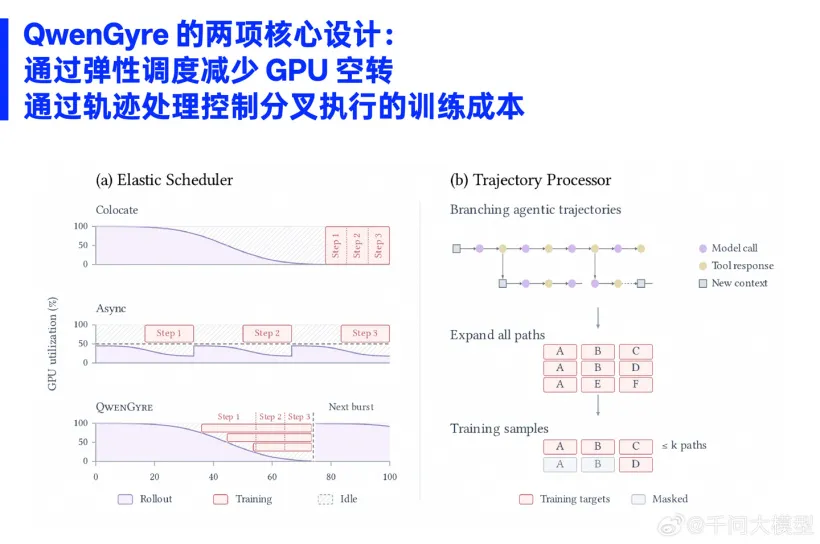
IT Home noted that QwenGyre records the actual context during each output generation via Token-in Token-out mechanisms, organizing them into trajectory trees based on shared prefixes. Only the selected paths are expanded into training samples. Additionally, tasks that time out but have partially completed can provide useful feedback through Partial Scoring, ensuring no effort is wasted.
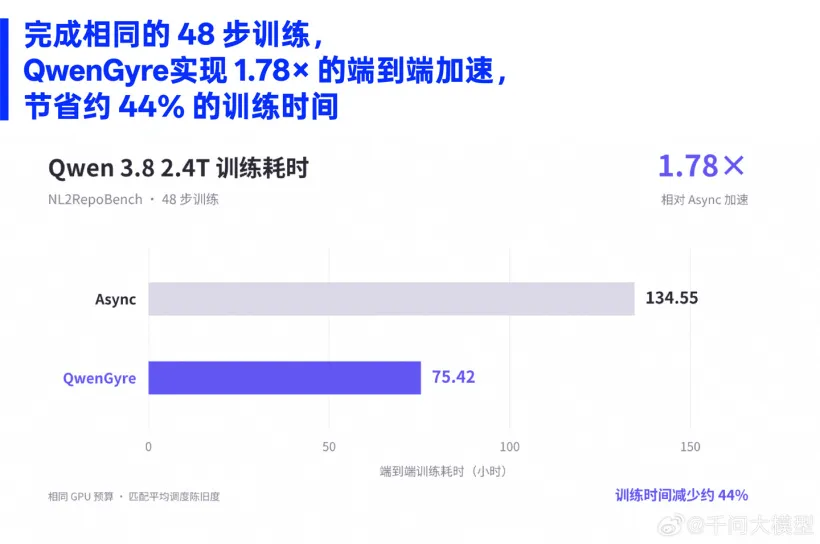
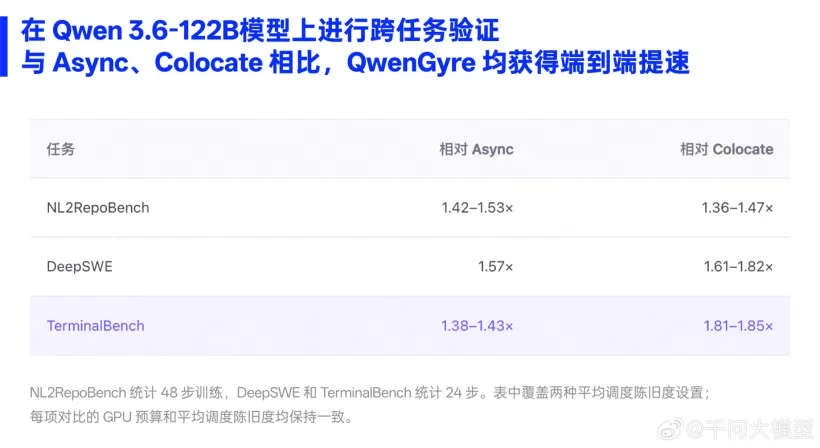
In terms of benchmarks, the official team conducted online reinforcement learning experiments on NL2RepoBench, training on tasks with approximately 700,000 tokens per rollout. After 48 training steps, the model's pass rate improved from 52.5% to 58.5%. Under the same GPU budget, QwenGyre achieved a 1.78× end-to-end speedup compared to Async, while maintaining training scores comparable to both Async and Colocate approaches. Cross-task validation on Qwen3.6-122B demonstrated end-to-end acceleration across three types of tasks: NL2RepoBench, DeepSWE, and TerminalBench.