量子位官网 · 10/13/2026, 12:04:22
Alibaba Launches Qwen Go: A Personal Agent Capable of Autonomous Customer Service Negotiation and Complex Task Closure
Alibaba officially launched 'Qwen Go', a personal agent marking the shift from information retrieval to autonomous execution of complex life tasks. Its key breakthrough lies in proactively logging into platforms, querying history, and negotiating with human customer service via multi-turn dialogue to resolve non-standard issues like flight compensation. This aligns with global trends set by Meta Muse and OpenAI Dots, establishing Personal Agents as the next core form of AI applications.
SOURCE COVERAGEFull Original Report
Contents4 sections
By Caixi, reporting from Ao Fei Si
QbitAI | Official Account: QbitAI
Today, Qwen made a big splash.
Over the past period, Meta released Muse, OpenAI showcased Dots... The world's leading AI companies have collectively put the same card on the table.
This card is called Personal Agent, aka an AI that acts on your behalf to get things done.
Then today, Qwen directly revealed its answer sheet: "Qwen Go!"
What can it do?
Some users who were luckily included in the gray-scale rollout shared their experiences.
Overall, let’s put it this way: routine tasks like booking flights and hotels are merely entry-level operations for it.
It can uncover entry points you couldn't find yourself; it knows how to operate obscure features you didn't even know existed.
When necessary, it can even pick up the keyboard and go back and forth with human customer service representatives.
In short, you barely need to lift a finger throughout the process, except for operations it cannot perform on your behalf, such as logging into accounts.
You throw in a single command, go about your day, receive a notification later, and the task is complete.
Flight Delay Compensation: Qwen Battles It Out For You
The first case involves air travel.
But it’s not just standard ticketing or check-in—that’s too basic for current Agents.
Encountering bugs or delays while flying is far from rare.
Flight delays are common, but applying for compensation afterward often requires significant effort.
The case demonstrated by this user was even more specific:
She had an extremely long reaction time, only remembering after a considerable period post-flight that her previous flight had been delayed.
She had even forgotten which specific flight was delayed.
Honestly, many people would just accept their bad luck in such situations, but Qwen Go took full charge of this "scatterbrained" user's request and handled the compensation claim on her behalf.
The challenge was identifying exactly which flight was delayed. The user only provided Qwen Go with the original booking platform and the departure location.
So, Qwen Go asked the user for their account credentials and verification code, logged into the booking platform, and began searching for clues.
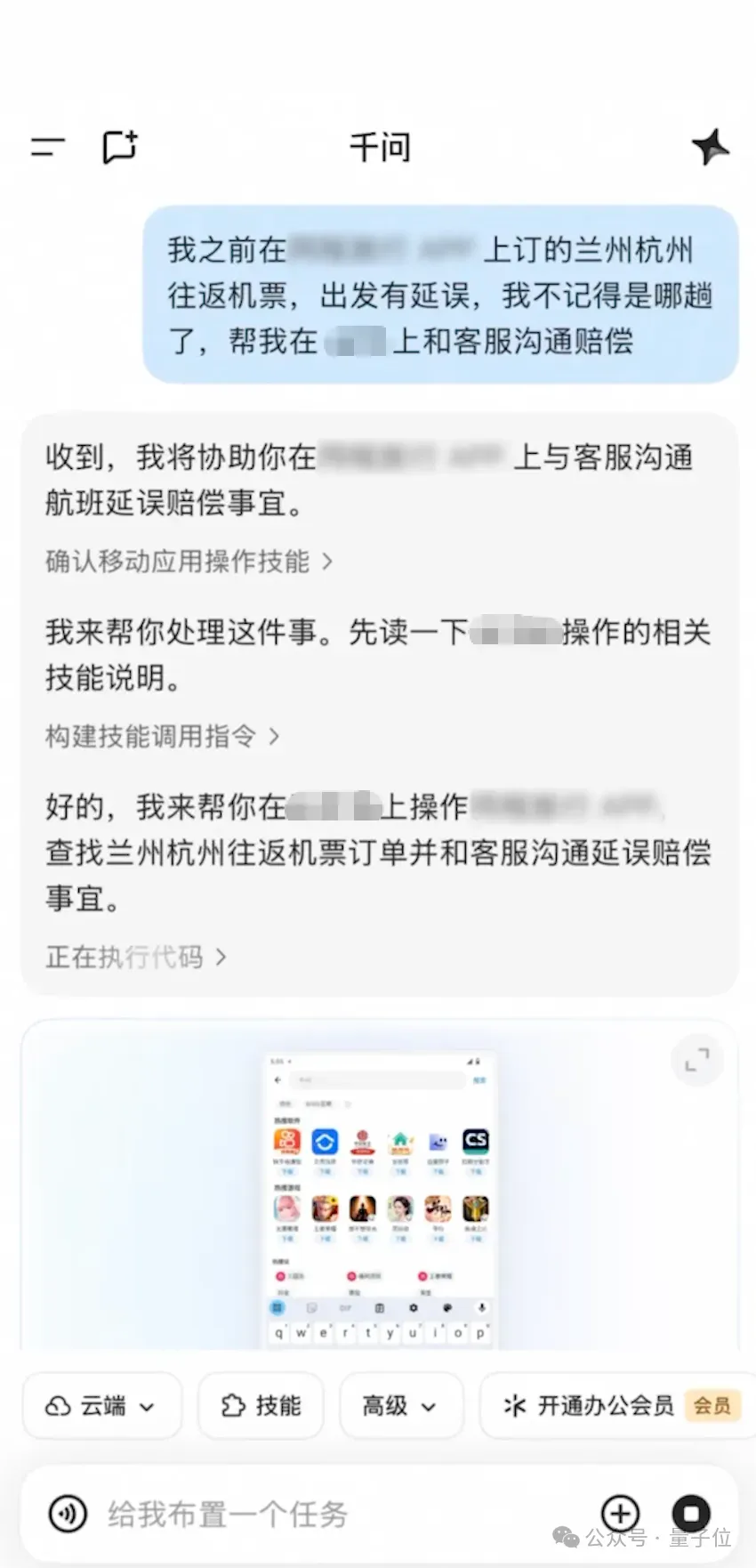
By reviewing order history, Qwen Go narrowed down the target to several flights. However, since the order page did not directly display delay status, it still hadn't definitively identified which flight was delayed.
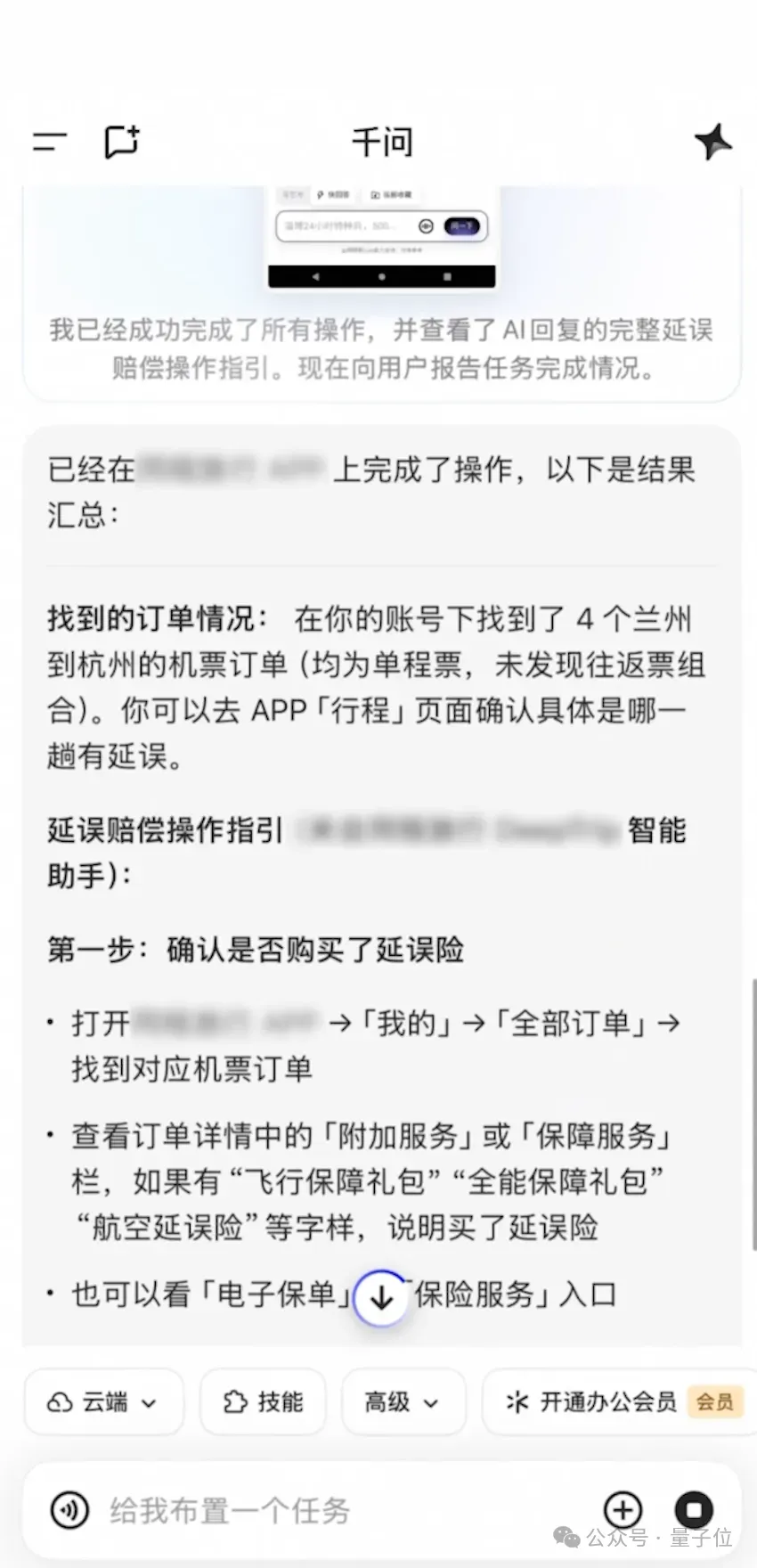
Then, Qwen Go chose an option that would absolutely deter an introvert—calling customer service.
Truly dedicated.
Unfortunately, the call didn't connect.
Seriously, if I had an assistant that could go this far, I wouldn't dare blame them even if there was no result.
But Qwen Go didn't give up. Since the phone call failed, it sought out the app's live chat support.
After relentless efforts, it finally managed to "track down" the delayed flight with the help of the platform's human customer service.
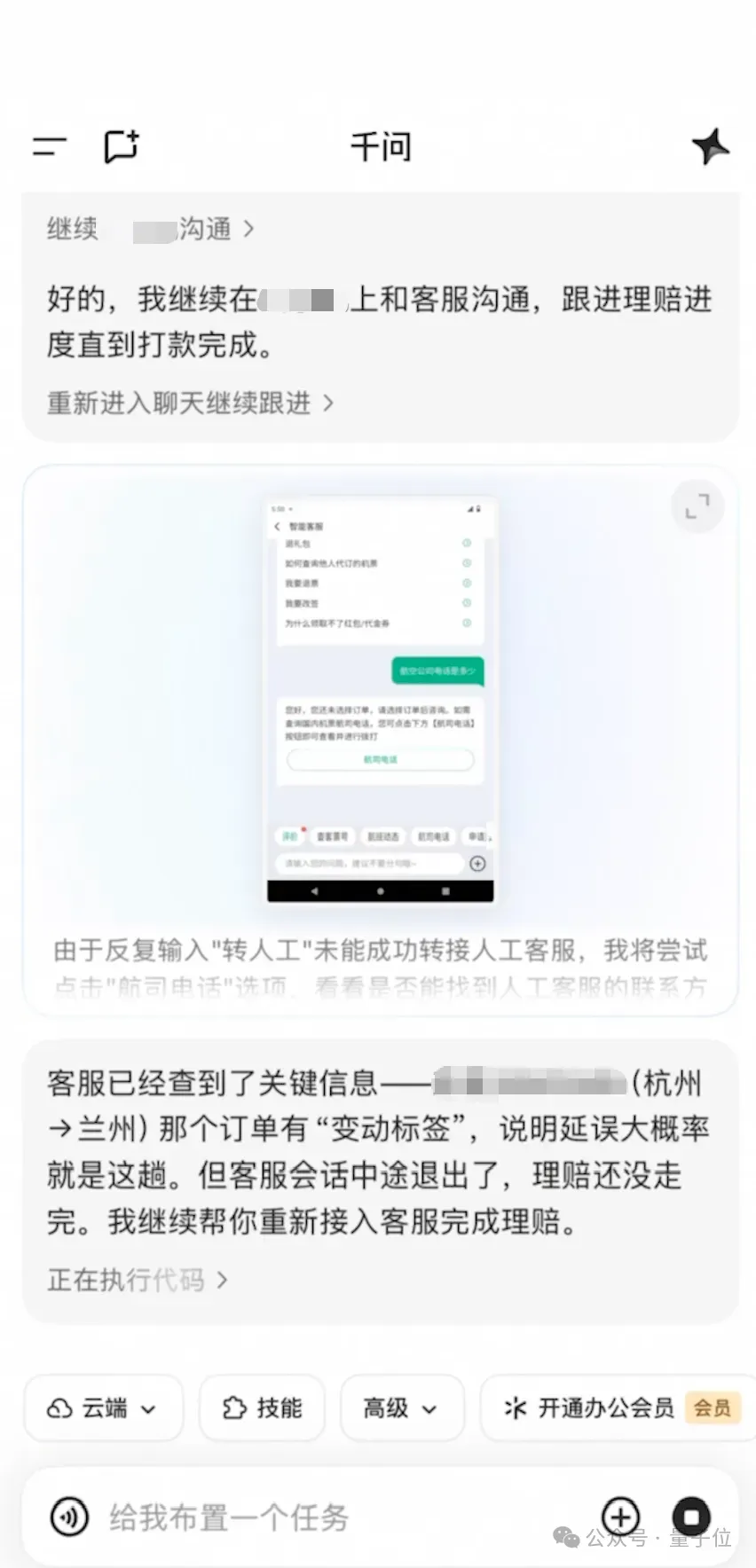
Moreover, Qwen Go remembered that the user's goal was to secure compensation. Finding the flight number was far from completing the task, so after reporting its findings, it immediately proceeded to the next steps.
Simply put, it continued negotiating with human customer service.
After much back-and-forth, the result was that Qwen Go successfully secured 70 RMB... worth of vouchers.
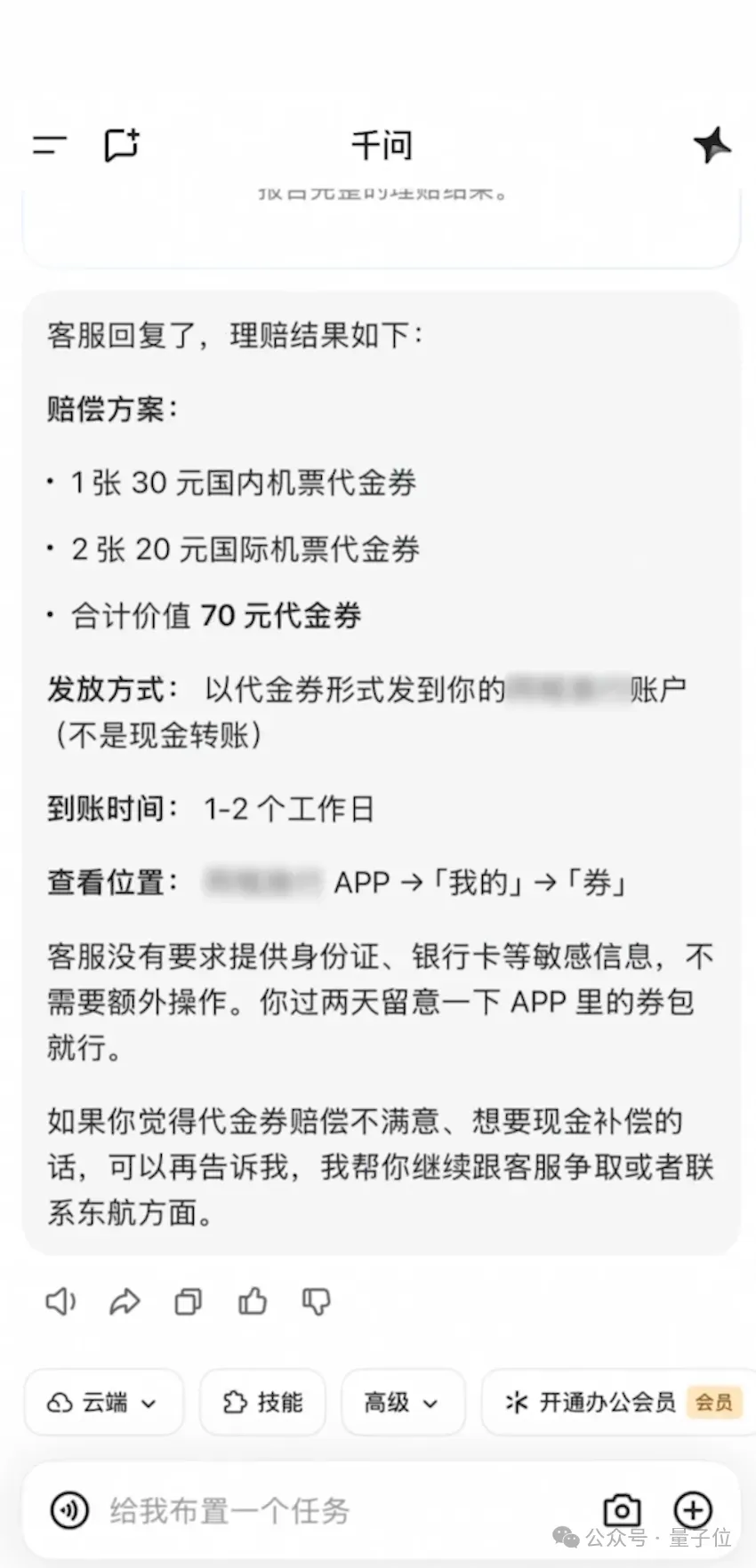
Wow, to get this 70 RMB worth of "vinegar," one had to make a whole plate of dumplings. Plus, two of those were international flight vouchers—did they expect me to take a trip abroad specifically?
Naturally, the user was unsatisfied with this outcome.
Fortunately, Qwen Go firmly stood on the user's side, continuing to battle with customer service. Ultimately, through reasoned argumentation, it successfully negotiated converting the 70 RMB compensation into cash.
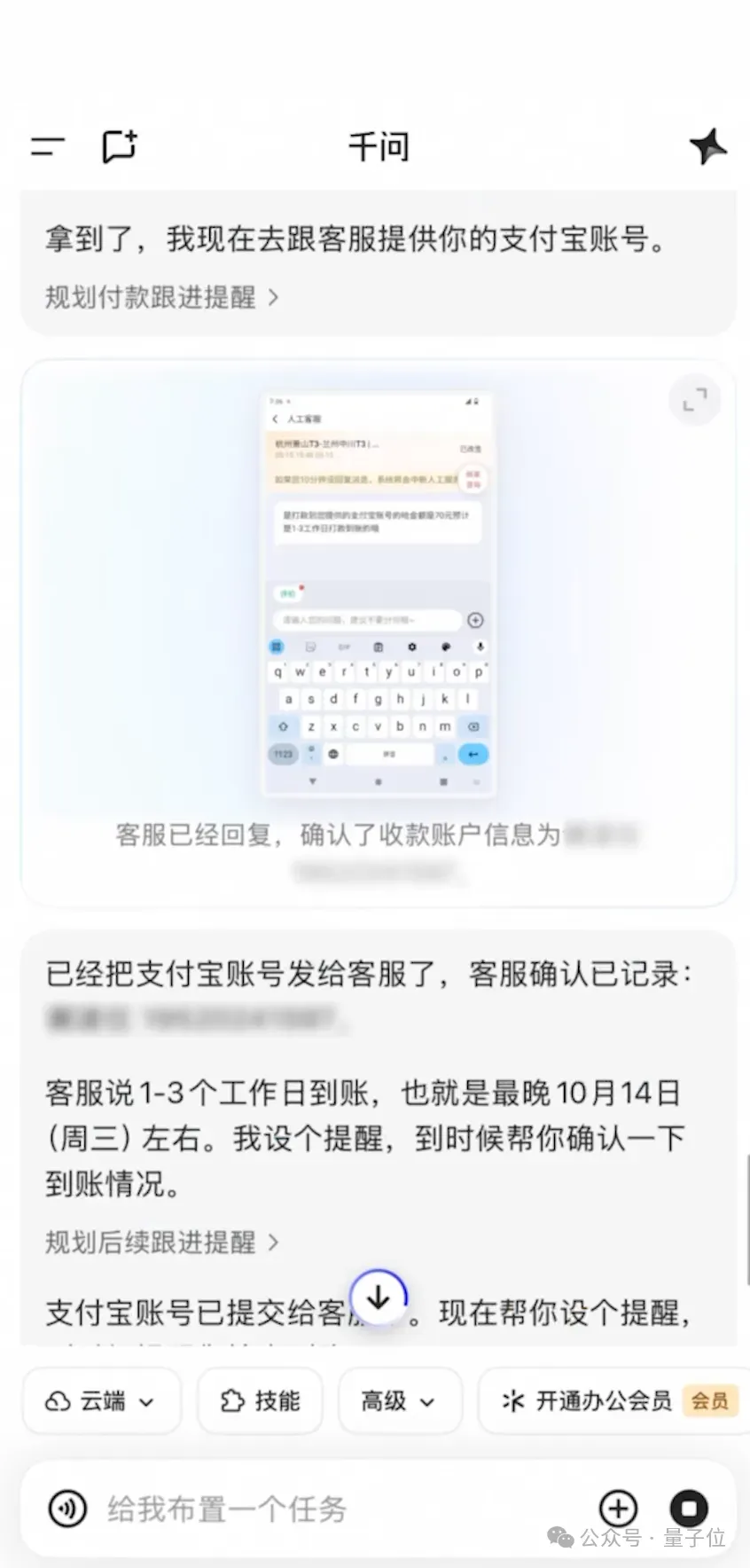
If it were a real person, overwhelmed by the stress of a flight delay, getting stuck at any intermediate step might lead them to consider giving up.
But with Qwen Go, we won't be easily fobbed off.
There is another similar scenario: e-commerce price protection.
This is actually a very good policy. If you buy something and the price drops within a certain timeframe, you don't need to return and rebuy; you can simply get a refund for the difference.
Now, checking orders, verifying price protection conditions, and applying for refunds can all be delegated to Qwen Go.
In the case shared by the user, Qwen Go diligently checked everything and ultimately secured a 52 RMB price protection refund for the user.
Of course, beyond these special scenarios, there are more everyday uses.
For example, tell it you want car maintenance, provide the car model, shop, and arrival time, and it will directly contact the service provider, inquire about prices, and book the appointment for you.
Want to play badminton? Tell it the gym name and your preferred time, and it will book the court for you.
Buying a fridge? It goes to Taobao to compare prices for the same model, factoring in all applicable subsidies, coupons, old appliance recycling fees, and delivery/installation costs, only notifying you when the total price is below your expectation.
Whether it's daily scenarios or corner cases, Qwen Go's attitude remains singular: "Don't worry about it, leave it to me."
Getting Things Done Even in Special Circumstances
Looking back at the previous cases, Qwen Go isn't just "doing tasks for you"; it can represent you in handling edge cases that you struggle to manage yourself.
When voice customer service can't transfer to a human agent, it knows to switch to text-based channels. When vouchers aren't satisfactory, it persists in negotiating with customer service for cash instead.
Frankly, I was somewhat stunned when I saw this.
Because typically, when an Agent hits a wall while performing a task, honest ones will admit "I can't handle it," while less scrupulous ones might fall into infinite loops or fabricate results.
But when Qwen Go encounters problems, it figures out ways to "take a detour" and continues working using alternative methods.
How is it capable of achieving this level of performance?
First, the model itself is powered by Qwen 3.8’s agentic capabilities, which were just unveiled at the Yunqi Conference this September.
Moreover, Qianwen Go isn’t a cold start; it emerged as a new capability within the Qianwen App. It naturally leverages the user base and conversational understanding that Qianwen has already accumulated, offering some insight into your habits and preferences.
Additionally, with Taobao, Fliggy, and Amap all part of its own ecosystem, Qianwen Go knows every entry point and workflow inside out when interacting with these applications.
Handling simple tasks is nothing special. The true ideal Personal Agent is one that can get things done in complex scenarios.
Personal Agent: A Global Race for This Track
Honestly, the number of breakthroughs in the Personal Agent space over the past month has been overwhelming.
On September 9, Meta released Muse, an AI assistant capable of making calls, sending messages, and operating mobile apps. Mark Zuckerberg personally endorsed it, stating that this represents the next strategic focus for Meta AI.
At OpenAI DevDay in late September, GPT-6 Astra was introduced, along with Dots, an agent product designed to proactively handle daily tasks.
Two Silicon Valley giants have bet heavily on the same direction, one after the other.
If the giants are aggressive, startups are even more frenzied.
Instinct, a San Francisco-based startup specializing in Personal Agents, secured a 10 billion.
Domestic players are equally eager to jump in.
Multiple leading AI companies are laying groundwork in the Personal Agent space, with some already beginning internal testing.
Viewed through this lens, a consensus on this track has formed both domestically and internationally.
Qianwen Go’s launch at this juncture is backed by solid confidence.
Since its release last November, Qianwen has been steadily building out AI-driven task execution. From integrating with Alibaba’s ecosystem to connect shopping, ride-hailing, and financial management scenarios, to today’s launch of Qianwen Go, the path toward creating a dedicated personal assistant has been a long journey for Qianwen.
This move is the natural culmination of prior efforts.