IT之家 · 智能时代 · 10/21/2026, 21:49:39
NVIDIA and Agile Robots Launch Humanoid Reference Platform Agile ONE SN
NVIDIA expanded its Isaac platform at GTC Berlin and partnered with Agile Robots to launch the Agile ONE SN, a humanoid reference platform pre-configured with Isaac GR00T and Jetson Thor. Scheduled for early 2027 release, it integrates simulation, training, and deployment tools to reduce setup time from weeks to days, targeting research and enterprise development.
SOURCE COVERAGEFull Original Report
On October 21, NVIDIA announced at the GTC Berlin conference that it is expanding its Isaac open robotics development platform. The update introduces a new reference platform for humanoid robots, runtime frameworks, simulation assets, and datasets, along with updated robotics learning tools. These additions cover the entire development workflow, from training data generation and simulation-based training to deployment on physical robots.
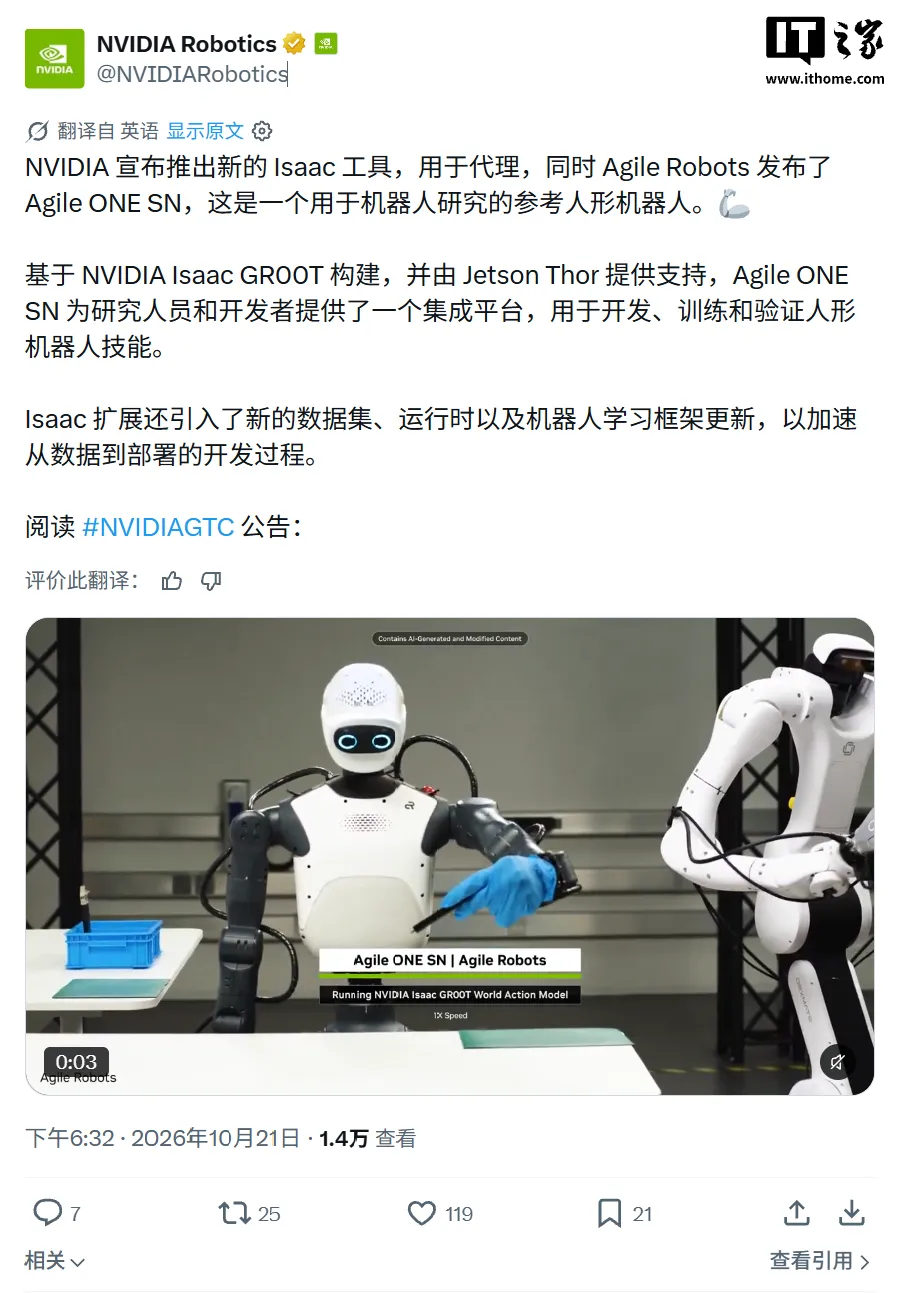
In terms of hardware, NVIDIA partnered with Agile Robots to launch the Agile ONE SN, a reference platform for humanoid robots scheduled for release in early 2027.
The platform comes pre-configured with NVIDIA Isaac GR00T and features the Jetson Thor compute platform, targeting robotics research and development. By integrating simulation, training, and deployment tools, Agile Robots states that the platform can reduce initial setup time for relevant environments from weeks to days.
Jensen Huang, Founder and CEO of NVIDIA, stated that general-purpose robotics technology is advancing rapidly, and the "ChatGPT moment" for robotics is accelerating. NVIDIA noted that this update aims to provide developers with models, data, simulation tools, and computing systems to help them apply general-purpose robotics technology to real-world industrial scenarios.
The Agile Robots Agile ONE SN utilizes the Agile ONE S humanoid robot body, standing 1.4 meters tall and weighing 40 kilograms, with 31 degrees of freedom (DoF) and a single-arm payload capacity of 3 kilograms. It is equipped with two WUJI Hand 2 five-finger dexterous hands, each featuring 20 DoF and supporting 1kHz force control and tactile sensing. Note that Reuters reported the robot's weight as approximately 34 kilograms, which differs from NVIDIA's official figure of 40 kilograms; current information is insufficient to confirm the reason for this discrepancy.
Regarding computation, the Agile ONE SN is powered by the NVIDIA Jetson Thor, delivering 2070 TFLOPS of FP4 performance and 128GB of unified memory. Sensors include head and wrist cameras, LiDAR, and an inertial measurement unit (IMU), enabling environmental perception and interaction between the robot and its surroundings.
For safety, the platform plans to integrate on-robot safety protocols with NVIDIA Halos full-stack security system, though this integration is currently pending completion. NVIDIA indicated that research institutions such as Stanford University and ETH Zurich have expressed interest in the Agile ONE SN.
Reuters also reported that Agile Robots plans to produce up to 2,000 humanoid robots in collaboration with NVIDIA starting in 2027, targeting customers such as universities and corporate research labs.

On the software front, NVIDIA Isaac Lab 3.0 has been officially released. As an open-source robotics learning framework, it supports multi-GPU training workflows and integrates physics engines such as Newton and PhysX. The framework is designed to help developers train and optimize robot policies across various computing environments, from desktop workstations to data centers.
IT Home noted that NVIDIA also launched Isaac OS, an open-source runtime framework. Built on Holoscan, Isaac OS connects AI models, sensors, control systems, and robot hardware. It supports migration from simulation environments to physical robots and provides deterministic real-time execution capabilities.
For the DGX Station, NVIDIA simultaneously released three sets of open-source reference workflows. The first optimizes the GR00T 1.7 model via reinforcement learning; the second uses Isaac Lab to train dexterous manipulation skills; and the third leverages ChatGPT Astra for post-training the Cosmos world model to generate synthetic training data. These workflows aim to help developers integrate robotics learning, simulation, and data generation processes.
Regarding data, the SimReady Central Library offers over 2,000 simulation-ready robotic and factory assets, covering various robot devices and industrial scenario resources. The Human 1M dataset includes diverse human activities, synchronized tri-view videos, and 3D hand tracking data, suitable for robot learning and action understanding. Both resources are available via Hugging Face, although the full version of the Human 1M dataset is exclusively accessible to Cosmos Coalition partners.
NVIDIA also highlighted several companies adopting its robotics development tools. ABB Robotics has integrated Omniverse libraries into RobotStudio HyperReality for simulation and virtual commissioning prior to robot system installation. NEURA Robotics utilizes Isaac Sim and Isaac Lab to generate synthetic training data and train robot skills within simulation environments. NVIDIA stated that other enterprises, including KUKA, Humanoid, Sereact, and Universal Robots, are also adopting technologies related to its open robotics platform.