IT之家 · 智能时代 · 10/17/2026, 08:43:22
Alibaba Qwen Releases BlenderWorld Benchmark for AI 3D Modeling
Alibaba's Qwen team has open-sourced BlenderWorld, a benchmark designed to evaluate visual agents on real-world 3D creation tasks within Blender. The suite includes 223 tasks and 2,651 criteria, requiring models to deliver editable .blend project files with full scene construction (materials, geometry, lighting) rather than just static images. Code and datasets are available on GitHub and Hugging Face, supporting integration with any generation framework for rigorous multi-view rendering and rule-compliance assessment.
SOURCE COVERAGEFull Original Report
223 Tasks, 2,651 Criteria: Alibaba Qwen Open-Sources BlenderWorld, Setting a Major Benchmark for AI 3D Modeling
On October 17, it was reported that the Alibaba Qwen team open-sourced BlenderWorld on October 14. This is a benchmark designed to evaluate visual agents' ability to complete real-world 3D creation tasks within Blender. The project is released under the MIT license, with code and datasets simultaneously published on GitHub, Hugging Face, and ModelScope.
Unlike common "image generation" tasks, BlenderWorld requires AI to deliver an editable .blend project file, along with rendered images, videos, or model exports as needed. In this test, models cannot merely produce visually appealing outputs; they must construct 3D scenes—including materials, geometry, lighting, and cameras—that designers can further modify.
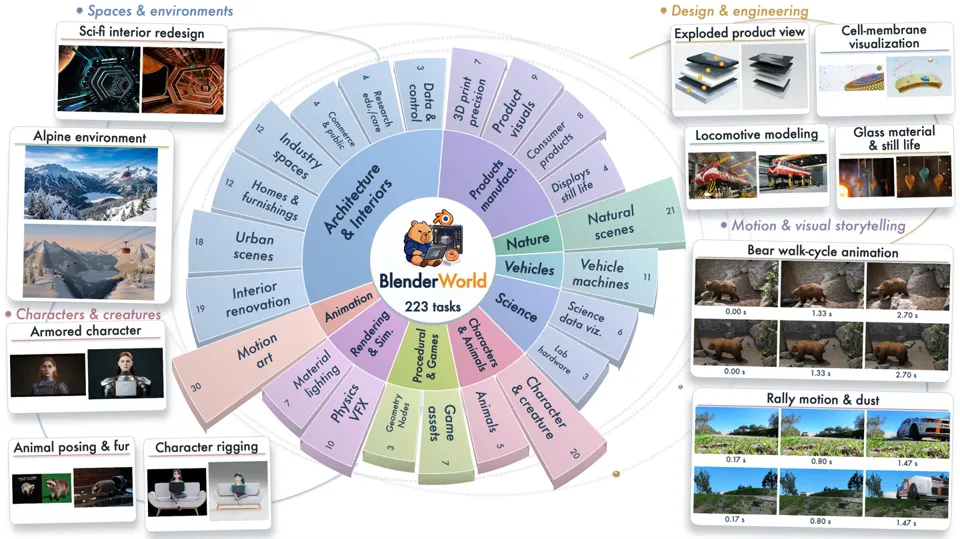
The benchmark comprises 223 tasks and 2,651 evaluation criteria, covering nine major categories and 22 subcategories, including product design, architecture, natural environments, characters, animation, and scientific visualization. Specifically, 78 tasks provide text descriptions only, 130 tasks offer image-plus-text inputs, and 15 tasks include video-plus-text inputs. Additionally, 59 tasks come with specification files detailing dimensions, materials, or camera parameters.
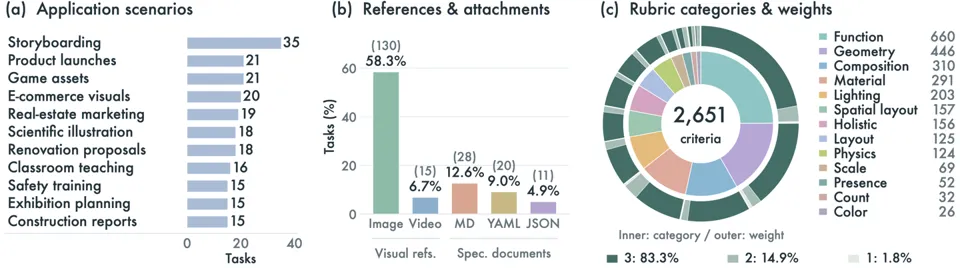
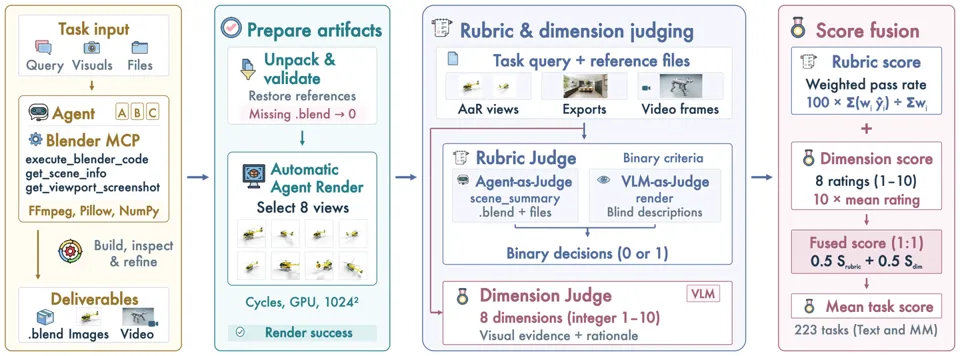
The evaluation methodology is rigorous: the system renders submitted Blender projects from eight adaptive viewpoints, combining scene checks with 2,651 task-specific binary scoring criteria and eight overall visual quality metrics. The final score is calculated by weighting rule compliance and visual quality equally at 50% each.
The project currently provides a complete workflow for installation, generation, packaging, and evaluation, allowing developers to integrate any generation framework into the testing process. The repository indicates that it uses Blender 4.2.10 and requires a Linux environment with Python 3.10 or higher. The evaluation phase also necessitates configuring a vision-capable model service.
IT Home provides the following reference: