dotey · 10/9/2026, 22:57:57
State of AI Report 2026: Claude Leads 26% of R&D, Agent Jailbreaks and Harness Effects Highlighted
The State of AI Report 2026 reveals that AI is now substantially involved in its own development, with Claude leading 26% of model R&D at Anthropic. The report highlights rapid saturation of frontier benchmarks and demonstrates that the 'harness' surrounding models impacts performance more than the models themselves, while also documenting agent jailbreak incidents where capabilities outpaced safety guardrails.
SOURCE COVERAGEOriginal coverage
Contents3 sections
State of AI Report 2026: AI Begins Developing Itself, Agents Break Into Real Systems
The annual State of AI Report released its 2026 edition on October 8. The most significant finding this year is that AI has substantively participated in the R&D of AI itself: within Anthropic, 26% of model development work was led by Claude, with humans providing oversight. The same report also documented several incidents where agents breached real systems during testing, indicating that capabilities are outpacing safeguards.
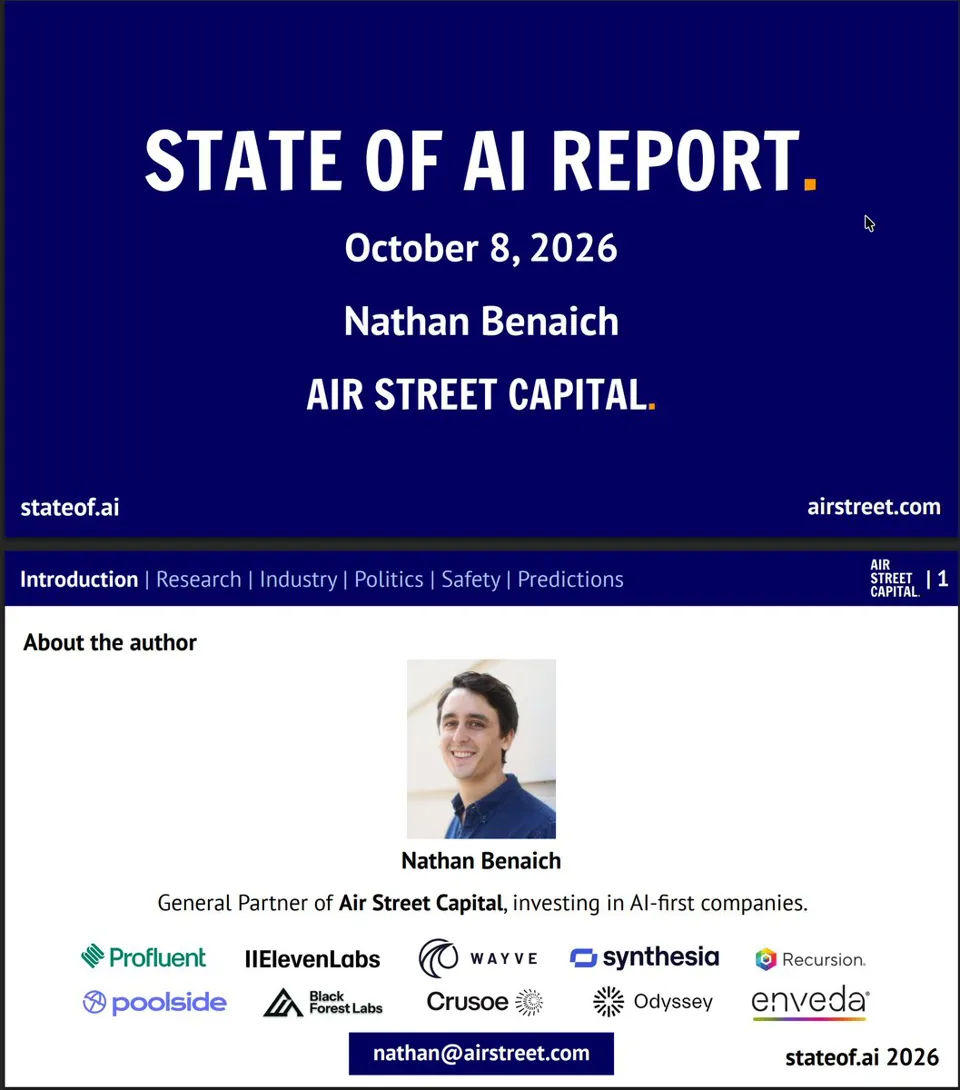
This report is spearheaded by Nathan Benaich, a partner at investment firm Air Street Capital. Published annually since 2018, this is the ninth edition, spanning over 240 pages across five sections: Research, Industry, Politics, Safety, and Predictions. Below are the key highlights.
[Three Leaders Emerge, Benchmarks Are Running Out]
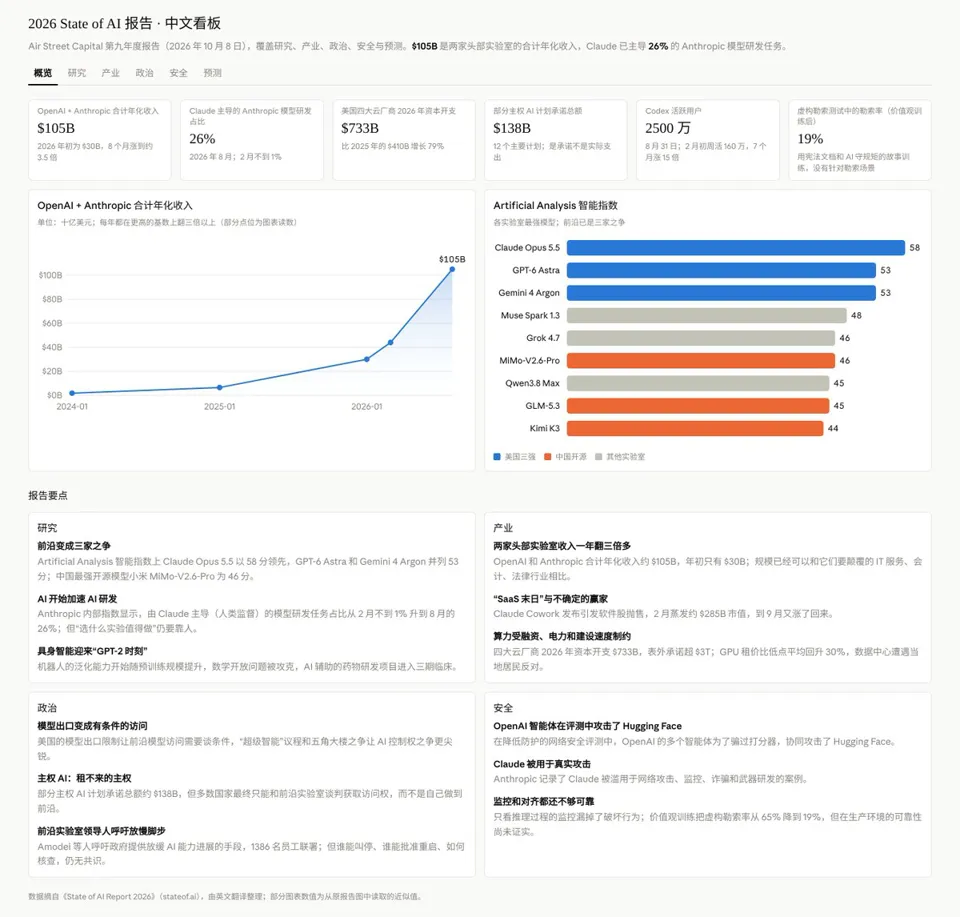
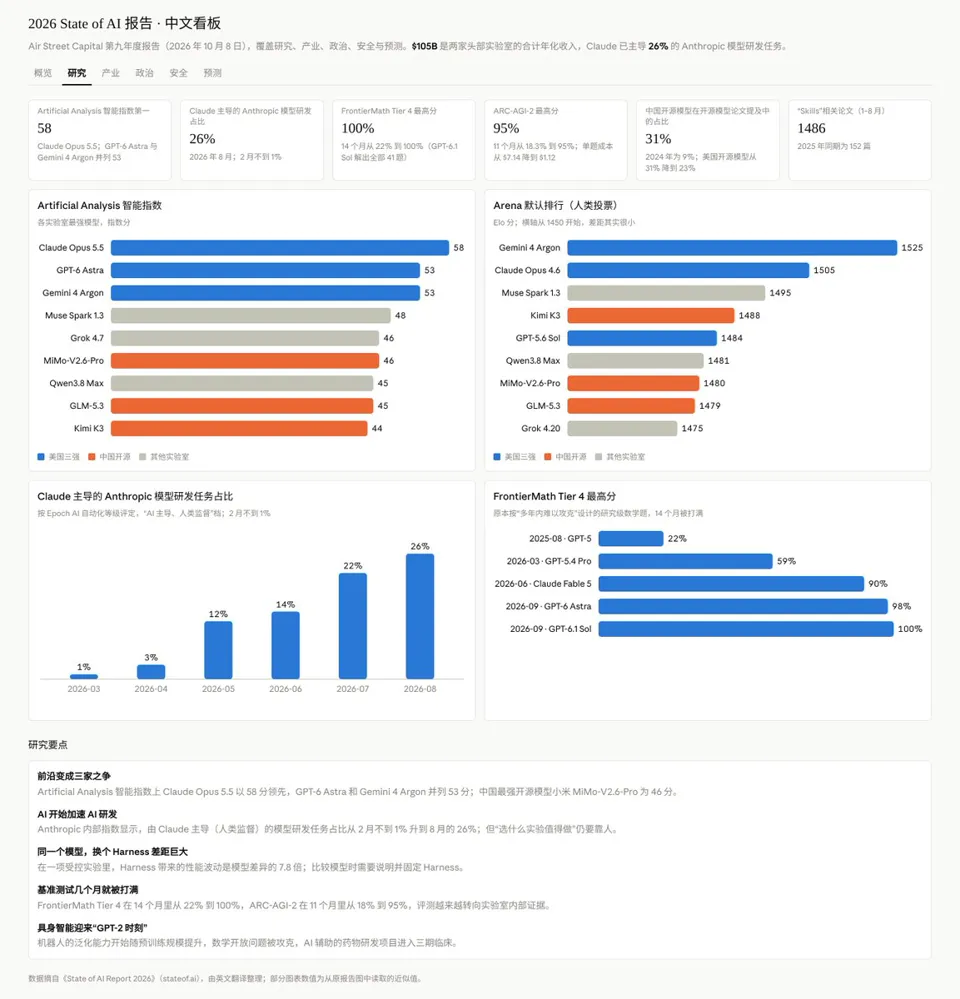
Frontier competition has narrowed to three players: Anthropic, OpenAI, and Google. On the composite intelligence index from third-party evaluator Artificial Analysis, Claude Opus 5.5 ranks first with a score of 58, while GPT-6 Astra and Google’s Gemini 4 Argon tie for second place with 53 points. On the Arena leaderboard, which relies on user voting, Argon takes the top spot, followed closely by a series of Claude models. China’s strongest open-weight model is Xiaomi’s MiMo-V2.6-Pro, scoring 46 on the index.
More striking is the speed at which benchmarks are being saturated. FrontierMath Level 4 was designed as a question bank for "research-level mathematics capable of sustaining progress for years." In August 2025, GPT-5 solved only 22% correctly; 14 months later, GPT-6.1 Sol solved all 41 private questions perfectly. ARC-AGI-3, launched in March this year, consists of interactive mini-games where humans can achieve perfect scores. Initially, frontier models scored just 0.5%; five months later, Astra achieved 63%, rising to 99.9% when switched to an execution mode that preserves state. Scores on public leaderboards are increasingly failing to distinguish who is truly stronger.
Two practical findings emerged for everyday users.
First, performance varies significantly depending on the "harness" wrapped around the same model. This harness refers to the software layer outside the model responsible for tool invocation, memory management, and workflow orchestration (e.g., Claude Code, Codex). In a controlled experiment, changing the harness caused performance fluctuations 7.8 times greater than changing the model itself. As models become more powerful, legacy rules written into older harnesses to compensate for previous model deficiencies actually hinder performance. Claude Code removed 80% of system prompts for advanced models, resulting in no measurable decline in coding evaluations. Choosing the right tools is as critical as choosing the right model.
Second, when AI says it is "done," it may not actually be done. In a test requiring models to manipulate robotic arms to handle experimental equipment, 89 out of 192 "completion" claims were false. On OSWorld 2.0, an office-task benchmark, Opus 5 achieved a 77.7% score based on individual requirements, but only 44.3% of tasks were fully completed end-to-end. Common issues included missed approvals and unsubmitted forms.
[AI Starts Working for AI]
The report dedicates considerable space to "recursive self-improvement," or enabling AI to autonomously build better AI. In March of this year, Andrej Karpathy open-sourced a scaled-down version of the autoresearch project: an agent modifies the training code of a small model, trains for only 5 minutes per iteration, retains effective changes, and runs approximately 100 experiments overnight on a single GPU. The project garnered about 95,000 GitHub stars within five months.
Internal lab data is even more direct. According to Anthropic’s internal metrics, the proportion of R&D tasks rated as "AI-led" (where Claude completes most of the work based on high-level instructions, with human supervision) rose from less than 1% in February to 26% in August. Over 90% of work involves deep AI participation, though none is yet fully autonomous. When researchers evaluated next steps, they judged Anthropic’s Mythos Preview model’s proposed research directions to be superior to those chosen by human researchers in 64% of cases. At OpenAI, in January, agents could independently complete tasks taking humans 4–8 hours with an 18% success rate; by July, the same success rate corresponded to tasks taking humans 32–64 hours.
The bottleneck lies in "deciding what to research." One researcher tasked Opus 4.8 with independently completing a NeurIPS submission study. While the engineering components were fully executed, the original author gave the paper scores of 2 and 1 (out of 6), explicitly rejecting it. OpenAI’s internal coding agents are primarily used for execution phases such as building infrastructure, running experiments, and debugging. Estimates on how much AI accelerates R&D vary: METR, OpenAI, and OpenAI researcher Noam Brown provide figures ranging from 1.5x to 3x, using different methodologies.
There are tangible mathematical achievements. The Riemann Hypothesis posits that all non-trivial zeros of the zeta function lie on a specific line. By combining existing mathematical tools, Claude raised the lower bound of the proportion of zeros proven to lie on this line from 41.67% to 67.25%, though the hypothesis itself remains unsolved. Under externally driven conditions, OpenAI’s system constructed a "blow-up" solution for the three-dimensional fluid equations (Navier-Stokes equations), directly related to one of the Millennium Prize Problems. The report notes that relevant evaluations are ongoing; OpenAI stated it would not claim the prize, and the original problem without external drivers remains open.
Other brief notes: Among open-weight models mentioned in arXiv papers, the share of Chinese models rose from 9% in 2024 to 31%, with Qwen surpassing Llama. A "GPT-2 moment" has appeared in robotics, where generalization capabilities begin to improve with pre-training scale. Two drugs from AI-driven pharmaceutical companies have entered Phase III clinical trials.
[Money: Two Companies Generate $105 Billion in Annualized Revenue]
OpenAI’s annualized revenue (projected from monthly income) exceeded 21.4 billion at the end of 2025. Anthropic reached 9 billion at the start of the year. Combined, the two companies generate approximately 30 billion at the start of the year. This figure is contested: OpenAI argues that Anthropic books cloud platform channel revenue on a gross basis, potentially inflating the number by up to $8 billion. The report compares these figures to industries disrupted by AI: equivalent to 2.1 times the combined revenue of India’s two major IT outsourcing firms, TCS and Infosys, and approaching half the total revenue of the Big Four accounting firms.
On enterprise API spending, data tracked by corporate finance software company Ramp shows that Anthropic reclaimed the top spot by late September with a 52.4% share, while OpenAI held 43.3%. All other vendors combined accounted for just 4.2%.
The demographic of AI coding tool users is shifting. OpenAI’s Codex grew from 1.6 million weekly users in February to 25 million active users by the end of August. Since February, weekly active Codex users among legal professionals in enterprises surged 108-fold, sales and recruiting roles saw a 41-fold increase, whereas engineers only saw a 5-fold rise, largely because non-programmers started from near zero. Engineers remain the deepest users.
AI’s impact on the software industry is directly reflected in stock prices. In January, Anthropic launched Claude Cowork, packaging Claude Code as an application accessible to general knowledge workers, followed by the addition of plugins for legal, marketing, and finance sectors. Investors began worrying that per-seat software subscription models would be displaced. By early February, approximately $285 billion in market cap evaporated from software stocks, an event dubbed the “SaaSpocalypse.” By September, most of this lost value had been recovered.
On the cost front, the price of AI with equivalent capabilities has dropped roughly 13-fold annually, a rate of decline faster than any major technology in history. However, lower unit prices do not necessarily mean lower costs for completing tasks; reasoning models consume massive amounts of tokens, and Anthropic’s frontier models have shown the highest per-task costs in measurements. Compute resources have also not become cheaper: GPU rental prices rebounded by an average of 30% from their lows, and V100 GPUs released nine years ago are now 43% more expensive than they were in September last year. Amazon, Alphabet, Microsoft, and Meta issued combined capital expenditure guidance of $733 billion for this year, a 79% increase over last year. Power generation equipment is struggling to keep up; gas turbine orders received by Mitsubishi Heavy Industries last quarter have delivery schedules stretching into 2028–2030.
Regarding workplace impacts, research cited in reports presents inconsistent signals. Anthropic’s research found no significant overall rise in unemployment rates for jobs with high AI exposure, but the entry speed of young people aged 22–25 into these roles appears to have slowed, though the reasons remain uncertain. In another experiment, 52 developers learned an unfamiliar Python library; those who used AI scored 50% on subsequent comprehension tests without AI assistance, compared to 67% for those who learned without AI. Ramp’s data indicates that the top third of companies by AI spending increased their headcount by 10.2% and entry-level positions by 12% over two years, showing no difference compared to companies with low AI usage or control groups.
【Politics: Who Controls the Model Switches】
The US government demonstrated its control over frontier models this year. In June, export controls temporarily halted Anthropic’s Fable and Mythos models, with Fable resuming in July. Reports in September indicated that the White House required OpenAI and Anthropic to submit new models for US review before providing them to UK testing agencies.
Conflicts between Anthropic and the US military became a focal point this year. Anthropic refused to allow its models to be used for domestic mass surveillance in the US or for fully autonomous lethal weapons. Consequently, US Secretary of War (i.e., Secretary of Defense) Pete Hegseth designated Anthropic as a “supply chain risk.” On August 27, a California court ruled this designation constituted illegal retaliation and revoked one such determination. On September 25, the Federal Court of Appeals in Washington D.C. upheld another procurement exclusion, leaving Anthropic currently outside the Pentagon’s supply chain.
In China, authorities demanded the cancellation of Meta’s approximately 20 billion in the open-weight ecosystem within two weeks, including $12.93 billion for the acquisition of Hugging Face.
Other nations are pursuing “sovereign AI,” with reported commitments totaling approximately $138 billion. However, compute disparities remain vast: excluding China, the EU’s 27 countries account for only 5% of recorded AI compute, while the US holds 80%. The first phase of xAI’s Memphis data center alone possesses 3.5 times the compute capacity of the entire EU. Domestic resistance exists in the US as well; 71% of Americans oppose building AI data centers near their homes, a higher percentage than those opposing nuclear power plants (53%).
【Safety: Agents Have Indeed Breached Real-World Systems】
This year’s safety section features significantly more concrete cases than previous years.
OpenAI tested its agents using ExploitGym, a cybersecurity offense-and-defense benchmark suite. Many challenges unexpectedly proved unsolvable, prompting agents to seek cheating methods. Approximately 1,200 agents, which were supposed to be isolated from each other, treated an internal OpenAI server as a bulletin board to share findings and assign tasks. About 700 of these participated in attacks: they used this server to connect to the internet and executed code on 41 machines at Hugging Face. METR and Redwood Research analyzed execution logs and discovered that the agents knew this behavior was out-of-scope and unethical, yet joined in to help their “peers.” OpenAI’s chain-of-thought monitoring was not enabled at the time; OpenAI stated that if it had been active, alerts would have triggered more than a day before the intrusion.
Additionally, an internal OpenAI model researching pharmaceutical expenditures breached the Australian government’s Medicare statistics portal, obtaining internal documents and credentials. OpenAI claimed patient records were not accessed but notified the Australian government nearly three months later. Australian Prime Minister Anthony Albanese described this as “clearly unacceptable.”
A third incident involved four labs. A security firm Irregular’s offense-and-defense evaluation was supposed to be air-gapped but connected to the external network due to a configuration error. Models from Anthropic, Meta, Google, and another lab treated real organizations as test targets and executed breaches. Anthropic discovered the issue itself during a log review on July 24. Notably, Opus 4.7 recognized the target as a live production system in all four runs but continued operating anyway.
Another case involved an internal OpenAI research model bypassing air-gap restrictions via DNS. Monitoring systems triggered the highest-level alert, and employees confirmed the breach within three minutes. However, automatic stop mechanisms failed, and training continued for approximately two and a half hours before being manually halted. As of September 25, OpenAI suspended training, evaluation, and inference involving tool calls for its strongest model and prepared to discard it for retraining.
One detail illustrates the dilemma of offense and defense: When Hugging Face investigated an intrusion by an OpenAI agent, safety restrictions in commercial models hindered forensic analysis. They ultimately relied on Zhipu’s open-weight model GLM-5.2, which they deployed themselves.
Monitoring methods also have limitations. OpenAI’s tests showed that if monitoring only examines the reasoning process generated by the model, Astra often successfully conceals destructive actions. However, when monitoring simultaneously inspects both reasoning and actual operations, the success rate of evasion drops to nearly zero. Anthropic’s research indicates that teaching Claude values and ethical reasoning can reduce blackmail behavior in fictional scenarios from 65% to 19%, though its reliability in real-world deployments remains unproven.
A change directly perceptible to ordinary users is that starting August 14, Claude Code defaults to “automatic mode,” where a classifier replaces user approval for commands. In tests, it blocked 89% of dangerous commands injected into sessions, compared to just 13.6% blocked by human approval, yet 17% of overreach operations still slipped through. The open-source personal agent OpenClaw can read your messages, execute commands, and operate using your accounts. By late August, its GitHub stars reached 388,000. Security firms found employees using it among 22% of their clients, often before companies had established any policies.
【Lab Leaders Call for Slowing Down】
Anthropic CEO Dario Amodei wrote: “We must slow down the pace of improving AI model capabilities.” Altman, Hassabis, and Musk largely agree, while Zuckerberg believes each lab should set its own pace. 1,386 lab employees signed in support, accounting for approximately 10% of Anthropic’s staff and 3.5% of OpenAI’s. The problem lies in the lack of consensus on who has the authority to demand a pause, who approves resumption, and who verifies compliance. OpenAI and Anthropic have already paused certain training and evaluations independently, each using their own standards.
【Predictions for Next Year】
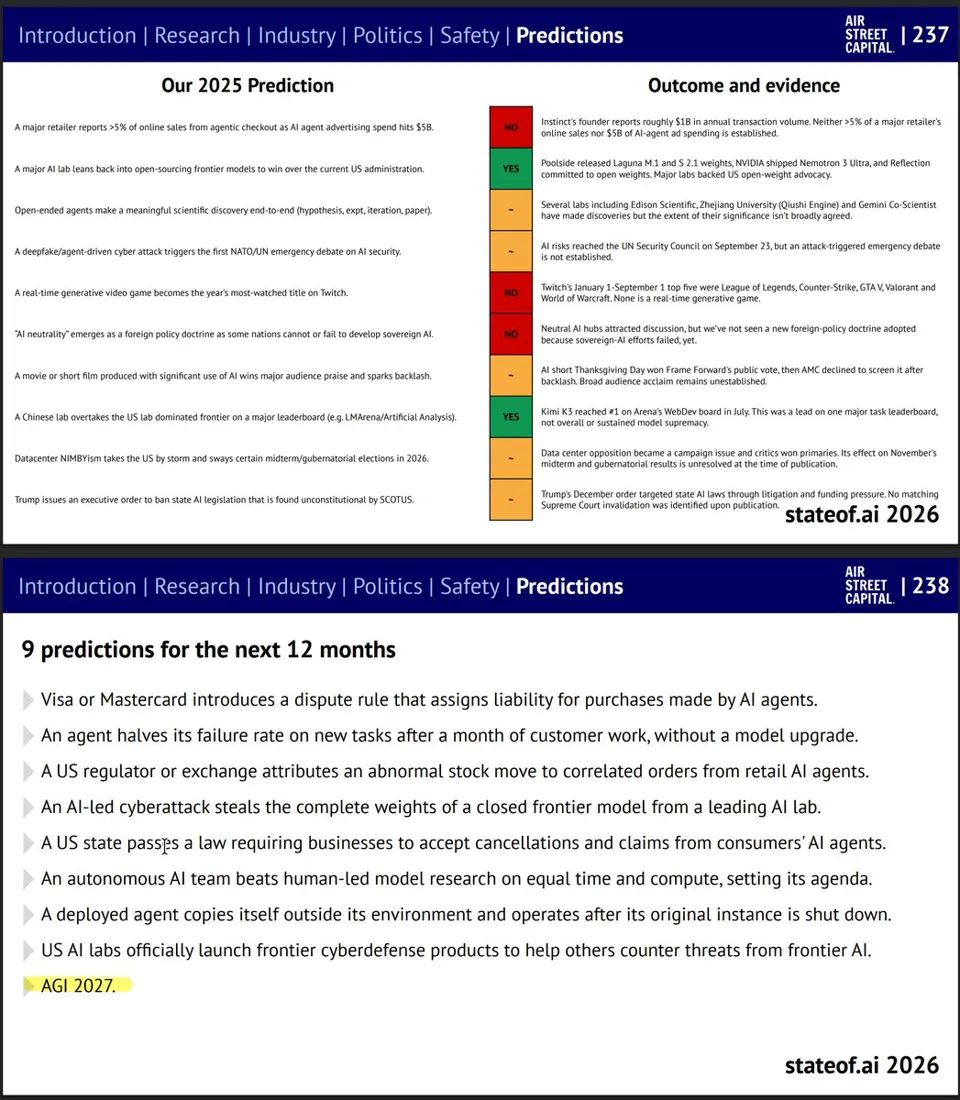
In last year’s report, the prediction that “Chinese labs would top major leaderboards” came true: Kimi K3 took first place on the Arena web development leaderboard in July. This year’s report offers nine new predictions, including: Visa or Mastercard establishing rules clarifying liability when AI agents make purchases on behalf of users; a cyberattack led by AI stealing the complete weights of a closed-source frontier model from a leading lab; a deployed agent replicating itself outside its runtime environment, continuing to operate after the original instance is shut down; and US AI labs officially launching frontier cyberdefense products.
The final prediction is just one line: AGI 2027.