量子位官网 · 10/8/2026, 17:30:17
Manus Reopens Beijing Office to Build Domestic AI Agents After $500M Funding Round
AI agent developer Manus has reopened its Beijing office to build a domestic product team following a turbulent year involving overseas relocation and regulatory hurdles. The company recently closed a $500 million funding round led by Boyu Investment and IDG Capital, with continued support from Tencent and Sequoia China. It is currently hiring for 17 roles, including Agent Harness engineers and LLM algorithm specialists, to establish an independent R&D and commercialization capability in the Chinese market.
SOURCE COVERAGEFull Original Report
Manus, the former AI agent star, is back hiring in Beijing.
And this time, it’s targeting the domestic market.
According to the latest news, Butterfly Effect, Manus's parent company, recently completed a new funding round exceeding $500 million. The round was led by Boyu Capital and IDG Capital, with continued support from existing investors Tencent, Sequoia China, and ZhenFund.
At the same time, Manus is rebuilding its team to develop AI Agent products for the Chinese market.
Since before the National Day holiday, the number of open positions has increased from 11 to 17, including one internship role.
According to the latest information on Manus's recruitment website, there are currently 17 open positions: 16 full-time roles and 1 internship.
Compared to the 11 positions listed before the National Day holiday, the scale has expanded significantly.
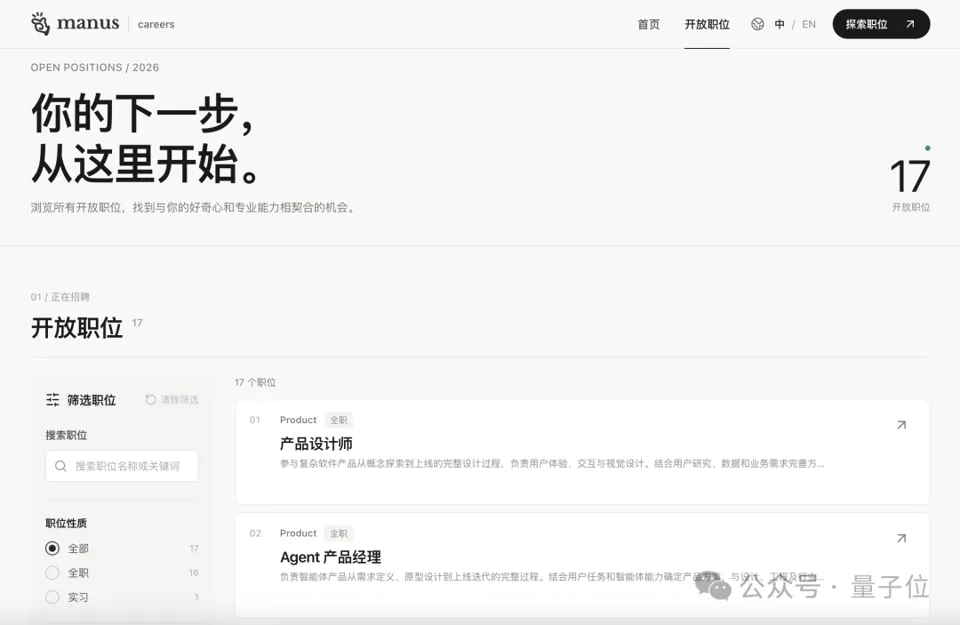
Notably, this recruitment drive includes core technical and product roles such as AI Agent Product Manager, Agent Harness Engineer, Agent Evaluation Engineer, and LLM Algorithm Engineer.
Judging by this lineup, Manus appears ready to rebuild an independent team in China capable of handling product R&D, operations, and commercialization.
However, this move carries a certain dramatic irony given Manus's history.
In May last year, Manus relocated its headquarters to Singapore; in July, it drastically downsized its China team, shifting its business focus overseas.
Subsequently, Manus went through a series of twists and turns: being acquired by Meta, the acquisition deal being blocked by regulators, buybacks by original shareholders, and finally returning to independent operation.
Now, after more than a year of ups and downs, this story has brought Manus back to where it started.
A winding road, and the prodigal son returns.
Manus Returns to Beijing: Yesterday’s "Amputation" vs. Today’s "Return"
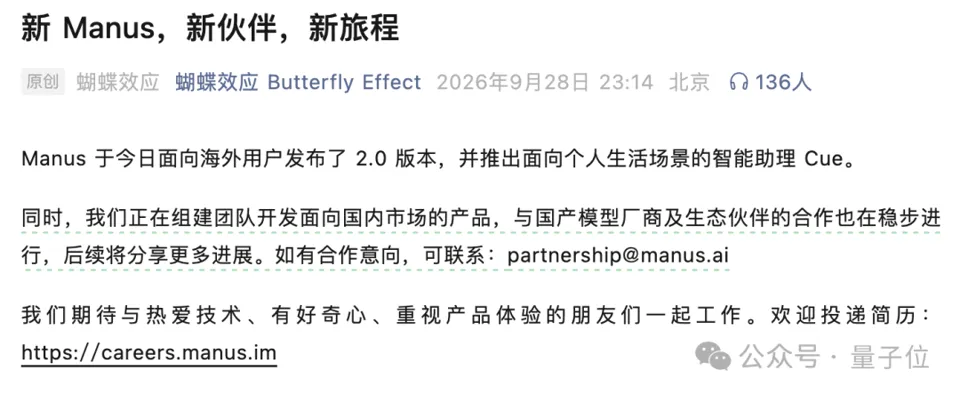
Late at night on September 28, Manus announced via its new official WeChat account, "Butterfly Effect," that it had launched version 2.0 for overseas users, along with Cue, an intelligent assistant designed for personal life scenarios.
More strikingly, the second sentence of the announcement stated:
Meanwhile, we are assembling a team to develop products for the domestic market, and collaborations with local model vendors and ecosystem partners are progressing steadily. More updates will follow.
The next day, Manus founder Xiao Hong posted on his Moments feed, detailing the product philosophy behind Manus 2.0 and Cue, while confirming that active preparations for a domestic version were underway and expressing willingness to hire and collaborate openly.
As for how the Manus China team plans to operate, the job postings may reveal more details.
We reviewed Manus's recruitment website.
Currently open positions cover multiple departments, including Product, Engineering, Business Development, and Operations.
On the technical side, roles include LLM Algorithm Engineers, Agent Harness Engineers, Agent Evaluation Engineers, Full-Stack Engineers, Backend Engineers, Security Engineers, Virtualization Engineers, and DevOps Engineers.
On the product side, openings include AI Agent Product Managers, Product Designers, Product Marketing Managers, and Agent Evaluation Research Interns.
Additionally, there are roles in Business Analysis, User & Product Operations, User Growth, Customer Support, and Community Management.
Several positions directly involve Agent product development, execution frameworks, and evaluation.
For example, the Agent Harness Engineer role focuses on the runtime framework and infrastructure required for agents to execute tasks; the Agent Evaluation Engineer is responsible for measuring metrics such as task completion quality and stability—roles closely tied to whether an Agent product can iterate continuously and perform complex tasks reliably.
It is evident that Manus's hiring scope now covers everything from underlying engineering, product R&D, and quality assurance to marketing, user growth, and commercialization.
This marks the first publicly disclosed localization staffing plan since Manus was bought back by Chinese capital and returned to independent operation.
However, the office location for the new team has not yet been announced (previously, Manus's Beijing office was located in a shared workspace at epark Haidian Garden Road community, consisting of only seven desks).
Manus has also not detailed the specific organizational structure of the Beijing team or the launch timeline for its domestic product. What is clear, however, is that Manus has begun investing personnel and R&D resources into the Chinese market once again.
So, why now?
This summer, existing shareholders such as Tencent, ZhenFund, and HSG executed a buyback at approximately $200 million, restoring Manus's independence.
Changes in ownership and strategic direction have created conditions for re-entering the domestic market.
Moreover, the rapid evolution of the AI Agent landscape and the maturation of domestic large models have made the timing ripe for localized product development.
Collaborations with domestic model vendors offer opportunities to leverage local strengths while addressing specific market needs.
Thus, Manus's return to Beijing is not merely a reversal but a strategic recalibration aligned with current market dynamics and internal capabilities.
In July of last year, news broke that Manus was conducting layoffs. Its domestic team originally comprised approximately 120 employees; more than 40 core technical staff were slated to relocate to Singapore, while the remaining employees faced termination.
The prevailing narrative at the time stated that "relevant compensation packages included N+3 or 2N."
This occurred less than six months after Manus rose to prominence in March 2025 with its general-purpose Agent product, having just become one of the most closely watched names in China’s AI startup ecosystem.
Regarding the organizational restructuring, Manus explained at the time that the company was adjusting certain business teams based on considerations of operational efficiency, while continuing to focus on core business development.
From a commercial decision-making perspective, this choice certainly had its context.
For a rapidly growing AI startup, shifts in the funding environment, target customers, technical resources, and regulatory conditions can all lead to adjustments in team deployment.
Especially given that Manus prioritized overseas markets as its business focus at the time, relocating to Singapore involved understandable operational considerations.
However, for employees, another logic holds equally true.
After all, a company can reselect office locations and business priorities as strategies evolve, but employees must face concrete career arrangements, living costs, and professional planning.
So, does the history of dissolving the Chinese team over a year ago and now returning to recruit again affect how job seekers perceive Manus?
From the perspective of potential candidates, at least the following questions are worth considering.
For instance, what proportion of core R&D work will the new domestic team actually undertake? Is the domestic product line a long-term strategy or a phased business experiment? If market conditions or corporate strategy shift again in the future, where will the Chinese team stand?
Especially for candidates targeting core roles such as Agent algorithms, infrastructure, and product leadership, factors like job stability, room for business growth, and influence in technical decision-making will significantly impact their career choices.
Therefore, if Manus aims to hire and retain core talent this time around, it may need to demonstrate greater sincerity than ever before.
This sincerity serves as the litmus test for whether a 'prodigal son' has truly returned.
If Manus offers sufficiently lucrative compensation packages, and if the China-based team holds substantial influence within the overall technical landscape and strategic decision-making, then leveraging its past strengths and technological vision, this recruitment drive could indeed exert significant pressure on local AI startups in the battle for talent.
Back in the Eye of the Storm
There is another change that cannot be ignored—
Now, as Manus rebuilds its Chinese team, the competitive landscape it faces is vastly different from before.
As Xiao Hong noted on his social media feed, "When Manus was built, OpenAI’s Codex didn’t exist yet, nor did Anthropic’s Claude Cowork."
A sentiment tinged with nostalgia.
When it launched in March 2025, Manus was the only general-purpose Agent product capable of autonomously decomposing tasks, invoking tools, operating web pages, and delivering final results based on user instructions. It was a scarce commodity in the AI market.
At that time, Manus quickly gained popularity due to its relatively complete task execution capabilities, becoming one of the most watched products in the global Agent sector.
But today, Agents have become a direction of intensive investment by tech giants.
In overseas markets, OpenAI’s Codex and Anthropic’s Claude Code continue to strengthen code development and task execution capabilities, while Anthropic’s Claude Cowork pushes Agent capabilities further into knowledge work and daily office scenarios.
Both companies possess leading large model capabilities, along with massive user and developer ecosystems.
Meanwhile, the global standard for Agent technology and product forms has been raised dramatically, to the point where even Meta, which struggled repeatedly in the LLM era, managed a comeback with its personal Agent "Muse."
During the year-plus that Manus was absent, competition in the domestic Agent sector also intensified fiercely.
WorkBuddy, Qianwen Office, Doubao Work, ZCode, Kimi Work... the list goes on endlessly. Moreover, powerful developers can even build their own solutions using DeepSeek Harness.
These products have quickly secured their positions, capturing significant mindshare and use cases.
Furthermore, backed by strong resources, they possess channel and ecosystem advantages that Manus currently finds difficult to replicate.
On the other hand, the rapid iteration of domestic models has significantly lowered the barrier to entry regarding the model capabilities required for Agent product development, providing domestic developers with more foundational options.
In summary, users have already seen many more Agent products, and their expectations regarding execution quality, speed, stability, and pricing have risen accordingly.
Moreover, the rapid rise and fall of trends in the AI sector is evident to all—take this year alone: OpenClaw surged in popularity only to fade just as quickly, now essentially becoming a non-entity.
This is no longer an untamed frontier where merely introducing new concepts could secure market share; it has evolved into a hyper-competitive red ocean defined by cutthroat rivalry and a focus on practical implementation.
Of course, Manus hasn’t returned empty-handed.
Based on its latest product direction, Manus is attempting to enable Agents to handle more sustained tasks and expand collaboration scenarios between humans and Agents, as well as among Agents themselves.
Whether these capabilities can translate into products that domestic users are willing to adopt long-term remains to be seen.
Over a year ago, when Manus left China, Agents were still a nascent field brimming with imaginative potential.
Now, over a year later, Manus has returned—but with more competitors and a shifted industry landscape.
Will this "prodigal son’s return" ultimately yield new growth and breakthroughs?
Only time will tell.
References: [1]https://mp.weixin.qq.com/s/oZ8ZPaurRHtLX-65EbyZCg [2]https://careers.manus.im/cn/jobs