Rohan Paul (@rohanpaul_ai) · 10/21/2026, 22:10:19
OpenAI Deploys ~2K Agents to Parallel-Process Whole-Brain CRISPR Atlas
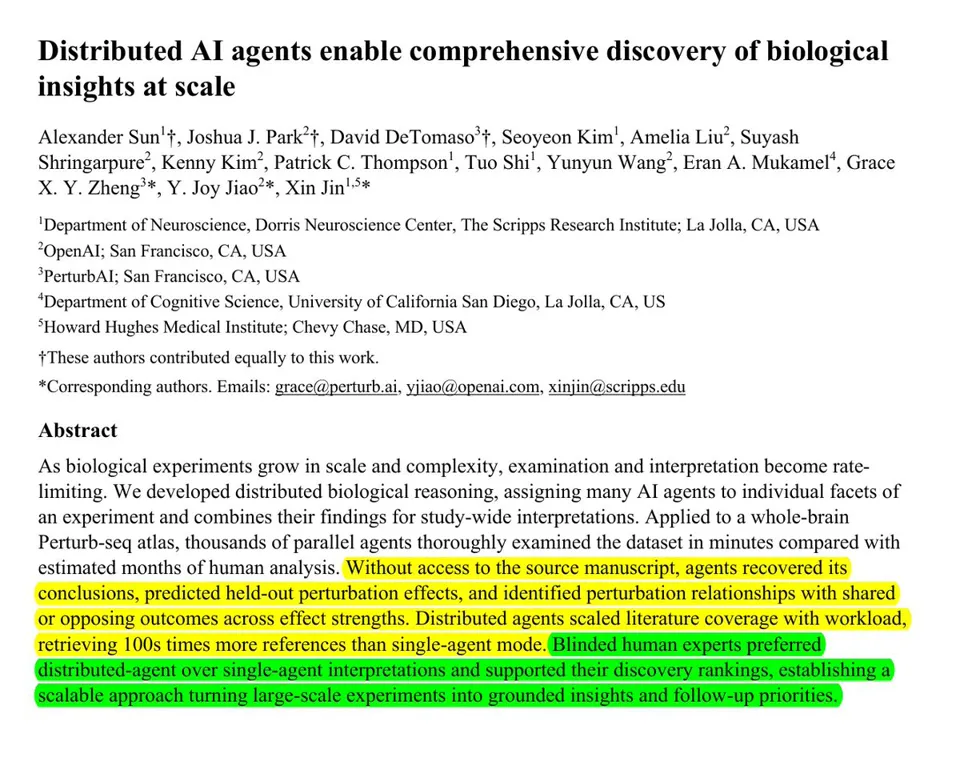
OpenAI, in collaboration with Scripps and PerturbAI, deployed 1,946 GPT-Rosalind-5.5 agents to analyze a whole-brain mouse CRISPR atlas in just 32 minutes, a task estimated to take humans months. By adopting a 'one gene per agent' parallel architecture, the system matched or refined 48 of 55 published findings and increased citation density by hundreds of times compared to single-agent baselines. Blind PhD reviewers preferred these agent-generated reports 75% of the time, demonstrating the efficacy of multi-agent systems in scaling biological data interpretation.
SOURCE COVERAGEFull Original Report
Rohan Paul (@rohanpaul_ai) · 2026-10-21 14
OpenAI showed that AI agents can handle the slowest step in modern biology, making sense of huge experiments.
By splitting a huge brain experiment among 1,946 AI agents, OpenAI got in 32 minutes what it estimates would take people months: a ranked list of leads for new brain-disease research.
So biology labs can now produce experiments far bigger than their own experts can fully interpret
OpenAI, PerturbAI and Scripps Research had 1,946 GPT-Rosalind-5.5 agents interpret a whole-brain mouse CRISPR atlas in 32 minutes.
Each agent analyzed a single knockout’s effects and searched the literature, without seeing the atlas paper, which appeared after the model’s December 2025 knowledge cutoff.
They still matched or refined 48 of the 55 published findings the expression data could support.
The main advance is the method: split 1 giant analysis into nearly 2K small ones, 1 gene per agent, and run them all at once. A single agent given 893 genes cited just 11 papers, while the split-up agents cited 711 times as many, and blinded PhD reviewers preferred their reports 75% of the time.
↳ 引用 @OpenAI (OpenAI): GPT-Rosalind surfaced a new lead for drug discovery: could restoring cholesterol transport protect neurons from degeneration?
DCTN1 is a gene linked to Perry syndrome, a rare neurodegenerative disorder. In mouse-brain data, disrupting it increased expression of genes involved in making cholesterol. GPT-Rosalind suggested a possible explanation: cholesterol may not be reaching where neurons need it.
That gives scientists a specific mechanism to test and, if confirmed, a direction for developing new treatments for neurodegenerative disorders.
With @perturbai_tx and @scrippsresearch, a team of thousands of GPT-Rosalind agents worked in parallel, connecting gene-expression results from millions of mouse brain cells with scientific literature in just 32 minutes. We’re now expanding this collaboration to identify new drug targets.