机器之心 (微信公众号) · 10/12/2026, 12:30:00
RoboFoundry Introduces Self-Evolving System-as-Policy Framework for Embodied Agents via Frozen Base Models
Researchers from NTU and other institutions introduced RoboFoundry, formalizing the entire agent system as a 'Self-Evolving System-as-Policy'. By keeping base models frozen and autonomously evolving context, skills, and execution interfaces, it boosted GPT-5.5's success rate on EmbodiedBench from 56.9% to 72.7%, significantly outperforming baselines in long-term memory and perturbation tests.
SOURCE COVERAGEFull Original Report
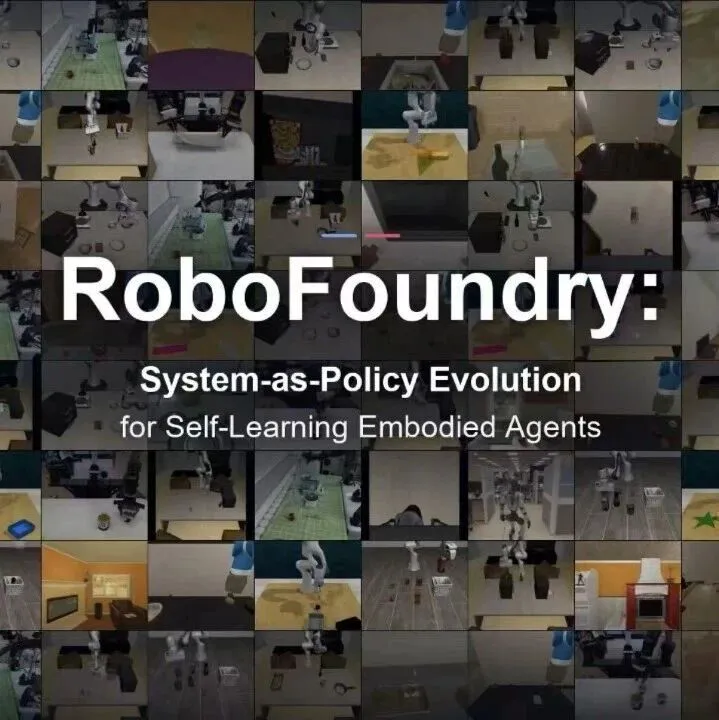
From Code-as-Policy to System-as-Policy

The same GPT-5.5 model can yield vastly different performance on embodied tasks depending on the system it is embedded in. On EmbodiedBench, using GPT-5.5 directly results in an average success rate of 56.9%. Without changing a single model parameter, simply allowing the surrounding system to continuously evolve raises this figure to 72.7%.
The difference lies outside the model itself: which information is presented to the model, which experiences are retained, and how decisions are translated into physical robot actions. The embodied policy actually executed in the environment has never been just a model; it is the model plus its entire surrounding system.
The role of large models in robotic systems has progressively shifted upward: from high-level planners to decision cores in Code-as-Policy that combine perception and control primitives into programs. However, the system surrounding the model remains largely manually constructed and fixed after deployment. Existing work often improves only one component—memory, skills, or the interaction harness—and issues exposed during execution are typically used only for evaluation or manual debugging. Consequently, the same weaknesses recur across episode after episode.
This raises a critical question: Can an embodied agent treat its entire system as a policy, diagnose where the system limits behavior, and evolve the corresponding parts based on embodied experience?
A research team from Nanyang Technological University (Singapore), Beihang University, National University of Singapore, Shanghai Jiao Tong University, and Cloud Butterfly Technology proposed RoboFoundry. They position it as the first embodied agent framework that formalizes the agent system itself as a "Self-Evolving System-as-Policy." The base model remains frozen, while evolution occurs within the context system, skill system, and execution interface surrounding the model. A shared semantic interface enables reuse across different robots.
In experiments, RoboFoundry improved performance for all five base models on EmbodiedBench. On the long-term memory benchmark RoboMemArena, task success rates exceeded all baselines by at least 39.0%. In perturbation tests on LIBERO-PRO, it outperformed CaP-Agent0 by 243.8–679.7%. On real robots, the framework demonstrated zero-shot transfer across different robots and tasks, as well as online evolution post-deployment.
- Paper Title: RoboFoundry: System-as-Policy Evolution for Self-Learning Embodied Agents
- Paper Link: https://arxiv.org/abs/2609.32862
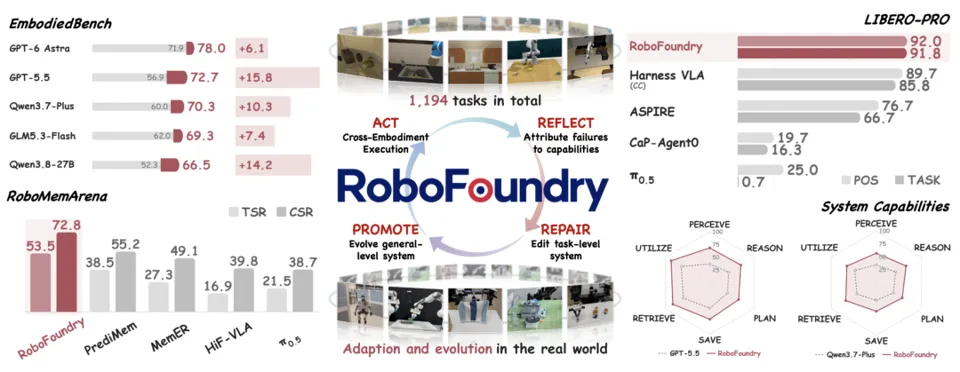
Figure 1: Overview of RoboFoundry. It features an evolutionary loop comprising "Execution — Reflection — Repair — Promotion," results across three benchmarks, and significant improvements in six system capabilities before and after integration.
Model Frozen, System Evolving:
Rewriting Itself Like Maintaining a Codebase
RoboFoundry does not update the base model's parameters; instead, it optimizes the system supporting the model in completing tasks. This system exists in file form, allowing the model to view it using cat and grep, and modify it using add, modify, and delete, much like a developer maintaining a codebase. The system is divided into two layers: a task-level system serving the current task, and a general system persistently retained across tasks and embodiments.
Evolution proceeds via inner and outer loops: the inner loop executes tasks and records trajectories; the outer loop proposes modifications based on these trajectories, which are then validated by subsequent executions. Modifications act on two "evolution surfaces":
- Context Surface: Manages active context for the current turn and cross-turn filesystem memory. Through SAVE, RETRIEVE, and UTILIZE operations, it determines what to record, what to retrieve, and how to use it.
- Skill Surface: Ranges from atomic skills to composite workflows like "move-grasp-place," and failure recovery trees. When execution fails, the system replans from a still-valid state.
Beneath these two evolution surfaces lies a shared semantic interface. The semantic layer handles task logic shared across embodiments; the execution layer adapts decisions to specific robots. Backends can include frozen VLAs (such as π0.5), functions generated by coding agents, or visual-motor interfaces like CuRobo. Since evolution acts on the semantic side, a system evolved on one robot can be reused on another by swapping the execution adapter, or connected to different base models.
Figure 2: RoboFoundry Method Framework. (a) The inner loop executes tasks and generates trajectories; (b) The general system, structured as a file directory, provides reusable rules and skills; (c) The outer loop diagnoses capability gaps: modifications that fix the current task update the task-level system, while those that pass validation across other tasks are promoted to the general system.
An Evolutionary Loop with Diagnosis and Validation,
Not Unconstrained Self-Rewriting
Failures or inefficiencies encountered during execution are first attributed to one of six capabilities: perception, reasoning, and planning fall under decision-making capabilities, while storage, retrieval, and utilization fall under memory management capabilities. The system only proposes modifications on the corresponding evolutionary facet; a modification is committed only if it resolves the failure in the current task.
RoboFoundry first abstracts successful modifications into candidate rules, then identifies repair records for similar capability gaps in other tasks. It replays the pre-repair states of those tasks, allowing the system applying the candidate rule to generate new repair plans. Subsequently, the system itself acts as the verifier, scoring the new plans against the repairs that actually worked at the time. A candidate rule is written into the general system only if its average score is no worse than that of the original repairs.
Figure 3 illustrates an example evolution process on the spatial relation subset of EB-Habitat, using GPT-5.5 as the base model, involving six candidate evaluations:
- The first three modifications were committed, raising the held-in success rate from 21.4% to 50.0%;
- The next two candidates only reached 42.9% and were not adopted;
- The final candidate pushed the success rate to 78.0%, passed the held-out check, and was marked for promotion into the general system.
Figure 3: An evolution trajectory on the EB-Habitat spatial relation subset (GPT-5.5), with held-out check results for each candidate shown below.
Accepted modifications result in specific changes within files. For example, for the instruction "move all cleaning agents from the sink to the sofa," the system rules were rewritten as:
- Each plan should include no more than 20 actions.+ Prefer one action; at most two when both are currently supported.+ After Navigation, observe before Pick/Place/Open/Close.+ Trust environment feedback over visual appearance for proximity.+ After a not-near Pick failure, navigate before retrying.The new rules do not mention any specific objects such as cleaning agents, sinks, or sofas, making them shareable across tasks. The entire evolution process is recorded in the .robofoundry/ directory, referred to in the paper as the "Evolution Ledger," which allows for retrospective review.
All five base models improved,
and the gap between base models narrowed significantly.
EmbodiedBench comprises 1,128 tasks across four environments, covering high-level semantic planning and low-level action execution. All settings use the same task flow and interaction budget, starting evolution from the first scored turn. Every trajectory during the evolution process contributes to the final score.
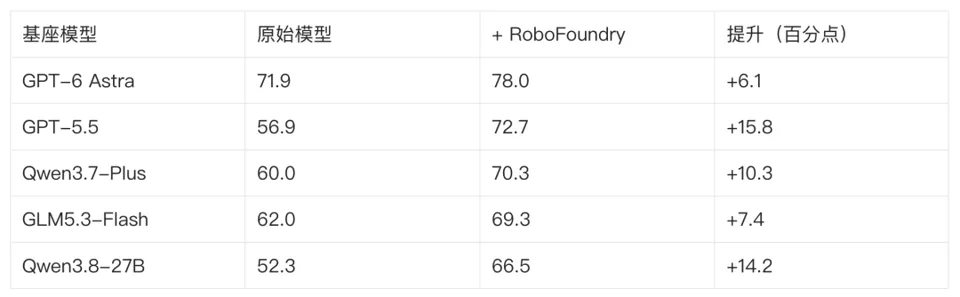
Note: Average success rates (%) across the four EmbodiedBench environments. Improvement values match Figure 1 in the paper; due to rounding, individual improvement values may differ by 0.1 from direct subtraction of the two columns.
- GPT-5.5 achieved a relative improvement of 27.8%. The evolved GPT-5.5 (72.7%) already outperformed the non-evolved GPT-6 Astra (71.9%).
- The gap between base models narrowed significantly. The maximum difference among the raw scores of the five base models was 19.6 percentage points, shrinking to approximately 11.5 percentage points after integrating RoboFoundry.
- Even the strongest models benefited. GPT-6 Astra achieved a relative improvement of 8.5%.
Ablation studies show that general evolution is key: when using Qwen3.7-Plus as the base model, the full version outperformed the Lite version (which retains only task-level modifications) by a relative margin of 11.2%. Expanding the context budget from 4K to 16K caused mixed results for the original models; however, under the 16K setting, RoboFoundry still enabled the four tested base models to improve their respective baselines by a relative margin of 7.9%–13.1%.
Long-term Memory and Distribution Shift:
Evolution goes beyond prompts.
RoboMemArena is a long-term memory benchmark comprising 26 tasks categorized into moving, occlusion, counting, and sequencing. Using Qwen3.7-Plus as the base model, RoboFoundry achieved a Task Success Rate (TSR) of 53.5% and a Cumulative Success Rate (CSR) of 72.8%, leading in all four task categories. Its TSR exceeded all baselines by at least 39.0%, including PrediMem, which uses Qwen3-VL-8B-Instruct for memory management.
On this benchmark, evolution modifies not just prompts but also mechanisms determining "what state to retain, what evidence to retrieve, and how to present it to the model." For instance, it converts task progress into current subgoals and explicitly stipulates that "attempted instructions cannot serve as evidence of physical success."
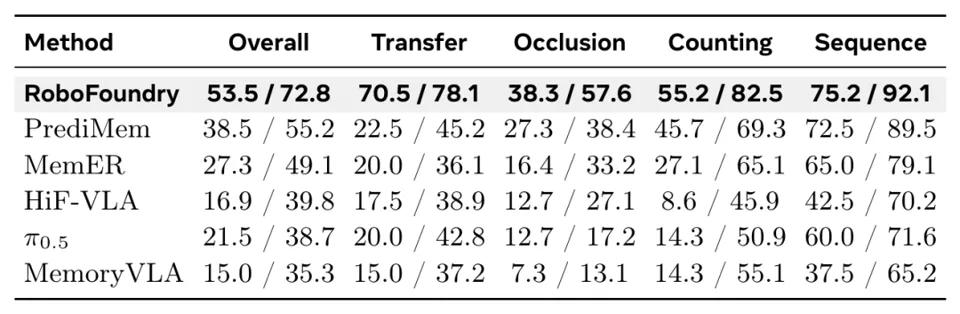
Figure 4: Long-term memory results on RoboMemArena, showing TSR / CSR (%) for each item.
LIBERO-PRO tests system robustness under variations in object layouts and task settings. Among methods that do not use privileged object poses, RoboFoundry achieved the highest average success rate at 91.9%, compared to 87.8% for Harness VLA (CC). It outperformed CaP-Agent0 by a relative margin of 243.8%–679.7%.
The evolved system further distinguishes improvements across two timescales: reusable composite skills are retained long-term in the shared system, while recovery logic temporarily generated during a specific trial remains confined to that trial.
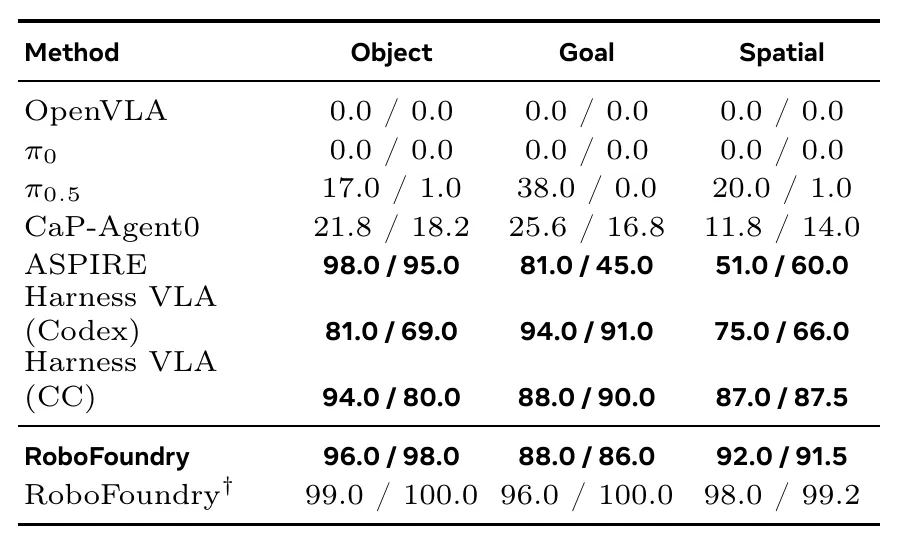
Figure 5: LIBERO-PRO perturbation test results. Each entry shows the success rate (%) under position perturbation / task perturbation. † indicates the use of privileged object poses.
Zero-shot transfer on real robots and online evolution during deployment
The real-world experiments aim to answer a key question: Can the general-purpose RoboFoundry system transfer to physical robots and continue evolving after deployment? In these experiments, RoboFoundry uses GPT-5.5 as the base model and π0.5 as the manipulation execution backend. To ensure fairness, RoboFoundry and standalone π0.5 utilize the same fine-tuned checkpoint for their respective tasks. RoboFoundry begins without any task-specific system adaptations; each task is tested 10 times, with trials used for online evolution included in the success rate calculation. System updates occur only between trials.
- Matryoshka dolls: Online evolution. On the AgileX COBOT MAGIC platform, the matryoshka doll task requires both sorting from smallest to largest and precise insertion. The first trial ended with the doll falling. The system then added an alignment check (a modification at the skill level). The second trial used insertion with alignment, but the execution lost track of task progress. The system subsequently added progress tracking (a modification at the context level), allowing execution to resume from the last completed subtask. The third trial was fully successful. Ultimately, RoboFoundry achieved a 70% success rate, compared to 30% for standalone π0.5.
- Towel folding: Zero-shot transfer. The towel-folding skill evolved exclusively on blue towels and was then directly applied to green and pink towels, which differed in appearance, geometry, and material. Without additional adaptation, RoboFoundry achieved a success rate exceeding 80%, whereas π0.5 scored below 20% and required further fine-tuning.
- Humanoid robot: From manipulation to navigation. On the Unitree G1 humanoid robot, RoboFoundry leverages a shared semantic interface to map the instruction "Find drinking water" to a water dispenser identified in the RGB image. This mapping is then converted into navigation actions via embodiment-specific execution bindings.
- Chemical experiment: Long-horizon dependencies across subtasks. Six interdependent subtasks were performed sequentially: inserting a funnel into an Erlenmeyer flask, placing a weighing dish, taring the balance, adding powder with a spatula, returning the spatula, and pouring powder into the flask. RoboFoundry used a task state record to link the entire workflow. The final pouring step read the "funnel in place" status written several subtasks earlier to guide execution. Standalone π0.5 struggled to complete the full sequence.
Figure 6: Real-world evolution and transfer. (a) Alignment and progress tracking were added sequentially in the matryoshka doll task; (b) The towel-folding skill transferred to unseen towels; (c) Semantic navigation on the Unitree G1.
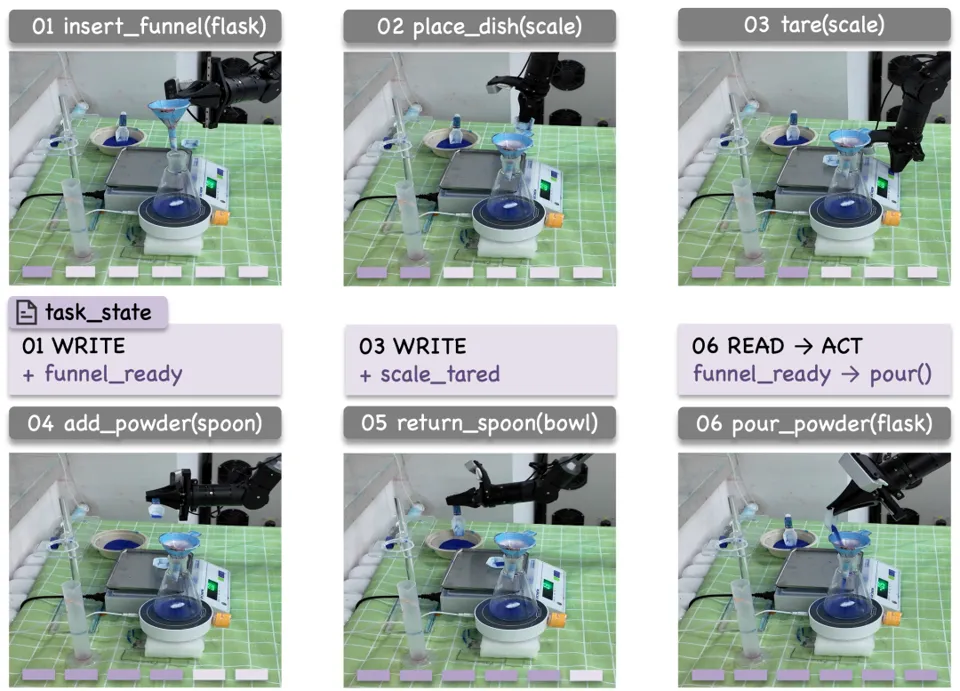
Figure 7: In long-horizon chemical experiments, the task state record connects six interdependent subtasks.
Conclusion:
From "training stronger models,"
to "continuously strengthening the systems in which models reside"
From language model planning, to code-as-policy execution, and finally to system-as-policy evolution, the role of large models in embodied systems has consistently shifted toward higher-level abstraction. RoboFoundry offers a concrete approach: the base model remains unchanged, while execution trajectories determine which parts of the system require modification. Every modification must first be verified to fix failures on the current task. Only improvements that are also validated as effective against similar capability gaps in other tasks are consolidated into general capabilities to serve subsequent tasks. As foundation models become increasingly powerful, progress in embodied intelligence may stem not just from "training a stronger model," but also from "continuously strengthening the systems in which those models reside."
Author Information
This research was conducted collaboratively by researchers from Nanyang Technological University (Singapore), Beihang University, National University of Singapore, Cloud Butterfly Technology, and Shanghai Jiao Tong University. The co-first authors are Liang Jingsong (Ph.D. student, Nanyang Technological University) and Liao Shuhao (Ph.D. student, Beihang University). The corresponding authors are Wu Wenjun (Professor, Beihang University), Li Wanhua (Nanyang Assistant Professor, Nanyang Technological University), and Lü Chen (Associate Professor, Nanyang Technological University).