IT之家 · 智能时代 · 10/23/2026, 07:23:36
Microsoft Unveils MAI-DxO: AI Diagnostic System Hits 83% Accuracy on Complex Cases
Microsoft has released MAI-DxO, a multi-agent medical diagnostic orchestrator published in Science. By simulating expert consultation workflows, the system achieved 83% accuracy on complex NEJM cases, significantly outperforming general practitioners while reducing costs.
SOURCE COVERAGEFull Original Report
The system, named the Microsoft AI Diagnostic Orchestrator (MAI-DxO), simulates the process of a multidisciplinary expert medical consultation by orchestrating multiple AI agents. These agents collaborate to interview patients, order diagnostic tests, and engage in deep analysis and debate over potential diagnoses.
In simulated evaluations based on complex cases from the New England Journal of Medicine (NEJM), MAI-DxO achieved a diagnostic accuracy rate of 83%. By comparison, primary care physicians and general internists—who could independently consult reference materials—achieved an accuracy rate of only 36%.
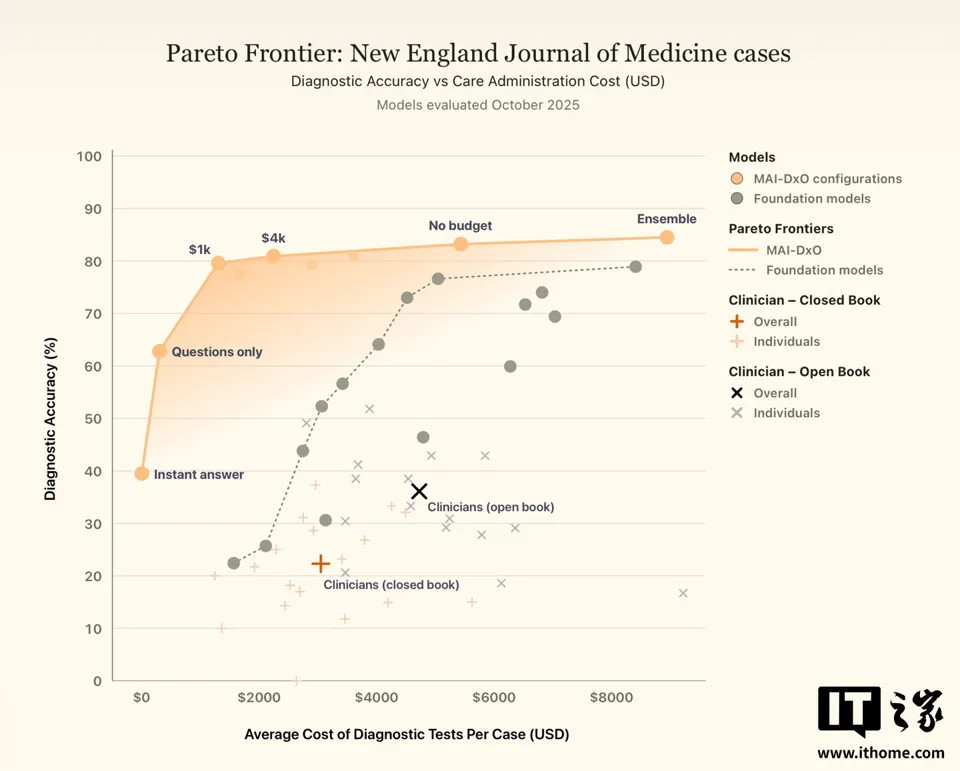
It is worth noting that such complex cases are typically handled by specialist experts or multidisciplinary medical teams in real-world clinical settings. However, these specialists were not included in this controlled experiment.
According to official statements, the system requires only half to one-third of the cost associated with human doctors, accurately identifying correct diagnoses with fewer tests and procedures. This research has been officially published in the journal Science.
Data from the study itself indicates that the significant improvement in the system's diagnostic capabilities is largely attributed to enhancements in the underlying foundation AI models, while Microsoft’s orchestration architecture further amplifies these performance gains.
Microsoft tested MAI-DxO using models from various organizations, including OpenAI, Google, Anthropic, Meta, and DeepSeek. Among them, OpenAI’s GPT-5 and GPT-5.5 delivered the most impressive results.
IT Home provides the following link to the paper: