IT之家 · 智能时代 · 10/17/2026, 07:13:28
Anthropic Report: AI Work Hours Exceed Humans by 6x, Junior Dev Roles Drop
Anthropic's internal report reveals that its revenue per employee is 2-4 times higher than Meta and Google during their growth phases. With AI agent work hours exceeding human employees by 6x, junior technical hiring dropped from 27% to 9%, yet engineering efficiency surged without compromising code quality.
SOURCE COVERAGEFull Original Report
Anthropic Report: AI Work Hours Now 6x Human Levels, Junior Programmer Roles Plummet, Revenue Per Employee Hits 2–4x Meta/Google’s Peak Growth Periods
On October 17, it was reported that AI company Anthropic released a report yesterday (October 16) stating that approximately five years after its founding, its revenue per employee has reached 2 to 4 times that of Meta Platforms and Google during their respective high-growth periods.
This data is based on Anthropic’s internal financial and headcount records as of April 2026, compared against publicly available financial reports from Meta and Google at their five-year marks, adjusted for inflation.
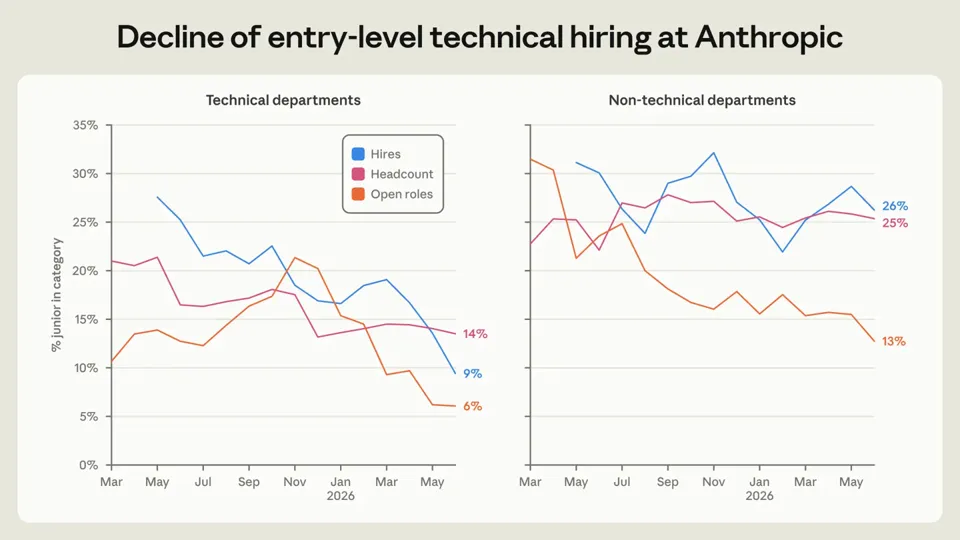
The report indicates that the proportion of junior employees in Anthropic’s technical department has dropped from 21% in early 2025 to 14%, while the share of junior technical hires has plummeted from 27% to 9%. Approximately one-third of machine learning managers and one-fifth of software engineering managers stated they reduced hiring due to the emergence of AI. Meanwhile, the company continues to expand overall, with faster growth in roles such as sales, finance, and recruiting.
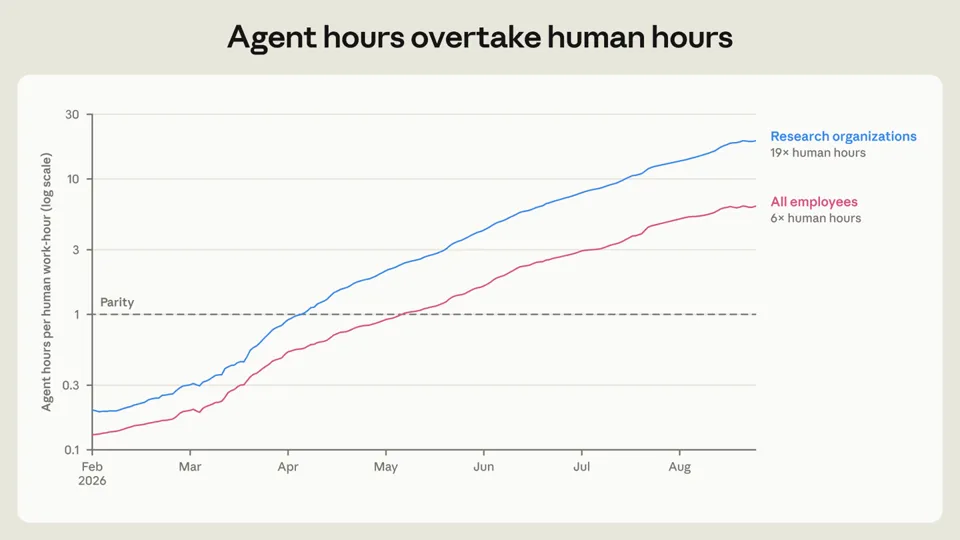
Agent work hours exceed human work hours. Note: We only consider employee-led interactive sessions and sub-agent pools. The concept of "work hours" refers to agent runtime, including inference and tool use, but excludes wait times exceeding 30 minutes. Human work hours are calculated by headcount, assuming 40 hours per week.
AI brings not just job contraction, but also efficiency leaps. After adopting coding agents, engineers’ code commits per person reached 5 times the level of six months prior; lawyers processed more contracts, finance teams handled more invoices, and sales personnel closed more deals. The report tracked 192 engineers who adopted coding agents and found that their code output rose significantly post-adoption, with no deterioration in the ratio of code subsequently deleted or rolled back.
According to the report, by August 2026, the work hours of interactive AI agents deployed by employees had reached 6 times that of human employees; as early as March, total company-wide agent work hours surpassed human work hours for the first time. IT Home includes relevant images below:
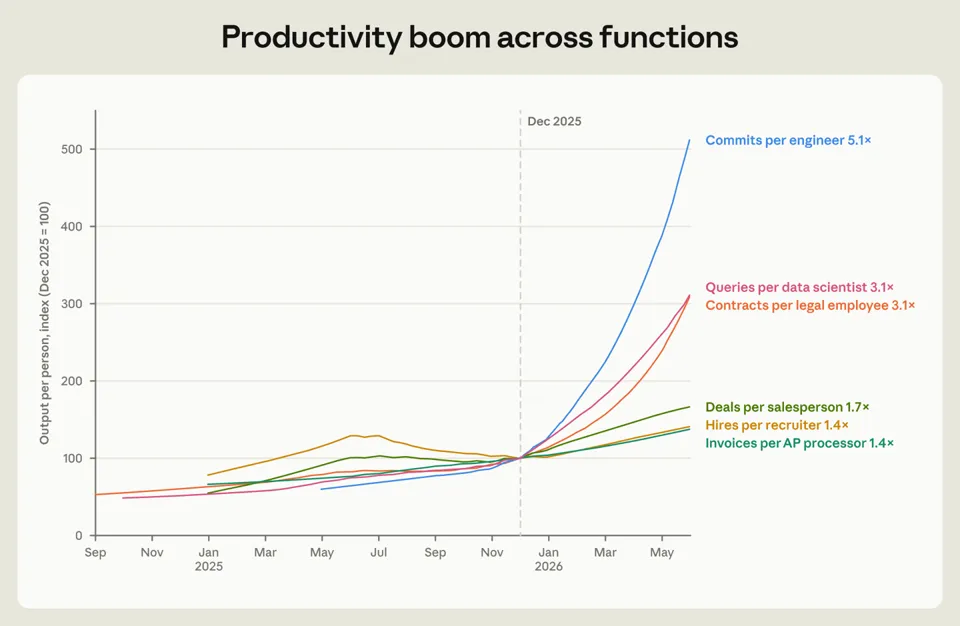
Productivity surges across functional departments. Note: Loess smoothing was applied to fit indexed baseline output data.
However, "human-AI collaboration" also introduces new burdens. The report states that even non-technical employees may spend half a work week reading all outputs from their Claude agents. Employees are shifting from being "executors" to "agent managers," responsible for writing instructions, building monitoring dashboards, and reviewing AI outputs. In Spring 2026, this type of "meta-work" accounted for 22% of employees’ interactive Claude sessions, up from 10% the previous year.
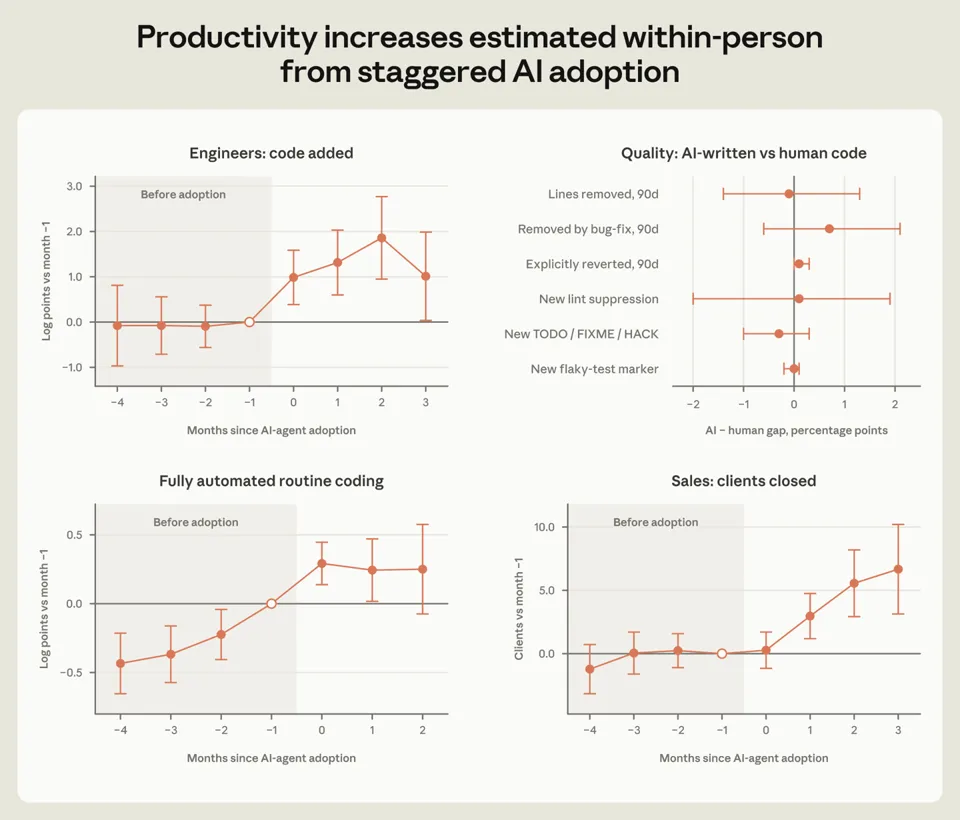
Estimated productivity gains based on gradual individual adoption of AI. Note: Coefficients compare users who adopted coding agents versus those who did not, accounting for two-way fixed effects for users and calendar months. Treatment timing is based on the month a user first conducted at least 5 agent sessions. Bars represent 95% confidence intervals based on standard errors clustered by user. The quality panel compares code written directly by users versus code written by the same users using coding agents. Quality metrics include: the percentage of lines of code deleted within 90 days for any reason; the percentage of lines deleted specifically for bug fixes; whether entire commits were explicitly rolled back; whether linting suppression comments were added; whether comments requiring fixes were added; and whether tests were marked as skipped, retried, or allowed to fail.
Hiring standards have shifted accordingly: managers now prioritize candidates’ autonomy, judgment, and ability to creatively use AI over narrow domain expertise and specific execution skills. Anthropic has simultaneously established a role-risk warning mechanism and prioritizes internally redeploying affected employees.
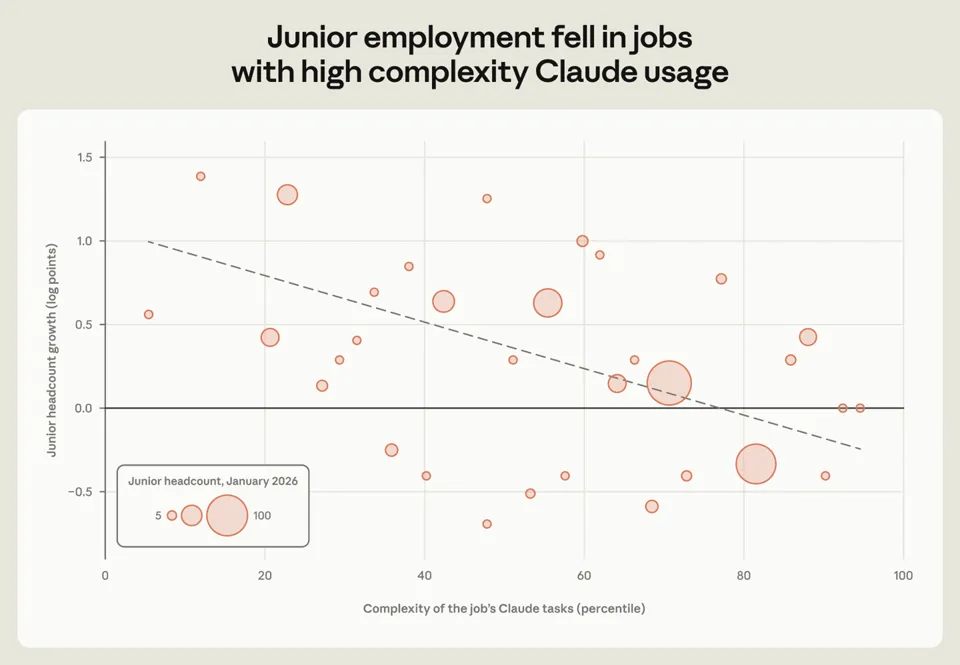
Junior employment growth categorized by Claude usage complexity. Note: The chart is unit-based by position. Growth rates compare headcounts in January 2026 and July 2026. AI complexity is based on automated coding of agent logs (prior to the decline in headcount, i.e., October–December 2025), with percentile transformations applied. Points in the chart are scaled by the position’s January headcount; regression lines are fitted to weighted points.
However, revenue per employee is not the sole indicator of corporate health. External research firm Epoch AI previously estimated that Anthropic’s annualized revenue per employee in April 2026 was approximately 2.55 million and Google’s ~$2.11 million; however, the firm also cautioned that its employee count and revenue data were not disclosed concurrently, introducing uncertainty into the estimates.