量子位官网 · 10/16/2026, 16:00:31
UBTECH Releases Thinker-WM, Setting New Benchmarks in Embodied AI
UBTECH has released Thinker-WM, a new embodied world model that tops three major benchmarks. By employing the Unified Dynamic Transformer (UDT) architecture to integrate vision, geometry, and action into a shared dynamic representation, it resolves the decoupling issues of traditional modular approaches, enabling unified video-action generation and policy reasoning.
SOURCE COVERAGEFull Original Report
Contents7 sections
01 Top of All Three Benchmarks: Thinker-WM Secures First Place in Three Categories
Recently, UBTech’s Thinker-WM achieved first place across three widely recognized embodied world model benchmarks, setting new industry records:
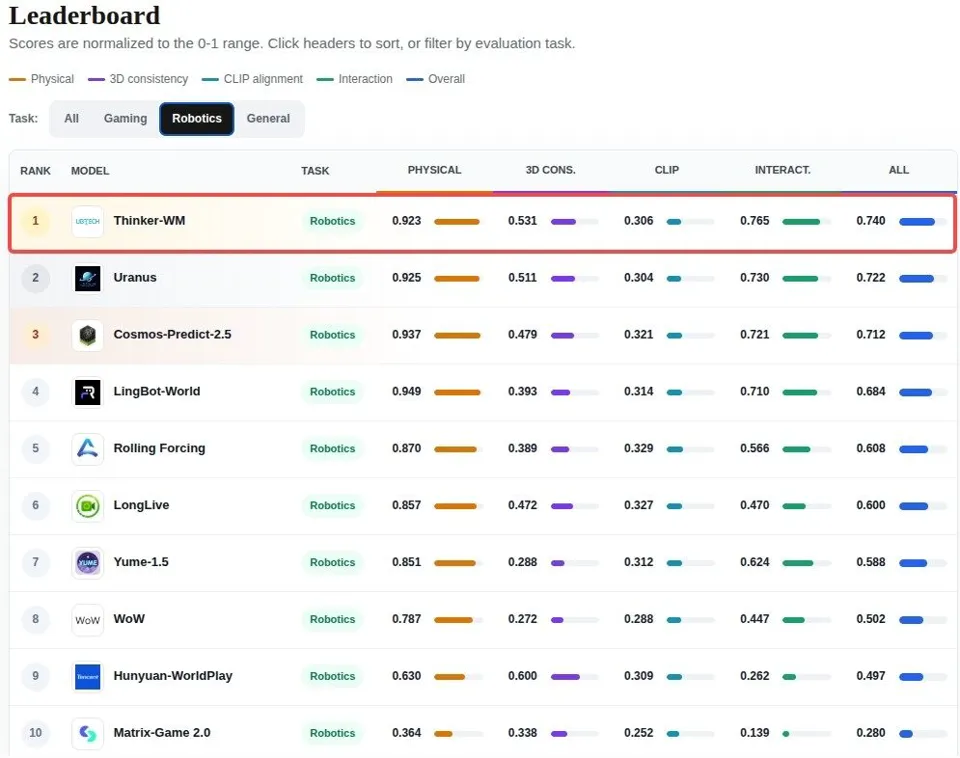
WorldOlympiad:
Thinker‑WM secured the top spot with a comprehensive score of 0.740. This benchmark is constructed from extensive real-world robot interaction data, covering over ten different robot embodiments and various camera configurations. It primarily evaluates models' generalization capabilities across different robot morphologies and viewpoints. The model achieved scores of 0.531 for 3D consistency and 0.765 for interaction fidelity, ranking first among all participating models on these two individual metrics. This demonstrates the model's precise modeling capability regarding 3D geometric structures and robot interaction processes.
EWMBench:
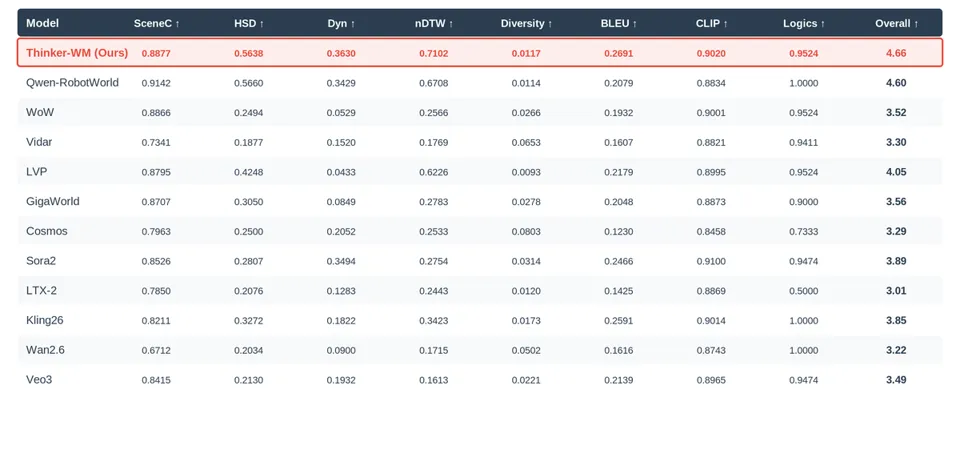
Thinker‑WM achieved a total composite score of 4.66, surpassing mainstream models such as Qwen‑RobotWorld and Sora2. EWMBench comprehensively assesses three core capability dimensions: scene consistency, correctness of robot end-effector motion, and instruction-semantic alignment. Leveraging multimodal joint modeling at the representation level, Thinker‑WM leads in key robot motion metrics, including nDTW (Normalized Dynamic Time Warping), which reflects spatiotemporal matching of robot trajectories, and Dyn (Dynamic Consistency), which evaluates the plausibility of motion velocity and acceleration.
WorldArena1.0 Track-1:
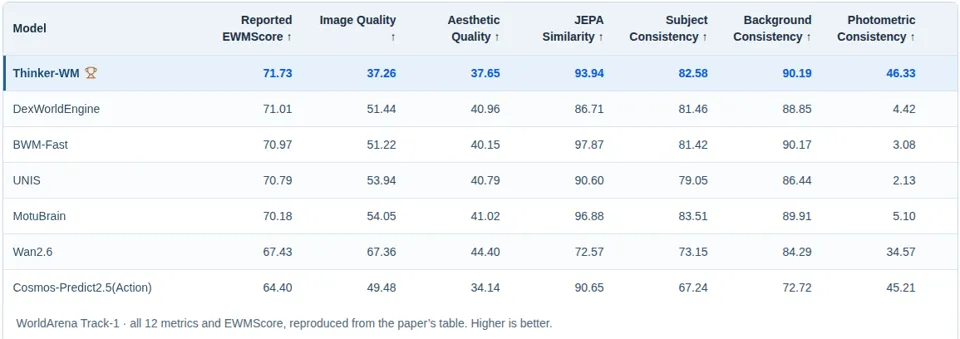
In the simulation environment benchmark WorldArena Track‑1, Thinker‑WM leads overall across 12 critical evaluation dimensions, including visual quality, content consistency, physical plausibility, 3D geometric accuracy, and instruction adherence. It balances visual generation quality with physical interaction credibility within simulated environments. At its core, Thinker‑WM utilizes a Unified Dynamic Transformer (UDT) to integrate RGB images, metric depth, and robot actions into a single shared dynamic representation that evolves jointly. This architecture unifies multiple capabilities—including video-action joint generation, world prediction, policy reasoning, video-to-action conversion, and inverse dynamics—providing a next-generation foundational world model base for embodied intelligence.
02 Technical Breakthroughs in Thinker-WM: Unifying Vision, Geometry, and Action at the Representation Level
The hardest part of deploying robots to perform tasks in the real world is not recognizing objects in front of them, but predicting how the environment will change next. This is precisely the value and significance of world models. However, past world models generally adopted a "stitching" approach: video generation handled visuals, policy networks handled actions, and geometric prediction handled spatial information. These modules computed independently and were stitched together via interfaces for output.
The problem with this technical paradigm is that actions change the environment, the environment constrains actions, and geometric structure influences both. Physically tightly coupled signals are split into different modules, losing their intrinsic causal relationships.
For example, the event "a cup is pushed off a table" can be described as one sentence in language, a sequence of joint commands in action, an object moving through frames in video, and a set of continuously changing distance fields in depth. These four representations point to the same event, not four different objects. Therefore, asking the model to generate any one of them is essentially querying the same underlying process.
However, this overlap is incomplete. Actions carry neither appearance nor context; the same joint command has entirely different meanings depending on whether it is executed on an empty table or a cluttered one. Language lacks spatiotemporal details; the phrase "the cup is pushed off the table" does not specify which side it was pushed from, how much force was used, at what speed, the specific trajectory of the hand, how many times the cup flipped, or where it ultimately landed. Video lacks explicit geometry and metrics; it uses only a series of pixels, knowing neither the size of the cup nor its distance. Depth lacks appearance, naming semantics, and intent; it tells you where surfaces are, how they occlude each other, and how they contact, but it does not tell you if it is a cup or a tablecloth, nor why it is being pushed.
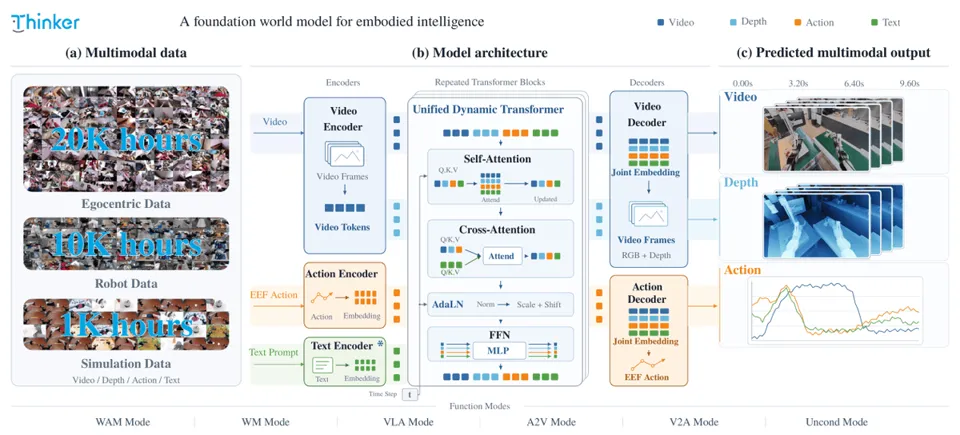
To address this issue, the UBTech Thinker team proposed a novel solution: instead of simple merging at the interface level, achieve multimodal unification at the representation level. Thinker-WM (Thinker World Model), UBTech’s self-developed unified multimodal world model, encodes RGB video, depth, and robot actions into the same intermediate representation space, relying on a set of shared parameters for joint evolution. Appearance, geometry, and action are no longer three independent pipelines but three expressive forms of the same world evolution process. In other words, the underlying design logic of Thinker-WM can be summarized as: different modalities are different expressions of the same process; the model aligns them into a shared representation space and performs reasoning on this shared representation, rather than doing conditional combination at modality interfaces.
Thinker-WM: A Unified Modeling Framework for Vision, Geometry, and Action
Specifically, RGB images, depth information, and robot actions are mapped to a unified latent space via their respective encoders. They are then fed into a shared Unified Dynamics Transformer (UDT) for joint temporal modeling. Finally, dedicated decoders reconstruct the outputs: video, depth maps, and executable robot actions. This means multimodal interactions occur inside the Transformer, where visual tokens, geometric tokens, and action tokens directly exchange information through the same attention mechanism, rather than undergoing shallow stitching at the input or output layers.
Geometric information is no longer just an auxiliary supervision signal. Thinker‑WM treats depth as a native generative modality, sharing consistent latent topology and spatiotemporal organization with video. Depth supervision directly shapes the shared representation, making physical spatial structure the "native language" of the world model, rather than an external add-on module added later. This helps humanoid robots understand physical space more accurately. The value of unified modeling is also reflected in actual robot execution performance. In ablation experiments on single tasks in RoboTwin, introducing the depth modality improved operation success rates by 15 percentage points compared to the baseline without depth. This indicates that spatial geometric information not only aids the model in understanding scenes but also improves action generation and task execution.
03 30,000 Hours of Heterogeneous Data Unlock Six Capabilities with One Model
Leveraging a unified multimodal representation where all modalities share the same set of parameters, Thinker-WM supports six capability modes by flexibly switching between conditioning and generation modalities.
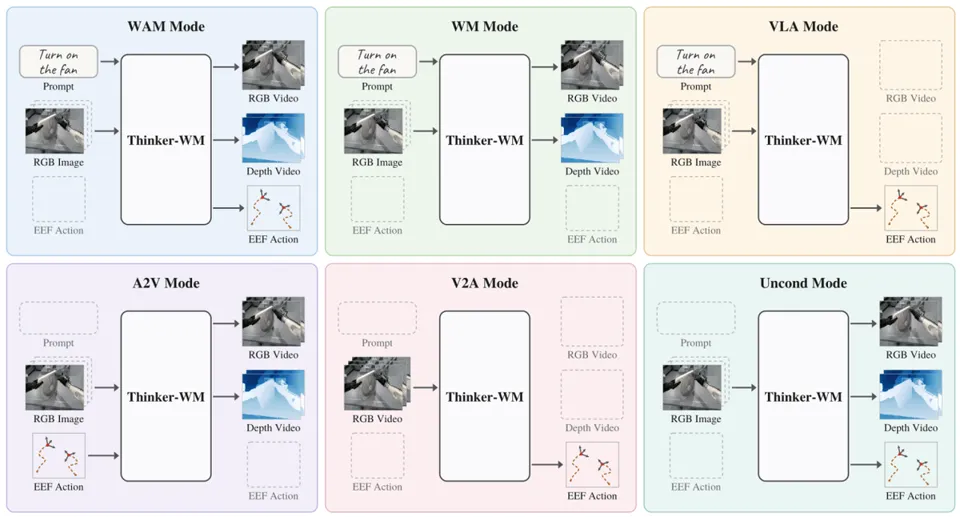
With a single set of weights, the model can predict and imagine future frames, reverse-infer robot execution trajectories, and extract action information from videos. This is precisely the core technical dividend brought about by unified representations.
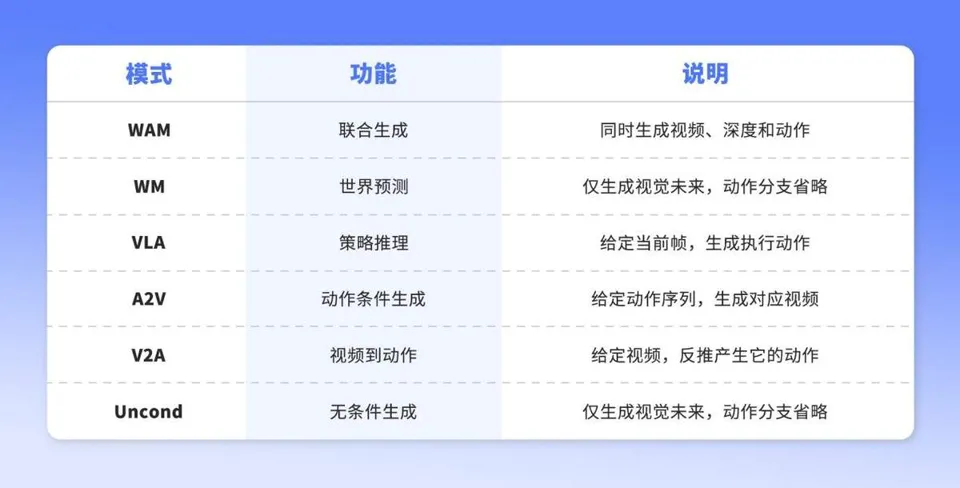
04 30,000 Hours of Heterogeneous Data Underpinning a General-Purpose World Model Foundation
Behind the unified representation capability lies UBTECH’s extensive and diverse training data. The Thinker-WM training corpus boasts significant volume in the field of embodied intelligence:
- ~20,000 hours of first-person human videos: Covering home, commercial retail, and industrial scenarios, these compensate for the lack of task, object, and scene diversity that is difficult to obtain cost-effectively via robot teleoperation. They are accompanied by ~1,000 hours of aligned depth data.
- ~10,000 hours of real-world robot data: Sourced from robots with various morphologies, this provides paired supervision of visual observations and executable actions, including ~3,000 hours of aligned depth annotations.
- ~1,000 hours of simulation data: Providing high-precision geometric and physical supervision signals.
Action spaces, coordinate systems, and control protocols vary significantly across different robots. Thinker-WM’s unification principle applies not only to the model architecture but also to data selection. The model uniformly represents all robot actions using end-effector poses while embedding exclusive tags for different robots within tokens. This allows robots of varying morphologies to share the same generative space while retaining precise proprioceptive control capabilities.
05 Data Infrastructure: Efficiently Supporting Unified Model Training with Massive Heterogeneous Data
Transforming massive data into model capabilities requires stable and efficient data infrastructure. Facing differences in format, modality, and annotation across robot data, human videos, and simulation data, UBTECH’s Thinker team built the "Data Factory." This decouples data management from training sampling, allowing multi-source data to be flexibly combined according to model requirements.
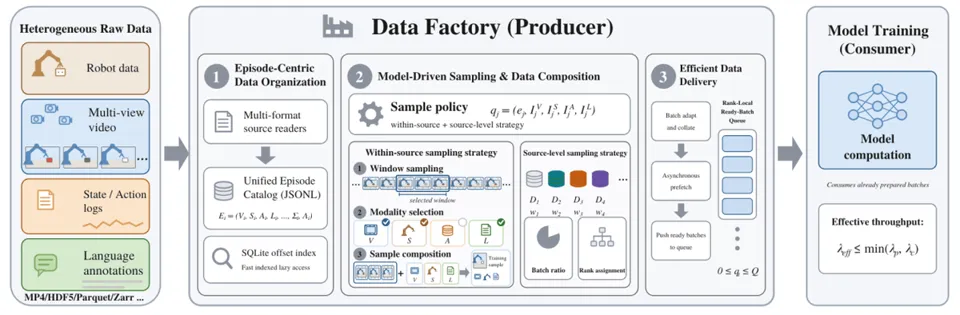
Data Factory: From Multi-Source Heterogeneous Data to Unified Model Training
The Data Factory supports training through three key stages: Unified Organization of video, state, action, and language information to generate samples required for different training modes on demand; Hierarchical Quality Inspection to filter anomalous segments and verify depth-video alignment, ensuring reliable training signals; and Asynchronous Prefetching and Encoding Reuse to pre-prepare training data, reducing wait times and redundant computation.
This data infrastructure enables reliable organization, flexible invocation, and efficient supply of multi-source heterogeneous data, providing engineering support for the joint training and continuous iteration of Thinker-WM’s six capability modes.
06 Validating True Cross-Modal Representation Coupling via Lightweight Motion Probe Experiments
Unifying multimodal representations at the feature level sounds like an architectural innovation, but a core question remains: Does the model truly learn the coupling relationships between vision, geometry, and actions within a shared space, or does it merely process multiple streams in parallel, simply juxtaposing different modalities?
To answer this, UBTECH’s Thinker team designed a lightweight "Motion Probe" validation experiment. The research team attached a minimal motion prediction head to frozen UDT visual representations, training only this head to see if end-effector displacement could be recovered from pure visual features.
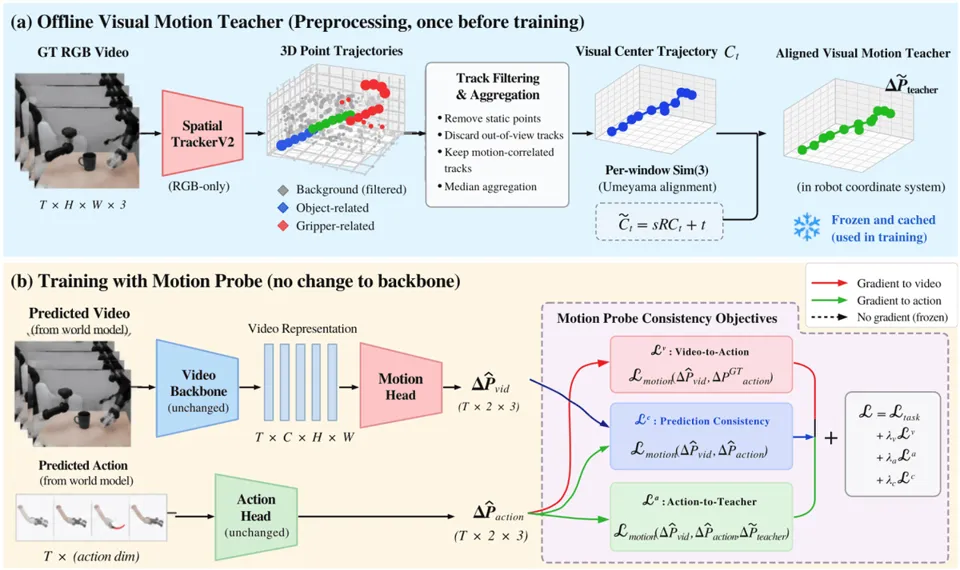
Motion Probe Diagram
Experimental results confirmed the hypothesis: The probe’s prediction error was very low. Even without action supervision, motion information related to actions is already encoded within the visual representations. This result directly proves that multimodal unification at the representation level is genuinely effective. Visual perception and action planning are not two independent pipelines but achieve deep coupling within a shared latent space.
07 What This Means
This further indicates that the value of Thinker-WM’s current technological breakthrough extends far beyond leaderboard achievements. It points toward a new underlying paradigm for embodied world models:
World models for embodied intelligence should not be simple combinations of a "video generator + policy head," but rather a complete, unified generative process—where visual observations, spatial structures, and action planning are different expressions of the same physical world process.
When a robot can simultaneously infer frame changes, spatial structures, and action trajectories within the same representation space, its understanding of the causal logic of the physical world advances significantly. This marks a critical leap for robots from "being able to execute tasks" to "being able to understand the real world."
Thinker-WM has completed deployment verification on UBTECH’s robot platform, and related technologies will continue to empower next-generation embodied intelligent systems.
Thinker-WM’s exploration goes beyond this initial release. The model’s technical report and subsequent iterative versions will be continuously updated in UBTECH’s official embodied AI developer community, Thinker Cosmos. Plans for opening secondary development capabilities for world models and previews of technical interpretation livestreams will also be announced to developers as soon as possible. Welcome to join Thinker Cosmos (https://thinkercosmos.ubtrobot.com/) to co-build the embodied intelligence ecosystem.
Project Links
Paper Link: https://arxiv.org/abs/2610.18447
Project Address: https://thinkercosmos.ubtrobot.com/thinker-wm
Github: https://github.com/UBTECH-Robot/Thinker-WM
Huggingface: https://huggingface.co/UBTECH-Robotics/Thinker-WM
This article is provided by UBTECH and reprinted with permission from QbitAI. Views belong to the original authors.