InfoQ 中文 · 10/21/2026, 14:07:36
Cloudflare Open-Sources Clef Decision Models for Low-Latency AI Agents
Cloudflare has released Clef (9B/27B), open-weight models designed for AI agents to make decisions among predefined options rather than generating text. Supporting multimodal inputs (text, JSON, images), Clef outputs typed results with probabilities in a single forward pass and leverages edge GPU infrastructure for low-latency integration into agent workflows.
SOURCE COVERAGEFull Original Report
Cloudflare has launched Clef, an open-source decision model available in 9B and 27B parameter versions. Designed specifically for structured option classification, it supports multimodal inputs and probabilistic outputs. Its edge GPU hosting architecture enables low-latency inference, allowing integration into agentic decision chains and coordination with Workers AI to execute subsequent actions.
Decision-making is treated as classification, outputting typed results with probabilities, thereby eliminating the need for text generation and parsing. It supports a unified input interface for text, JSON, images, and video. The API is compatible with Typesafe AI’s Jev System One.
This content is suitable for AI engineers, agentic system architects, and SREs (who require low-latency decision services).

During its recent "Birthday Week" event, Cloudflare released Clef, a set of open-weight AI models designed to make choices among predefined options rather than generating text. Cloudflare released models with 9 billion and 27 billion parameters, along with a platform to adapt them to specific decision tasks.
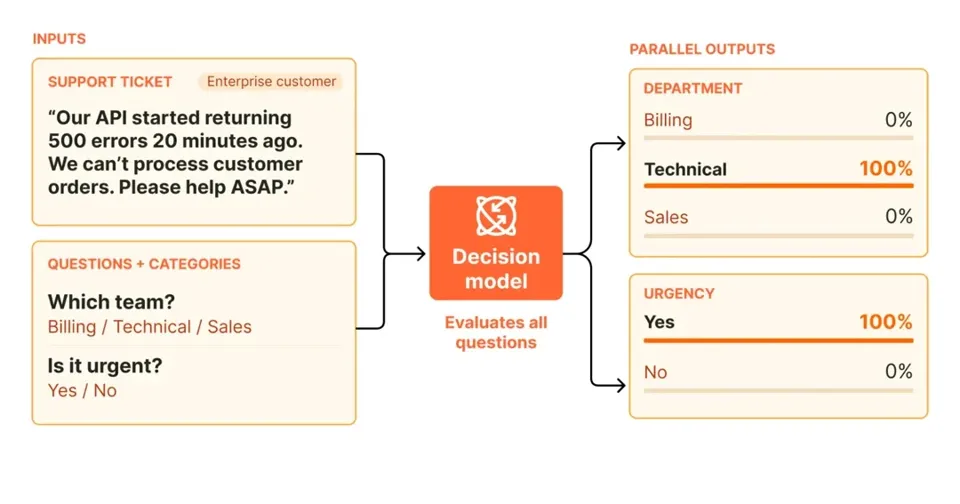
Clef is a 27-billion-parameter multimodal model that takes state and typed question schemas as input and outputs decision results. It can process text, JSON, images, or video, returning probabilities for all possible options corresponding to each question in a single forward pass, without requiring free-text generation or output parsing.
Decision models classify inputs and output typed results accompanied by probabilities. AI agents can leverage these results to determine subsequent actions, such as assigning customer service tickets, escalating issues, or handing decisions over to human operators. Cloudflare’s API is compatible with Typesafe AI’s Jev System One model.
Michelle Chen, Product Group Manager at Cloudflare, Alex Reneau, Principal Machine Learning Engineer, and Kevin Flansburg, Senior Engineering Manager, wrote:
Since the models are hosted on Cloudflare’s infrastructure, we can utilize edge GPUs to achieve lower network latency and faster decision-making. This means you can place Clef at the core path of agentic decision-making and combine it with an LLM on Workers AI to execute follow-up operations.
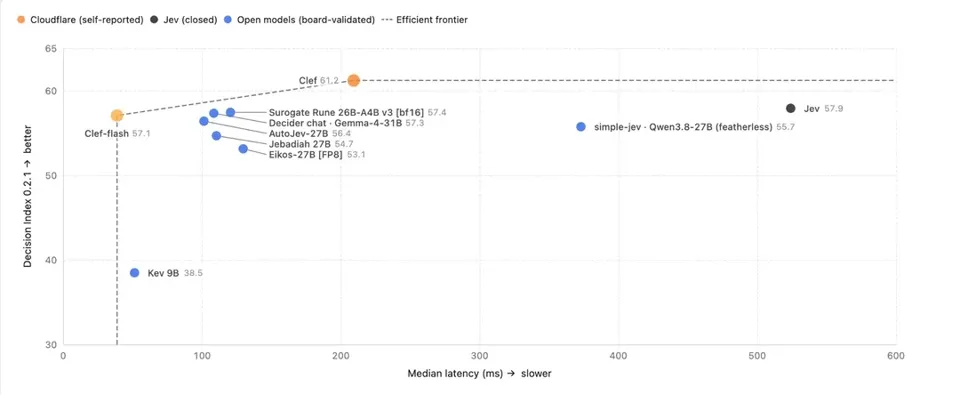
Cloudflare also released Clef-Flash, a smaller 9-billion-parameter multimodal model designed for latency-sensitive decision scenarios. In Cloudflare’s benchmarks, it achieved a median latency of 38.8 milliseconds, compared to 209.3 milliseconds for the 27-billion-parameter Clef model. Chen, Reneau, and Flansburg explained how Clef differs from other decision models:
First, it includes a vision encoder, enabling it to accept images and classify visual content. This differs from Jev, which currently only performs text classification. Second, our model features a 64k context window (compared to Jev’s 32k), allowing users to include more input states for the model to classify.
In a popular discussion thread on Hacker News, the community debated decision models, latency, open weights, and whether this constitutes a new model category. Jacek Złydach commented:
This isn’t a “new paradigm,” but rather low-hanging fruit that has been available for years; Typesafe was just the first to stop and pick it, then market it heavily.
Benchmark results sparked further skepticism, with user SebastianSosa warning:
Public benchmarks are easy to game. If I were Typesafe, I would also release public benchmarks to distract professionals, encouraging everyone to fit the benchmarks rather than building truly useful things.
Cloudflare plans to fine-tune Clef for scenarios such as customer service ticket triage and bot detection, leveraging its own historical labeled data to improve model accuracy and speed. On Reddit, user bugra_sa commented:
I care less about raw accuracy scores and more about whether Clef knows when to abstain from making a judgment. Test it on cases where false positives are far more costly than false negatives, then introduce sufficiently large perturbations to the data and observe when its confidence collapses. If it maintains high confidence in such situations, the benchmark numbers don’t mean much.
Cloudflare also announced a fine-tuning service, allowing customers to adapt Clef using their own data. Initially supported by Cloudflare engineers, a self-service platform is planned for future release, though no exact date has been announced.
Cloudflare has made the Clef model available through Workers AI and provides downloadable weights on Hugging Face, inviting developers to experiment and provide feedback.
View the original English article: https://www.infoq.com/news/2026/10/clef-decision-models/