InfoQ 中文 · 10/9/2026, 17:24:41
Google Cloud Launches Gemini Agent: Introduces 'Coworker' Identity and Multi-Model Orchestration
Google Cloud unveiled Gemini Agent at the Gemini at Work 2026 event, introducing the concept of 'Coworker Agents' that possess independent enterprise identities including email, calendar, and persistent storage. The agent executes cross-application tasks via a single prompt, supports sub-agent collaboration, and breaks model lock-in by currently integrating Anthropic Claude with plans for broader multi-model support. It is currently in private preview for enterprise knowledge work scenarios.
SOURCE COVERAGEFull Original Report
Contents5 sections
Gemini Agent is a general-purpose office agent launched by Google Cloud, capable of executing knowledge work, content creation, and code execution via a single prompt box. It supports the creation of collaborative sub-agents and pioneers the "Coworker Agent" design, granting agents organizational identities such as corporate email, calendars, and persistent storage.
It supports multi-model invocation, currently compatible with Claude, with plans to expand to other closed-source and open-source models.
The Coworker Agent enables long-term context awareness and team-level collaboration, functioning not as a temporary tool but as an organizational member.
Target Audience: AI Platform Engineers, Enterprise IT Architects, SaaS Product Leaders

Author | Lin Qibei Editor | Cai Fangfang
AI Agents have evolved into "digital colleagues."
Today, AI Agents can possess their own corporate emails, calendars, and cloud drives. They can be added to work groups like regular employees, receive tasks, and even leave revision histories in documents.
On October 8, at the Gemini at Work 2026 event, Google Cloud officially launched Gemini Agent, a general-purpose AI Agent for enterprises. Thomas Kurian, CEO of Google Cloud, introduced Gemini Agent as a new universal office intelligent agent. With just a single prompt box, it can handle a wide range of tasks, from knowledge work and Q&A to content creation and code execution.
Furthermore, Gemini Agent can create multiple sub-agents for collaboration. More notably, Google has introduced the concept of the "Coworker Agent": enterprises can assign dedicated identities to agents, including email addresses, calendars, and persistent storage spaces, enabling them to participate in long-term workflows as team members.
Regarding underlying model selection, Google has not restricted the Agent to the Gemini model series alone. According to official documentation, Gemini Agent currently supports invoking Anthropic's Claude, with plans to integrate other closed-source and open-source models in the future.
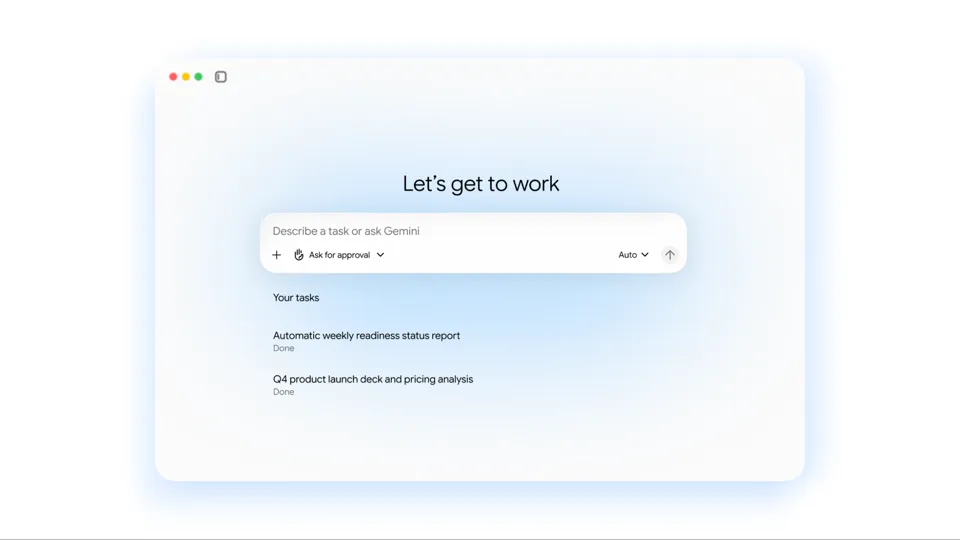
One Agent Handles Cross-Application Office Tasks
Google defines Gemini Agent as a "Single, Universal Agent for Work."
According to Google, users do not need to instruct the Agent step-by-step on which apps to open, which files to search, or what operations to perform. Instead, they can directly describe the desired work objective. Gemini Agent then plans the execution steps, selects the necessary tools, and completes tasks across relevant applications.
Currently, Google has announced support for Workspace products including Gmail, Google Drive, Docs, Slides, Sheets, Chat, and Calendar. It also supports connections to third-party enterprise software such as Microsoft 365, Slack, Confluence, Salesforce, ServiceNow, and Jira.
For example, when scheduling a meeting, a user can ask Gemini Agent to organize a meeting next week with regional activity leads, without providing each attendee's name and email address. In Google's demo scenarios, Gemini identifies relevant personnel from existing work groups and historical emails, checks their schedules, coordinates meeting times via email, and even contacts external participants.
Similarly, Gemini Agent handles cross-application workflows. In another demo scenario provided by Google, a user can ask Gemini Agent to research market trends, build a financial model in Sheets, and create a presentation based on the findings. Throughout this process, the Agent retains previous work context, eliminating the need for users to repeatedly explain task backgrounds across different applications.
Beyond responding to user instructions, Gemini Agent proactively identifies delegable tasks. For instance, when a user receives an email from a superior requesting a project progress report, Workspace Intelligence recognizes this task and offers an entry point to hand it over to Gemini for processing.
To support these operations, Google designed Gemini Agent with three core capabilities: Tools, Skills, and Context.
- Tools connect to existing enterprise software and data systems, supporting integration with external services via the Model Context Protocol (MCP).
- Skills store reusable task workflows, operational instructions, and domain expertise. Enterprises can establish shared registries of tools and skills for use by different teams.
In terms of memory mechanisms, Gemini Agent features four types:
- Session Memory: Saves current task context.
- Semantic Memory: Stores organizational knowledge.
- Procedural Memory: Retains working methods.
- Episodic Memory: Records historical operations.
This information operates in the cloud, allowing users to maintain relevant context when switching from desktop to mobile or interacting with the Agent across different applications. For tasks lasting hours or even days, the Agent can continue execution in the cloud even if the user shuts down their computer.
Creating Sub-Agents and Possessing Corporate Identities
In addition to cross-application execution, Gemini Agent can create sub-agents to enable multi-agent collaboration.
Google explains that Gemini Agent can dynamically create multiple sub-agents with independent identities based on task requirements, breaking down complex tasks and assigning parts to them. These sub-agents can work in parallel or sequentially, coordinating task progress through inter-agent communication.
However, Google distinguishes between two types of Agents in this release:
- Temporary Sub-Agents: Created specifically for certain tasks. They operate around clear objectives, handling decomposed parts of a larger task.
- Coworker Agents: Intelligent agents with persistent identities and fixed responsibilities, functioning as true colleagues within the organization.
Unlike ephemeral sub-agents, Coworker Agents can sustain work responsibilities across different dates and sessions. Enterprises only need to describe the required role, and Gemini will create a corresponding Agent based on those specifications. Coworker Agents can have their own Workspace accounts, including corporate email, calendar access, Google Drive storage, and an identity within the company directory. This means employees can collaborate with these Agents just as they would with human colleagues—adding them to Google Chat groups or assigning tasks via @mentions.
Google provided an example involving a marketing team: A marketing manager could ask the event coordination Agent in a work group chat to draft a product launch readiness document. Once completed, the Agent can send the document directly back to the group. Employees can also mention this Agent in Google Docs comments to request revision suggestions. The Agent replies to comments under its own identity, and its edit history displays the Agent’s name.
A key distinction in this mechanism is that Coworker Agents operate using their own identities rather than impersonating the employee who initiated the task.
Google states that Agents can only access content explicitly shared with them by users or teams, with permissions adhering to existing Workspace file-sharing and membership management protocols. For enterprises, this implies that Agents must not only possess task-execution capabilities but also maintain independent identities that are manageable, authorizable, and auditable.
Beyond Gemini: Google’s Agents Can Also Invoke Claude
Another noteworthy technical design in this release is the separation of Agents from underlying large models. According to official documentation, the Gemini agent handles task reception, workflow planning, and execution orchestration, while the specific model used for each task can be dynamically adjusted.
Currently, this mechanism supports Google’s Gemini series models as well as Anthropic’s Claude series models. Google plans to integrate other leading closed-source and open-source models in the future.
In other words, using a Gemini agent does not mean all inference requests must be processed by Google’s proprietary models.
During execution, Gemini can select models based on task requirements or combine multiple models within complex projects.
Google also introduced a Smart Routing mechanism designed to classify workload demands, ensuring each workload achieves optimal performance at the lowest cost.
Cost control is another focus of this release. Enterprises can set hard caps on AI spending for individual projects via the Google Cloud Billing Console. The system continuously tracks token usage and sandbox execution costs. When a project hits its budget limit, the corresponding Agent pauses execution, allowing administrators to resume it from the console. This approach enables enterprises to allocate costs by project and attribute AI usage expenses to different departments.
How Are Permissions Managed When Agents Have Independent Identities?
When Agents can access enterprise data, modify documents, and execute tasks over extended periods, permission and security management become integral parts of the product design.
In this release, Google outlined identity, authorization, audit, and network control mechanisms tailored for Agents.
First, each Agent can have an independent identity managed under the principle of least privilege. Administrators can configure fine-grained access permissions for different Agents based on roles or tasks. When an Agent needs to connect to external systems, identity and authorization information can be transmitted via standards such as OAuth.
Second, operations performed by Agents are recorded in audit logs. Unlike attributing all actions to employees, Google allows enterprises to track execution records by Agent identity, including logs generated when an Agent launches virtual machines to run code.
Regarding execution environments, Google introduced Agent Sandbox and Agent Gateway.
The Agent Sandbox provides an isolated environment for executing tasks, while the Agent Gateway manages network communications between Agents and external systems, as well as inter-Agent communication.
Enterprises can restrict Agent behavior through unified policies. For instance, administrators can prohibit all Agents from accessing files marked with specific confidentiality levels without needing to configure each Agent individually.
Beyond general office tasks, Google announced specialized capabilities for data analytics, finance, and legal sectors. In data analytics, Gemini can invoke tools like BigQuery to generate SQL, Spark, or Python code based on natural language prompts, facilitating data queries and report generation. Specialized versions for finance and legal are currently in preview, with support for other industries to follow.
How Do Google’s Agents Differ from Meta’s Muse?
Before Google released its Gemini agents, Meta launched Muse, a personal AI Agent, in September this year, attracting significant attention.
The two products share several similarities: both support autonomous task execution based on goals, cross-application operations, user context memory, and continued processing after users leave the application. However, based on publicly disclosed product designs, their primary use cases currently differ.
Meta initially positioned Muse as a personal AI Agent focused on daily life and personal affairs management. Users can assign tasks to Muse via the app or WhatsApp, including sending emails, booking travel, shopping, and scheduling long-term plans. Muse can open browsers, fill out forms, and perform actions on behalf of users once authorized. Meta also integrated Stripe’s Link payment service into Muse to facilitate online purchases.
In contrast, Google’s Gemini agents primarily target enterprise work environments. Their scope focuses on enterprise knowledge management, office collaboration, code execution, and data analysis, connecting internal workflows through Workspace and third-party enterprise systems.
This highlights the difference in how the two products handle identity and organizational structure.
Muse’s core design revolves around the individual. Users own their Muse, providing it with personal information and application access permissions; Muse then executes tasks, manages schedules, or proactively offers suggestions based on this data.
Google goes a step further by providing identity mechanisms at the enterprise team level. Gemini agents can function not only as personal assistants but also be created as persistent Coworker Agents, each with its own email address, calendar, and corporate directory identity, enabling collaboration with multiple employees.
However, Muse is not limited to personal life scenarios. On September 29, Meta launched Muse for Small Business, adding integration capabilities with tools such as Asana, Canva, Notion, Shopify, Slack, Stripe, and Zoom. This allows merchants to analyze sales data, formulate marketing plans, and handle operational tasks. Additionally, Meta announced the establishment of the Meta Enterprise Platform, planning to further push products like Muse, Muse API, and Muse Code into the enterprise market.
Fundamentally, both agents serve the role of completing specific tasks on behalf of users. Therefore, how tasks are executed, how permissions are managed, and how security is ensured warrant closer attention. Regarding underlying execution and security architecture, Meta provides a dedicated Muse Secure VM for Muse. Each user’s agent runs in an isolated cloud virtual machine, with data and credentials required for service connections stored within the corresponding secure environment. It also includes a separate Sentinel Agent to monitor outbound operations and request user authorization when sensitive actions are involved—for example, sending emails or making purchases requires user confirmation.
Google’s Gemini agent similarly offers an isolated execution environment but places greater emphasis on enterprise-grade identities, access permissions, and unified policy management. Its Agent Sandbox handles task isolation, while the Agent Gateway enforces network access policies. Enterprise administrators can centrally view operation logs, configure permissions, and set cost limits.
Model scheduling choices represent one of the most significant differences between the two. Muse is powered by the Muse Spark model. Google, on the other hand, explicitly positions multi-model orchestration as an architectural capability of the Gemini agent, supporting selection among models such as Gemini and Claude.
In terms of availability, Muse is currently available to users in the United States and Canada, offering basic features for free alongside subscription plans. The enterprise version of the Gemini agent introduced by Google remains in private preview, with no official release date or complete pricing information yet disclosed for general enterprise customers.