量子位官网 · 10/17/2026, 20:10:35
Tsinghua Open-Sources PilotDeck: Editable Agent Memory Cuts Costs by 83%
Tsinghua University and partners have open-sourced PilotDeck 2.0, an agent operating system designed to tackle context pollution and high inference costs in long-running AI agents. The system features a 'WorkSpace' architecture for editable, isolated memory management and intelligent model routing that reduces token consumption for complex tasks by approximately 83%.
SOURCE COVERAGEFull Original Report
Contents2 sections
Mengyao, reporting from Aofeisi QbitAI | WeChat Official Account: QbitAI
Tsinghua University recently launched an open-source agent operating system, designed to tackle the persistent "pain points" encountered when AI Agents perform tasks?!
This system, named PilotDeck 2.0, was jointly released by Tsinghua University's THUNLP Lab in collaboration with ModelBest and OpenBMB teams.
Coincidentally, the problems it addresses are strongly correlated with the most frustrating issues we face when using AI Agents for work—
For instance… when juggling multiple projects, files, memories, and tasks all get mixed up, leaving us bewildered… (lol)
When tasks become complex, Tokens burn rapidly; the moment you step away from your computer, the AI gets stuck halfway waiting for instructions *1000 times…
PilotDeck 2.0 targets exactly these headache-inducing legacy bugs—memory management, task execution, and model invocation costs.

As a thoughtful assistant, I’ve summarized what this tool can actually do for us and which daily hassles it resolves—
- Project Management: Handle multiple projects simultaneously, isolating files, memory, and tasks to reduce data mixing and task cross-contamination.
- Long-term Memory: Remember project context, user preferences, and work progress, supporting viewing and editing to avoid repetitive explanations.
- Background Execution: Support running long-cycle tasks in the background and checking executable items, allowing the AI to continue working even when the user is away.
- Intelligent Routing: Select appropriate models based on task difficulty—using powerful models for complex tasks and low-cost models for simple ones—to reduce unnecessary expenses.
In terms of performance on the Workbuddy Bench evaluation, PilotDeck scored 79.1 using Qwen3.6-35B-A3B, outperforming Claude Code (77.3).
Furthermore, by adopting a scheduling approach where strong models handle decision-making and smaller models perform routine tasks, the cost of complex long-running tasks can be reduced by nearly five-sixths??
Sounds pretty practical, doesn’t it???
AI Gets Its Own Workspace: Managing Memory, Files, and Tasks
Many of us probably feel this way…
One of our biggest fears when using various AI tools is "context contamination."
For example, just after asking the AI to write a technical architecture document in a serious academic style, if you then ask it to write copy for Xiaohongshu (Little Red Book), it might still keep talking about architectural decoupling… (lol)
Behind this dramatic scenario lies primarily the "black box" problem inherent in the memory systems of most existing Agents.
In other words, we have no idea what the AI has remembered, when it remembered it, or where it stored it—we are completely in the dark.
If it mistakenly records a key business logic midway, finding the source of the error is difficult. Ultimately, we often have to abandon the entire conversation and start over!!!

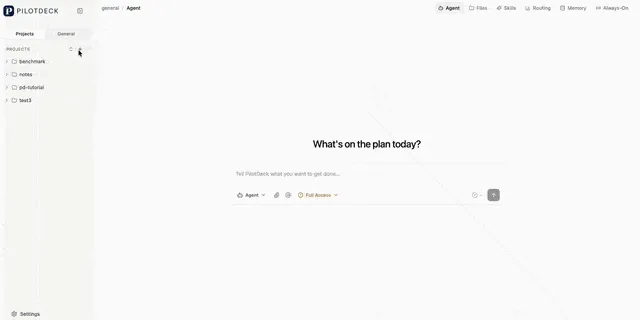
The core underlying architecture of PilotDeck uses the WorkSpace as its basic unit.
You can think of it as assigning independent physical workstations to the AI, where each project has its own dedicated file system, memory library, and skill set.
Here’s a specific example provided officially—
Working on audio/video editing in WorkSpace A and iOS mini-games in WorkSpace B ensures that their memory and retrieval spaces are physically isolated, preventing any interference between them.
This way, even when handling multiple tasks simultaneously, each retains its own context, reducing issues like memory cross-talk and task deviation:
More importantly, PilotDeck makes memory fully "white-boxed."
For instance, if the AI suddenly says, "I remember you prefer this writing style," you might not know where it got that conclusion or whether it’s mistaken!!
White-box memory solves this problem by giving users the ability to "audit the books" at any time—
The entire chain, from memory generation, extraction, and storage to final invocation, is completely visible to the user.
For example, you can click on the panel to view line-by-line which preferences and facts the AI recorded during its work.
If you find that it misremembered a critical parameter, you don’t need to painstakingly write a long Prompt trying to make it forget the incorrect information.
You can directly manually edit, delete, or even pin important information with one click~
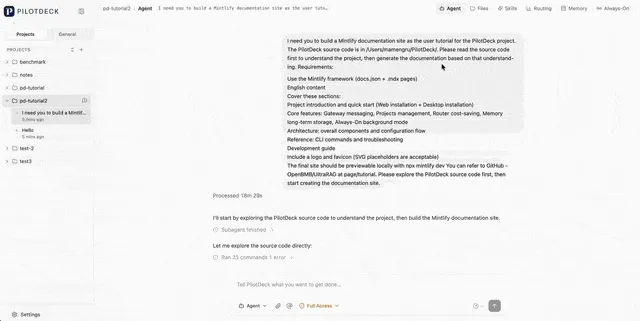
Additionally, it features a built-in mechanism called "Dream Mode."
When the AI is idle, the system automatically summarizes, refines, and deduplicates scattered interaction memories in the background.
If key details are lost during the organization process, you can roll back with one click, restoring the state to before the cleanup in seconds, so there’s no worry about things getting messier.
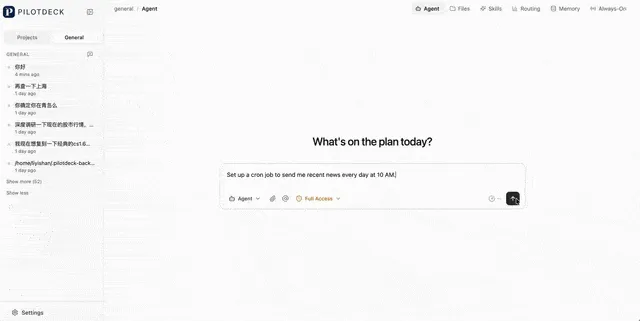
Moreover, PilotDeck introduces Always-on mode—
Even if you close the chat window or leave your computer, the Agent continues to drive long-cycle monitoring and execution tasks in the background.
It can complete established tasks, proactively discover potential candidate tasks during execution, and upon completion, deliver results as local files accompanied by a comprehensive progress and summary report.
Notably, the entire system natively supports MCP.
Whether you prefer operating via Web interface, Command Line Interface (CLI), or IM ecosystems like Enterprise WeChat or Feishu, the backend logic and behavior remain consistent.
For developers, this means they can extend tools and skills around existing workflows.
For frequent AI users, it also offers a chance to reduce the time spent repeatedly explaining background context and manually chaining steps~
"Strong Main, Weak Sub" Intelligent Routing: Outperform Top-Tier Models at 1/6th the Cost...
When running long tasks with Agents, wallet strain is often the biggest deterrent.
Often, the tasks aren’t difficult—they might just involve formatting text segments or applying templates to multilingual translations—
But because the system architecture is simplistic, it relentlessly runs the most expensive flagship models throughout, leading to exaggerated Token consumption…
Notably, PilotDeck has implemented Smart Routing.
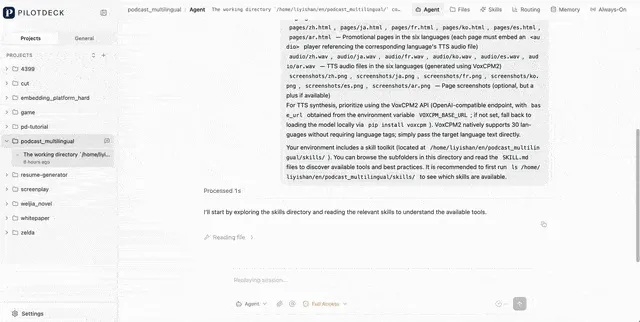
It features built-in task difficulty recognition at the underlying layer, decomposing tasks across different stages and distributing them to models of varying tiers, thereby implementing a device-cloud collaborative and hierarchical orchestration system.
Complex planning and decision-making are handled by top-tier large models, while low-level execution, polishing, and formatting tasks are downgraded to lightweight models.
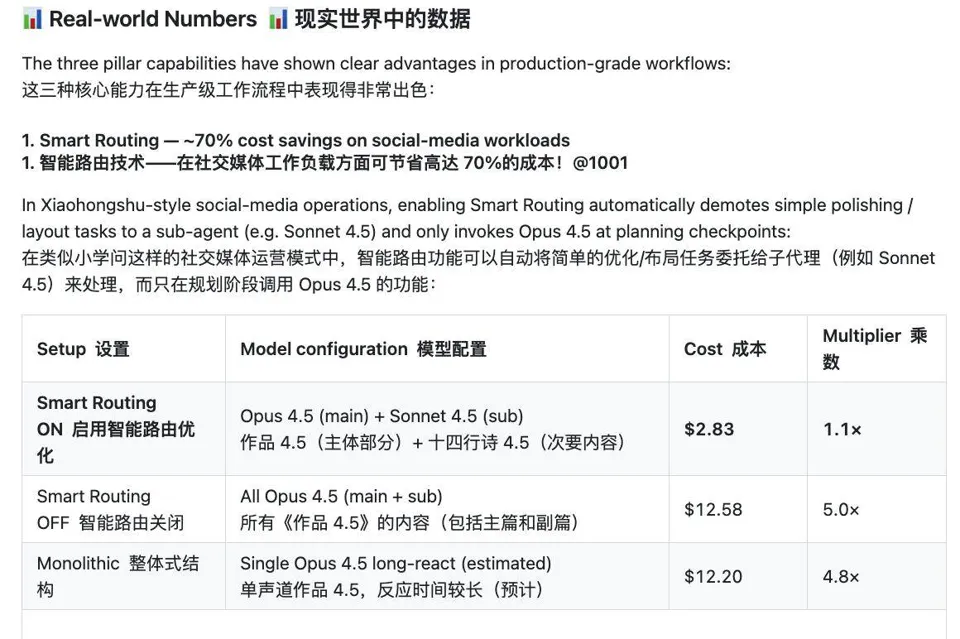
In real-world tests for social media content operations, running the entire workflow with Claude Opus 4.5 without cost-saving routing resulted in a single-run expense as high as $12.58.
With intelligent routing enabled, the main Agent handles top-level planning using Opus 4.5, while sub-Agents handle text polishing using Sonnet 4.5.
The cost dropped to $2.83, saving approximately 70% of expenses, as shown below:
Furthermore, in more rigorous complex task benchmarks, this performance gap becomes even more pronounced??
The research team conducted a horizontal comparison across seven high-difficulty complex tasks, including multilingual podcast distribution, multi-source data reporting, domain-specific literature reviews, and codebase architecture documentation:
Running solely on MiniMax-M2.7 kept costs low ($1.90), but the score was only 37.1—unusable and effectively ruled out...
Running solely on Claude Sonnet 4.6 achieved a score of 69.1, but each test run burned through $18.36.
Under PilotDeck’s routing orchestration, adopting a "strong-main, weak-sub" architecture (Main: Sonnet 4.6 + Sub: MiniMax-M2.7), the composite score surged to 70.6, with costs reduced to just $3.15.
This approach not only outperformed pure top-tier monolithic models but also reduced costs to roughly one-sixth of those models.

Additionally, PilotDeck is released under the AGPL-3.0 open-source license, supports macOS, Linux, and Windows, and offers Docker deployment options.
If you’re interested, feel free to try it out—the GitHub link is provided below~
References: [1] https://github.com/OpenBMB/PilotDeck [2] https://x.com/OpenBMB/status/2110364065822646570