量子位官网 · 10/9/2026, 08:16:56
Google Launches Gemini Agent: Enables Autonomous Task Planning and Cross-Model Integration with Claude
Google has officially launched the Gemini Agent, a general-purpose office intelligent agent that shifts from single-model assistance to autonomous, long-running agents. Key breakthroughs include goal-oriented interaction where the agent autonomously plans tasks across applications, and a multi-model routing mechanism that allows dynamic invocation of third-party models like Anthropic's Claude. By assigning AI independent enterprise identities (email, calendar), it aims to redefine standards for enterprise workflow automation.
SOURCE COVERAGEFull Original Report
Alright, alright—Google has officially joined the office agent fray, and with its emphasis on multi-model orchestration, it’s even integrated its competitor Claude!
Early this morning, Google Cloud published a lengthy article titled "Welcome to Gemini at Work 2026: Introducing the Gemini Agent," personally signed by Google Cloud CEO Thomas Kurian. The post details a series of updates regarding Gemini in the enterprise agent space.
The headline feature is undoubtedly the newly launched Gemini Agent.
According to Google’s vision, this will be a general-purpose office agent capable of long-running operations across various work tasks.
It can help you research information, draft emails, create presentations, analyze data, write and execute code, invoke tools across applications, autonomously plan tasks, and summon multiple sub-agents when necessary.
There are two particularly noteworthy aspects.
First, it can possess its own corporate identity, becoming an AI colleague with an email address, calendar, and independent account.
Second, it can automatically select underlying models based on the task, even invoking Anthropic’s Claude.
Wow, so Google isn’t necessarily sticking exclusively to its own Gemini anymore?
What’s even more interesting is that these newly released features seem clearly aimed at the recently heated-up office agent market.
Zuckerberg probably had the following internal monologue upon hearing this:
"Google, instead of optimizing your clumsy Gemini model, you’re turning around and coming after me????"
Gemini Agent
Google defines its working principle as follows:
You give it objectives, not instructions.
Give it goals, not step-by-step directives.
In other words, if you want the Gemini Agent to help with work, you don’t need to tell it what to do first, second, or third.
You only need to specify the desired final outcome and leave the rest for it to arrange autonomously.
Its core capabilities include a unified entry point, persistent cloud execution, cross-platform invocation, multi-agent collaboration, event triggers, and scheduled tasks.
The example cited in the article involves having it complete a market analysis report.
It can independently search and organize information, analyze relevant data, build financial models in Google Sheets, and then invoke Google Slides to generate a presentation.
Throughout this process, it selects tools and invokes different applications based on task requirements, finally delivering the completed work back to you.
You might be full of questions—Isn’t similar cross-application operation nothing new? What exactly is happening here?
Netizens were largely skeptical about this; a quick screenshot of the official announcement tweet shows a vibe that was anything but positive:
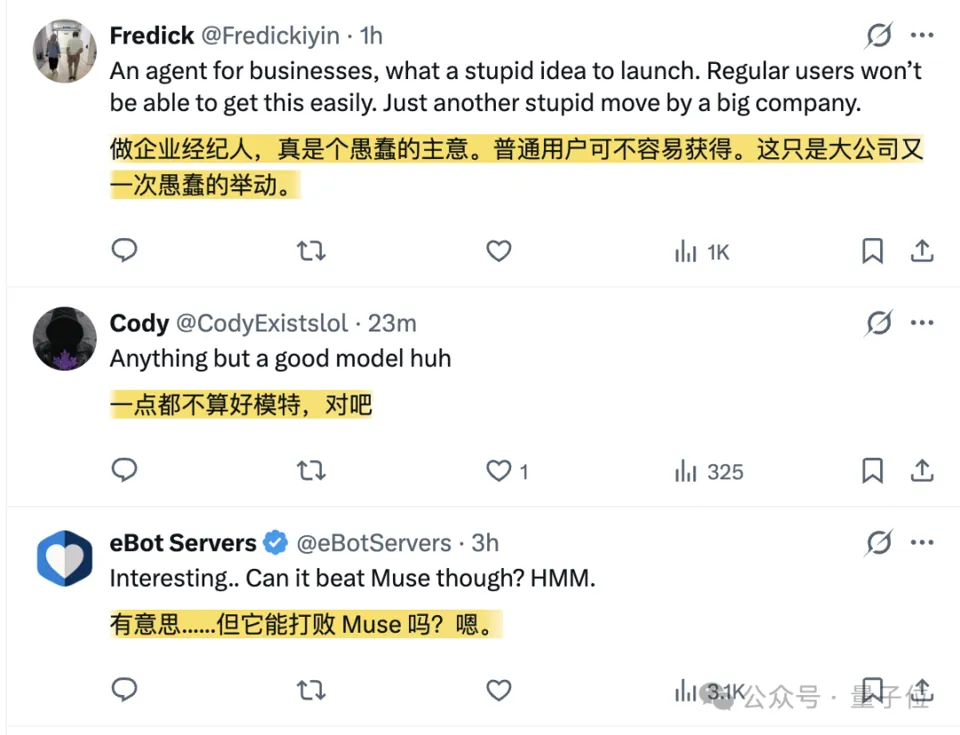
However, what Google emphasizes with this release of the Gemini Agent is the attempt to consolidate various work capabilities into a single Agent.
What’s different?
Under the broader Gemini Agent framework, Google also introduced the Coworker Agent, literally translated as "Colleague Agent."
Google now allows enterprises to create a long-standing identity for Gemini with defined job responsibilities, enabling it to participate in daily collaboration like any other team member.
Moreover, this AI colleague is configured with an independent Google Workspace account, corporate email, calendar, Google Drive storage... and can even appear in the company directory.
First, the barrier to entry is virtually non-existent. Second, once created, team members can invite it into Google Chat groups or @mention it in documents just as they would a regular colleague.
The AI colleague operates using its own identity, leaving its own records for executed actions, which facilitates enterprise management and tracking of exactly what it has done.
Up to this point, it still seems quite normal...
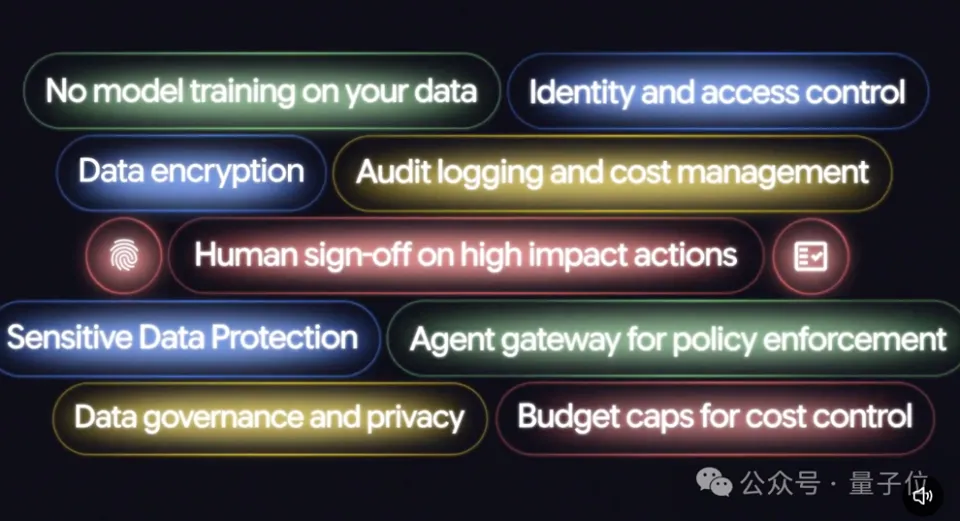
What’s somewhat unique is that, beyond its independent identity, the Gemini Agent has acquired a more comprehensive memory mechanism.
According to the official introduction, it possesses four types of memory.
The first is Session Memory.
This is primarily used to save the context of the current task.
Even if a task spans several days, Gemini Agent remembers which steps have been completed and what work remains.
The second type is Semantic Memory.
Gemini Agent accumulates knowledge from documents it reads, interactions with humans, and collaboration with other agents, organizing this information into a structured knowledge base.
For example, it can remember the company's product lineup, team members' respective responsibilities, and the specific internal definitions of business terminology.
The third type is Procedural Memory.
This primarily records how a specific task should be completed.
For instance, it notes what data is required for a certain type of report, the analytical process to follow, and the final delivery format.
A notable detail here is that Gemini Agent can even write its own Skills, saving methods learned during workflows for use in subsequent tasks.
The fourth type is Episodic Memory.
This records past completed tasks and the corresponding execution experiences.
By combining these four types of memory, Gemini Agent gradually becomes familiar with users' work habits, company operations, and team collaboration styles.
For example, when asked to generate a project weekly report for the first time, you might need to explain the report structure, data sources, and workflow.
By the second or third time, it can leverage previously accumulated knowledge and methods, reducing the amount of context you need to provide again.
Google used a specific analogy: "Gemini will act like a new employee, gradually getting to know you, your tools, and your team before officially starting work."
Well then.
Now it can handle onboarding training all by itself.

The only issue is, this employee doesn't seem to quit voluntarily (insert smiling face emoji here).
Additionally, this system can select the underlying large model for each task.
Google explicitly stated that the base models for Gemini Agent can be chosen independently.
At present, it dynamically selects between Google's own Gemini series and Anthropic's Claude series, with plans to support more closed-source and open-source models in the future.
Regarding which model to use, Gemini makes choices based on task requirements, balancing performance, speed, and cost.
For simpler tasks, it can utilize lower-cost models; for complex tasks, it can invoke more capable models.
Multiple models can also be combined within a single project to handle different stages.
Google refers to this capability as multi-model orchestration and provides Smart Routing capabilities alongside it.
It is worth noting that Google emphasized one key point—
While the underlying models may change, the context, Skills, and enterprise data accumulated by the Agent are preserved.
This ensures that the Agent does not need to understand the work from scratch every time but can continue previous tasks, knowledge, and working methods.
This means that even if model capability rankings shift in the future, enterprises can adjust their underlying models without having to rebuild established workflows from the ground up.
Is it a three-way showdown among Google, Meta, and OpenAI in the overseas daily agent market?
Google's entry comes at a rather delicate time.
Just on September 29, OpenAI released Dots, capable of working 24/7.
Prior to that, Meta launched Muse, a personal AI agent.
With Google now entering the fray with Gemini Agent, the three giants have effectively converged on the agent space.
Let's review the approaches taken by the other two companies.
Meta's Muse leans more toward personal life scenarios, assisting users with shopping, booking travel, sending emails, and even completing payments.
For example, if a user spots a desired item, Muse can help find stock, compare options, navigate websites, and ultimately complete the purchase.
Compared to complex internal corporate workflows, Muse focuses more on the trivial, time-consuming aspects of daily personal life.
This is closely related to Meta's existing social products and massive user base.
Getting ordinary users accustomed to delegating needs like shopping and travel to AI is clearly an opportunity Meta aims to seize.
OpenAI's Dots shares similarities with Gemini Agent in terms of continuous operation.
Dots operates 24/7, maintaining long-term context and executing tasks autonomously over extended periods.
Like Gemini, it emphasizes persistent memory and the ability to manage ongoing projects without frequent human intervention.
However, Dots currently integrates deeply with OpenAI's ecosystem, focusing on developer-centric workflows and API-driven automation.
In contrast, Gemini Agent highlights its multi-model flexibility and enterprise-oriented memory structures.
As the competition heats up, we can expect further differentiation in how these agents handle privacy, integration, and specialized domain knowledge.
In contrast, Google’s primary focus this time is on enabling Agents to integrate more deeply into existing enterprise organizational and office workflows.
Gemini Agent can leverage business context from applications such as Gmail, Docs, Sheets, and Calendar to understand what employees are working on.
Enterprises can also create "Coworker" agents with their own dedicated email addresses, calendars, accounts, and permissions, allowing them to participate in team collaboration under their own identity.
Simultaneously, Google has integrated model selection, enterprise data connectivity, security auditing, and cost management into this framework.
Notably, even competitors like Claude can serve as underlying models invoked by Gemini agents to complete tasks.
With this overview, the distinct strategic focuses of the three companies become clearer.
One More Thing
BTW, Google’s detailed announcement includes other relevant content. Interested readers are encouraged to visit the source for more information. 😘
- Gemini fully integrates into Google Workspace, supporting cross-application task completion
- Open Skills, Tools, and Enterprise Connectors
- Launch of specialized agents for data analysis, finance, and legal domains
- Enhanced agent security governance and cost control
[Google Original Announcement]
https://cloud.google.com/blog/products/ai-machine-learning/welcome-to-gemini-at-work-2026/