InfoQ 中文 · 10/22/2026, 13:30:40
GitHub Migrates Copilot Runtime to Rust, Cutting Latency to 292ms
GitHub used AI assistance to migrate the Copilot CLI, app, and SDK runtime from TypeScript/Node.js to Rust, rewriting over 800k lines of code. The new architecture eliminates V8 memory overhead and supports C ABI embedding, reducing startup and interaction latency from 5.25s to 292ms while ensuring continuous delivery via an incremental replacement strategy.
SOURCE COVERAGEFull Original Report
GitHub has fully migrated the runtime for Copilot CLI, apps, and SDK from TypeScript/Node.js to Rust. AI-assisted rewriting replaced over 800,000 lines of code, reducing startup and interaction latency from 5.25 seconds to 292 milliseconds.
The Rust runtime supports C ABI embedding, eliminating V8 memory overhead (approximately 100MB) while retaining optional process isolation. An incremental replacement strategy was adopted, ensuring continuous delivery during migration via an N-API interoperability layer. The Copilot SDK now natively supports TypeScript, Python, Go, .NET, Java, and Rust.
This article is suitable for client-side architects, AI toolchain developers, and language runtime engineers.

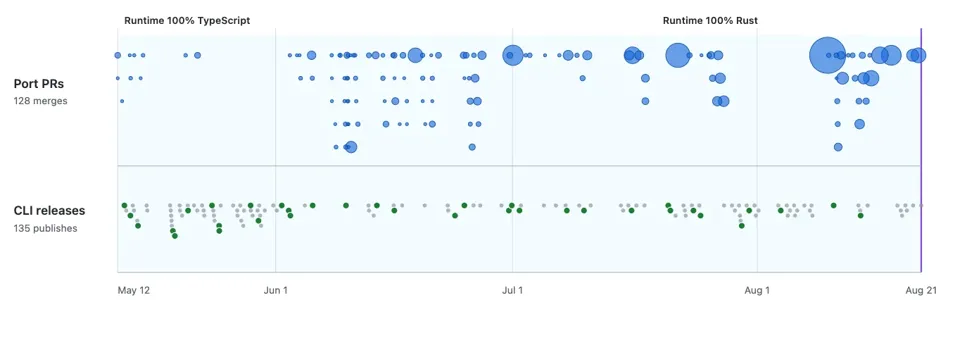
GitHub has migrated the runtime behind GitHub Copilot CLI, Copilot Apps, and Copilot SDK from TypeScript and Node.js to Rust, replacing over 800,000 lines of code through AI-assisted rewriting. This migration took approximately 14.5 weeks and involved 128 pull requests. Throughout the migration period, GitHub continued to release versions of the runtime. GitHub reported that for client startup, session creation, and single-turn interaction scenarios, the old runtime took 5.25 seconds, whereas the Rust runtime embedded in-process reduced this time to 292 milliseconds.
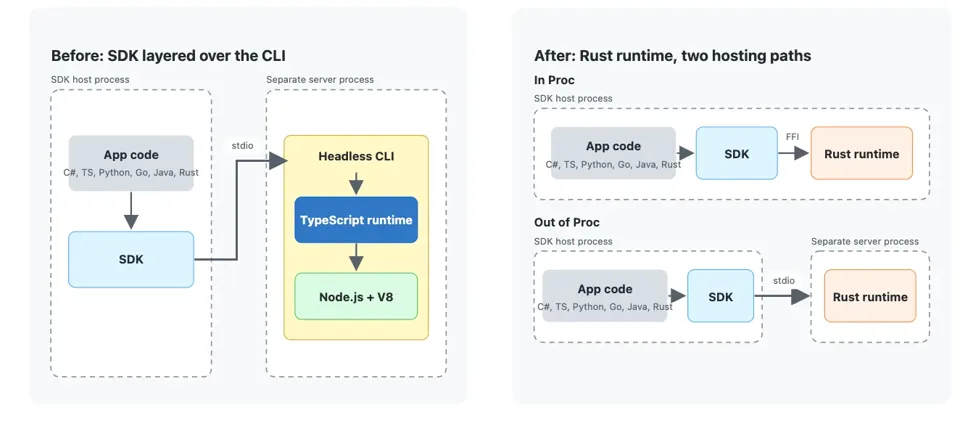
This migration also changed how applications integrate with the runtime. The previous implementation required Node.js and V8, communicating with the host application across process boundaries. GitHub stated that this added approximately 100MB of working set memory per client. In contrast, the Rust implementation can be directly embedded into host applications via C ABI, while still offering an optional standalone process mode. The Copilot SDK currently supports TypeScript, Python, Go, .NET, Java, and Rust.
GitHub adopted an incremental replacement strategy rather than performing a parallel rewrite followed by a one-time switch. Individual TypeScript components were replaced one by one with Rust implementations, connected temporarily via an N-API interoperability layer. This allowed existing end-to-end tests to validate new code even while other components remained in TypeScript. During the migration, GitHub released 135 versions, including 35 stable releases and 100 pre-releases.
Before its removal, the compatibility layer exposed 2,019 internal N-API exports and had 3,356 TypeScript call sites. As of August 21, the runtime contained 832,378 lines of production Rust code and 468,689 lines of Rust unit test code. The vast majority of the implementation code was generated by AI agents. Compilation, testing, and manual review were used to identify various regression issues, including behavioral changes, state management errors, lifecycle handling flaws, library semantic mismatches, and lost optimization logic. GitHub recorded 4,478 direct cargo check executions, with 87.1% passing validation on the first attempt.
Community reactions have focused on the verification challenges of AI-assisted migrations, noting that scenarios such as cancellation, retries, and backpressure require validation beyond compilation. User PLBjt wrote:
What’s interesting about this isn’t that Copilot uses Rust, but whether the migration can maintain stable runtime behavior at the boundaries.
Leonardo XR Tech Lead Francesco Pira noted:
Small, easily reviewable changes, compatibility layers, and human judgment by engineers are key elements of this approach.
Microsoft Senior Solutions Engineer Côme Redon pointed out:
The difficulty lies in uncovering undocumented behavioral contracts within legacy systems.
The final architecture provides a native Rust runtime that can either be embedded directly into host applications or run independently. The Copilot SDK retains language-specific interfaces across all supported languages. This migration combined AI-generated code, incremental integration, temporary compatibility boundaries, automated validation, and manual review, allowing the production runtime to continue evolving throughout the process.
View original English article: https://www.infoq.com/news/2026/10/github-copilot-rust-migration/