量子位官网 · 10/12/2026, 16:27:43
Physical AI Funding Hits $48B in 2026: Anduril Leads as Capital Builds Full Embodied Intelligence Chain
Global robotics and physical AI startups raised nearly $48 billion by October 2026, surpassing last year's total. Major rounds for Anduril ($5B) and NEURA Robotics ($1.4B) indicate capital is shifting from hardware-only bets to a full-stack strategy covering bodies, general intelligence systems, and training infrastructure.
SOURCE COVERAGEFull Original Report
Contents13 sections
Jessica, reporting from ROBO-Zhi Quantum Bit ROBO | WeChat Official Account: AI4ROBO
It’s hot—scorching hot.
The speed at which global capital is flooding into the embodied intelligence sector remains frenzied. With just over nine months of the year gone by, robotics and Physical AI companies have already secured nearly $48 billion (approx. 321.3 billion RMB) in funding, surpassing the total for last year.
What does this mean? Converted to RMB, that’s about 340 billion yuan, with an average of over $160 million (approx. 1.07 billion RMB) flowing into this field every single day.

△AI Generated
Billion-dollar funding rounds are appearing one after another, valuations of robotics startups are hitting new highs, and investors like NVIDIA, SoftBank, and Sequoia Capital are doubling down.
But amidst the hype, one can’t help but wonder: Where exactly is all this money going? Surely tens of billions invested aren’t just for a splash?
Looking through this year’s funding list reveals that capital deployment now covers multiple segments of the robotics industry. From manufacturing robot bodies and developing general-purpose intelligent systems to building training facilities and exploring practical applications, more and more companies are getting involved.
An industrial chain centered around Physical AI is taking shape at an accelerating pace.
Global Robotics Funding Hits Record Highs: Where Is the Money Going?
According to PitchBook data recently cited by the Financial Times, as of October 8, 2026, global Robotics & Physical AI companies have raised nearly $48 billion cumulatively this year.
Zooming out, annual funding for relevant companies remained largely in the $10–15 billion range from 2022 to 2024; funding scale rose significantly in 2025, and accelerated further this year, with year-to-date funding reaching approximately 1.7 times the total for all of 2025.
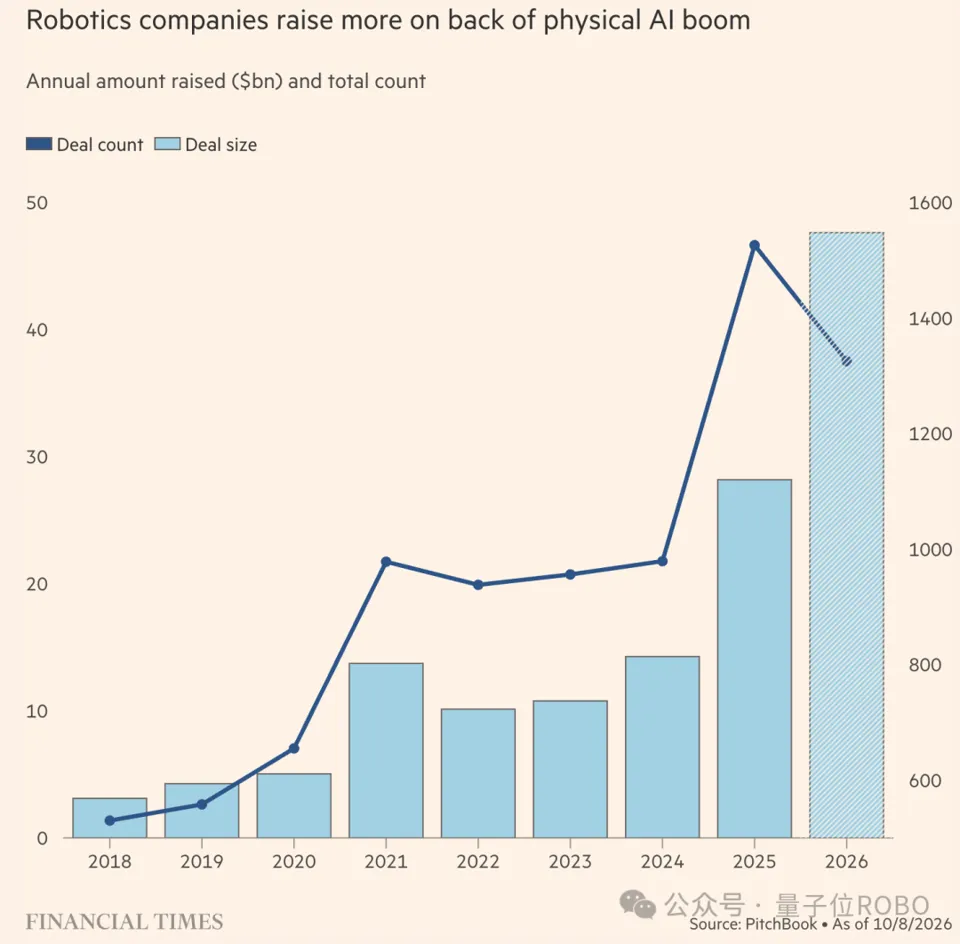
△Image Source: Financial Times
In terms of specific funding, top-tier companies are capturing a substantial portion of the capital.
For instance, US-based Physical AI company Anduril completed a **61 billion—a doubling from its previous round.
Anduril is a representative company applying Physical AI in the defense sector. This round was led by Thrive Capital and Andreessen Horowitz, making it one of the most notable large-scale financings in the sector this year.
Meanwhile, robotics companies targeting industrial, home, and other scenarios are also continuously receiving capital support.
German robotics company NEURA Robotics, which develops both robots and intelligent platforms, announced a Series C financing of up to $1.4 billion in June this year, with participants including Qualcomm, Amazon, and NVIDIA.
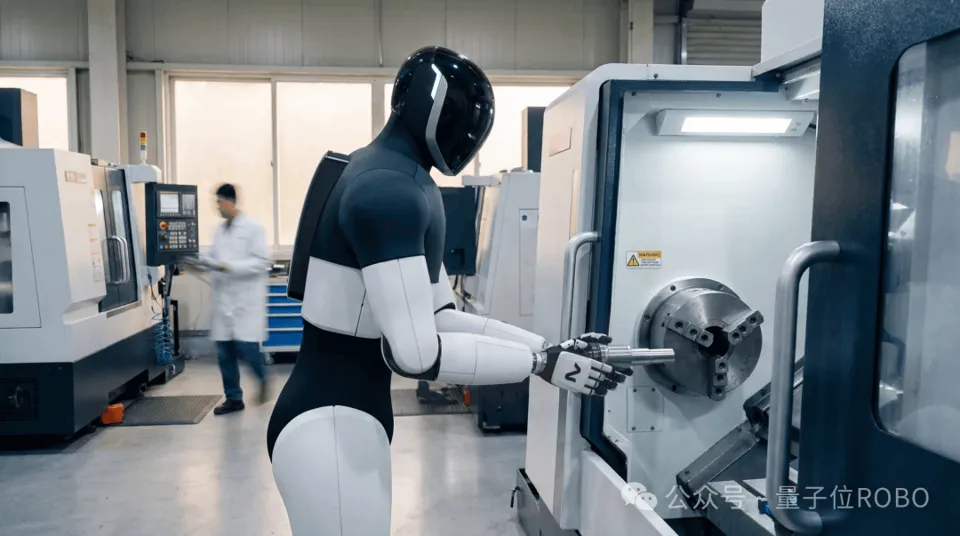
△Image Source: NEURA Robotics Official Website
If these companies are advancing robot hardware and intelligent systems simultaneously, another group of companies with staggering funding amounts is focusing on the "brain" of the robot.
For example, in January this year, US-based robot foundation model company Skild AI completed a **14 billion.
Another US company, Generalist, which is also developing general-purpose robot foundation models, announced a new **500 million. Investment arms under NVIDIA and Bezos continued to participate, and AI scientist Fei-Fei Li appeared on the list of new individual investors.
Additionally, Physical Intelligence (π) secured $1 billion in funding in Q2 this year, continuing to advance general-purpose models for various robot bodies.
While these companies have different technical focuses, they are all exploring a common direction: freeing robots from heavy reliance on pre-set programs and fixed tasks, enabling them to adapt to more real-world scenarios through learning.

△AI Generated
Capital’s enthusiasm for this direction is also reflected in the funding structure.
According to a report released by PitchBook in September this year, Robotics and Physical AI companies raised $18.6 billion in Q2 2026 alone, representing a quarter-over-quarter increase of 25.3%. However, the number of funding deals during the same period dropped by 14.1%.
Among these, three funding rounds—Anduril, NEURA Robotics, and Physical Intelligence—totaled $7.4 billion, accounting for 39.8% of the quarter’s total funding.
Even excluding these three mega-rounds, the remaining funding still amounted to $11.2 billion, a quarter-over-quarter growth of 9.9%.
Thus, current funding trends indicate a rough trajectory:
Capital continues to flow into the robotics industry, but funds are increasingly concentrating on top-tier companies and technical directions with platform potential.

The division of labor within the industry, as presented by the funding lists, has also become clearer.
Some companies are responsible for manufacturing robots and improving hardware performance; others are attempting to develop general-purpose intelligent systems adaptable to different bodies; and still others are bringing robots into factories, warehouses, and homes to explore scalable deployment.
Capital is deploying along the complete chain of robotics, from R&D and manufacturing to practical application.
However, for this chain to truly function, it faces a fundamental question.
How exactly should robots learn to work?
Hundreds of Billions in Capital Influx: Robots Are Spending Money to "Go to School" and "Hit the Gym"
This question might sound strange.
After all, Large Language Models (LLMs) are smart enough today to handle complex language tasks, even writing code, reasoning, and planning. So why is it still so difficult for robots to perform actions like picking up a cup, folding clothes, or tidying a desk?
One key reason is insufficient training data.
For LLMs, the internet has accumulated massive amounts of text, images, and videos, allowing developers to directly use them for large-scale training. But the data required for robots is far more complex.
For a robot to pick up a cup on a table, it must not only precisely identify the target but also judge its position, size, and shape, plan the motion trajectory, and control the grasping force; change the environment or the task, and it may need to readjust everything.
This information—encompassing space, motion, contact, and force—is difficult to obtain comprehensively directly from existing internet data.
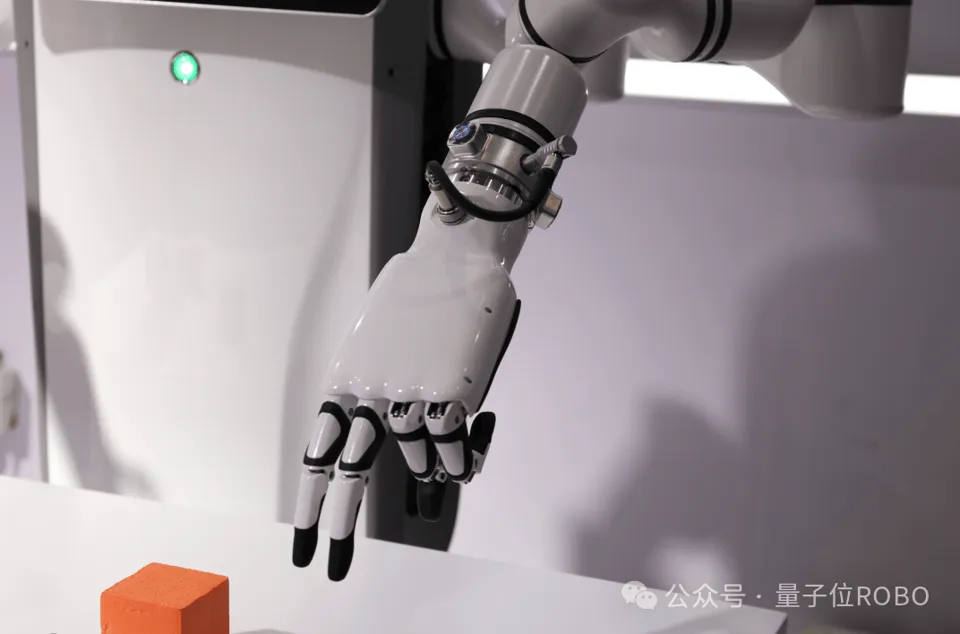
To address this challenge, robotics companies have begun experimenting with various approaches.
Perhaps the most interesting is the Index program announced in August by US humanoid robot company Figure: paying ordinary people around the world to help robots collect data.
Users record their daily tasks via the Index app, such as folding clothes, cleaning, or restocking shelves; Figure also sends specialized recording equipment, allowing participants to record according to rules and receive compensation.
These videos, after screening and processing, become training material for robots learning human movements.

△Image source: Figure official website
As of August 25, the Index app had accumulated over 264,000 downloads, covering 108 countries and regions, collecting more than 16 million video clips, and paying $15 million to data contributors.
At the data collection rate at that time, the platform received 30 minutes of video per second, equivalent to adding approximately 4.9 years of human activity records every day.
Figure also plans to invest **over 1 billion to learn how humans work.
It is worth noting that Figure initially attempted to purchase training data from third parties, but external suppliers struggled to meet requirements in terms of scale, diversity, and quality, leading them to shift toward building an in-house collection system.
Similar explorations are underway among robotics companies globally.
Physical Intelligence has deployed robots into multiple Airbnb listings in San Francisco to test their performance in unfamiliar environments; companies like Generalist, NEURA, and Skild AI are collecting data through self-built training facilities.
The Financial Times refers to these facilities as Robot Gyms—where staff operate dual-arm robots repeatedly performing tasks like moving, grasping, and organizing, while sensors on the robots simultaneously record the entire process for model training.

△AI-generated
China is also constructing similar facilities on a large scale. According to Interact Analysis statistics, as of the end of April this year, China had at least 90 humanoid robot data collection and training centers in operation, under construction, or planned, with 64 already officially in use.
As data demand continues to grow, new players are emerging.
Companies like Scale AI and Encord, which previously provided data services to large language model (LLM) providers such as OpenAI and Anthropic, are expanding their business into the robotics sector.
On October 7, Mecka, a US startup specializing in providing real-world training data, announced it had just secured a $60 million Series B round led by Sequoia Capital, with participation from NVIDIA, Microsoft’s M12, Qualcomm Ventures, Samsung, and others.
Robotics companies are competing to build their own training facilities, data companies originally serving LLMs are pivoting, and new enterprises are gaining capital support.
This indicates that robot training data is forming an independent industry segment.
But does collecting more data necessarily mean smarter robots?
This is precisely the question the industry needs to verify next.
Can Robots Learn to Work Through Massive Data?
The willingness of robotics companies to invest heavily in data stems from a technical logic validated in the field of large language models—Scaling Laws.
The rapid progress of language models like ChatGPT has proven the value of large-scale training. Now, the robotics industry hopes to find similar patterns: enabling models to master manipulation skills and adapt to new tasks through rich real-world data.

△AI-generated
Research published in August by US robotics company Dyna Robotics provides experimental evidence. Their latest world-action model, Dyna-2, was pre-trained on over 1 million hours of first-person perspective human videos, covering daily actions such as cooking, organizing items, and assembling parts.
Researchers set up comparisons across different training scales: 1,000 hours, 10,000 hours, 100,000 hours, and 1 million hours.
Results showed that across 14 real-world robotic manipulation tasks, average model performance improved from 20% to 53% as pre-training data expanded.
The task of turning a key was particularly notable: models trained on less than 100,000 hours of data failed, while the model pre-trained on 1 million hours of video achieved a 90% success rate. With only about 10 minutes of fine-tuning on robotic operation data, the pre-trained model acquired the ability to dexterously unscrew bottle caps with two hands.
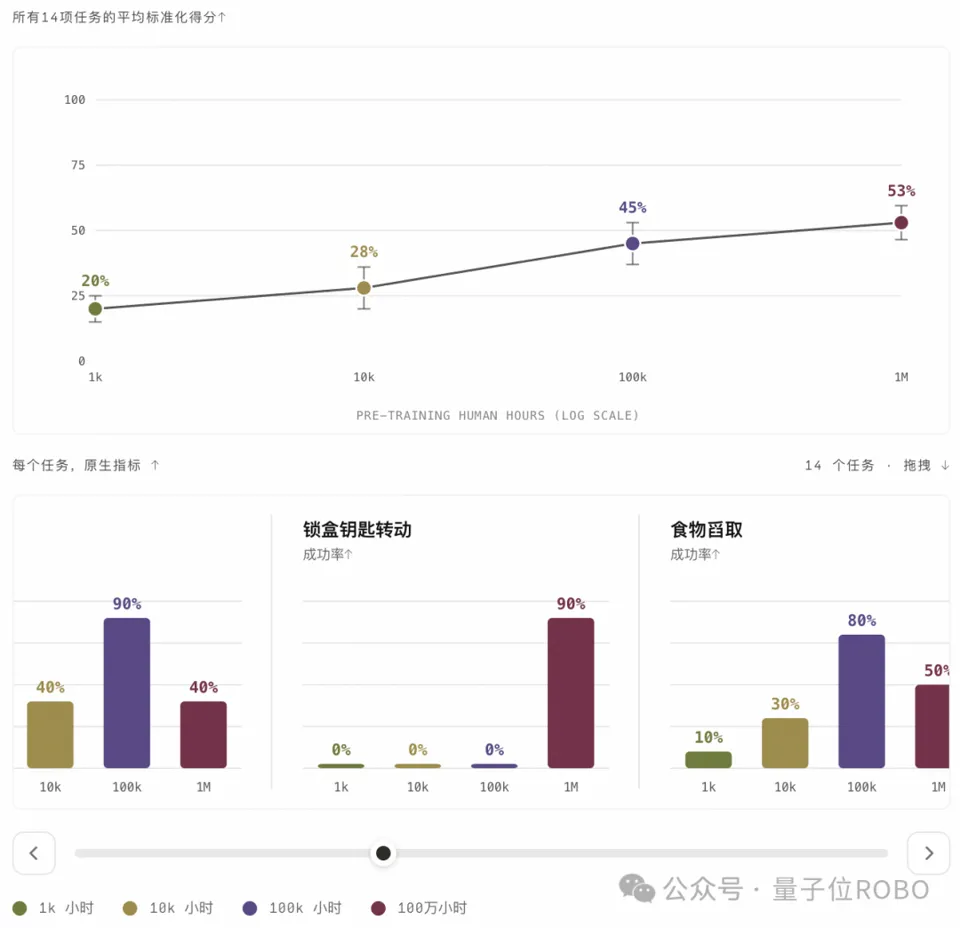
△Image source: Dyna Robotics official website
This study preliminarily proves that large-scale human video data can indeed continuously improve robotic manipulation capabilities and enhance learning efficiency for new tasks. Although the pattern still requires validation in more real-world scenarios, it at least provides a technical basis for the industry's heavy investment in data collection.
However, video quantity is only one factor; data quality, task coverage, and cross-robot transferability equally influence training effectiveness.
Therefore, beyond expanding data collection scale, the industry is exploring another path: deploying robots into real working environments to continuously accumulate experience through actual deployment.
In April this year, Skild AI announced the acquisition of Zebra Technologies' robotics business (including the former Fetch Robotics).
This acquisition gave Skild AI access to robot products and software systems already applied in warehouse logistics scenarios.
Compared to relying entirely on lab-collected data, Skild AI aims to leverage existing commercial deployments to bring general intelligence systems into real warehouses, using data generated during actual robot operations to continuously improve models.
According to operational data released by Skild AI last month, approximately 10 months after its first commercial deployment, its robot intelligence system had over 60 paying customers, with Annual Recurring Revenue (ARR) surpassing $100 million, covering sectors such as logistics, manufacturing, security, and food processing.
△Image source: Skild AI official website
The company is also collaborating with NVIDIA and Foxconn to deploy Skild Brain on dual-arm robots, exploring high-precision assembly scenarios.
From building dedicated training facilities to enabling robots to accumulate data through real-world tasks, the industry is attempting to establish more sustainable learning mechanisms.
Similar shifts can be observed in the Chinese market as well.
Earlier this year, Quantum Bit Think Tank released the 2025 Annual Report on Embodied Intelligence Startup Financing.
The report shows that in 2025, domestic embodied intelligence startups witnessed 447 financing events totaling 55.4 billion RMB, compared to just 173 events and 13.7 billion RMB in 2024. (Note: The report only counts public financing of unlisted companies, differing from PitchBook’s methodology.)
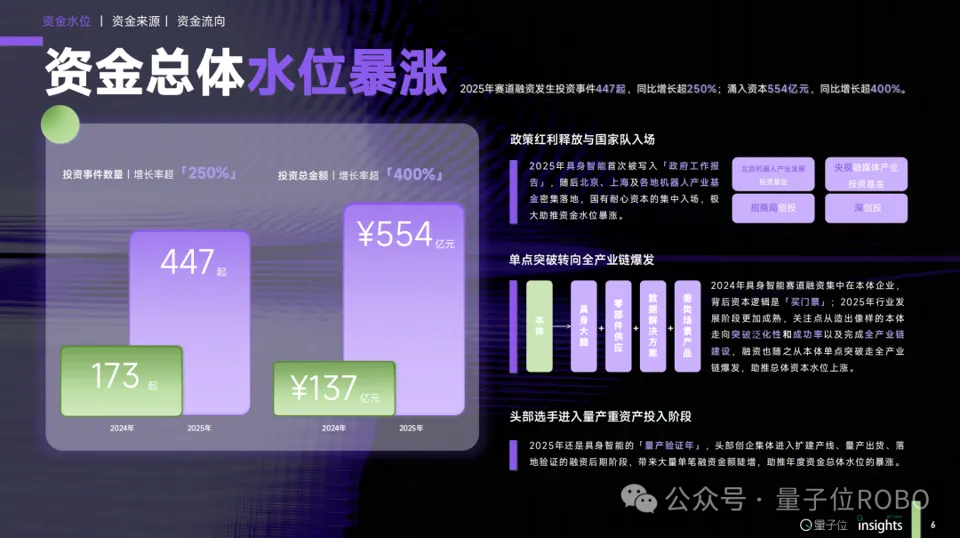
More noteworthy than the scale of capital is the shift in where the money is flowing.
Quantum Bit Think Tank found that in 2024, domestic embodied intelligence financing was concentrated on robot hardware manufacturers. By 2025, as leading companies entered mass production and deployment phases, capital began spreading across value chain segments such as embodied brains, core components, training data, and vertical applications.
Among them, Galaxy General set a new record with a single financing round of 2.031 billion RMB; synthetic data company Lightwheel Intelligent also completed a financing round worth hundreds of millions of RMB, surpassing 100 million RMB in revenue.
Meanwhile, major domestic internet companies, automakers, manufacturing enterprises, and state-owned funds are intensifying their strategic positioning.
These industrial investors bring not only capital but also supply chains, production lines, and real-world application scenarios. Strategic investments became increasingly active in 2025, with capital helping robot companies secure deployment opportunities.
This holds particular significance for the Chinese market, which boasts a massive manufacturing ecosystem.
Real production environments like factories and warehouses can both validate robot capabilities and continuously generate new training data—experience accumulated by robots across different tasks can be processed to feed back into models, supporting more complex operations.
Currently, robot companies are still spending heavily on equipment procurement, hiring personnel, and building training grounds specifically to generate data for models.
However, as robots enter actual production environments, commercial deployments themselves have the potential to become continuous sources of data. More deployments yield richer data, improved model capabilities create conditions for robots to enter new scenarios, and economies of scale extend accordingly.
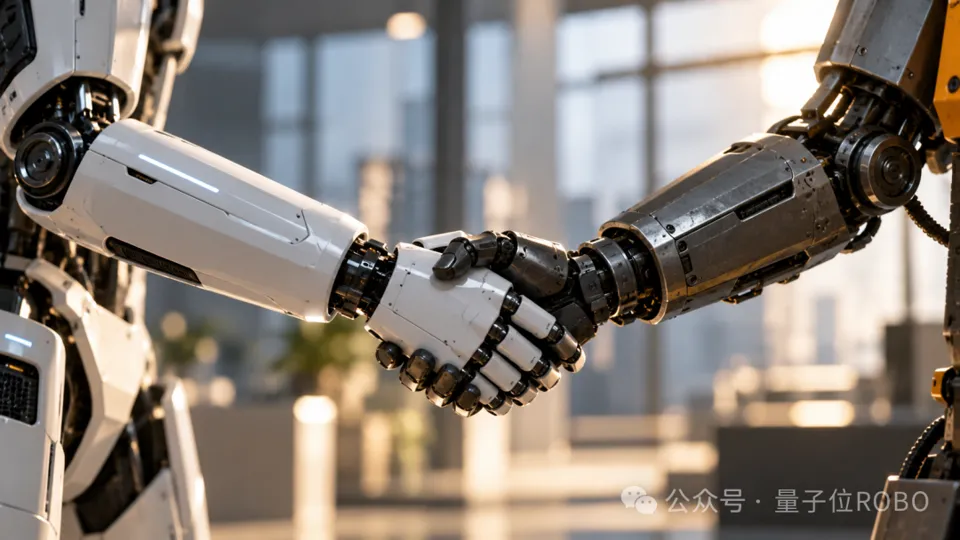
△AI-generated
Global capital is betting on foundation models, while Chinese capital is refining the industrial chain. Behind these moves lies a shared direction: Robot model companies are actively securing commercial deployment resources, while industrial investors are bringing robots into factories and production lines.
The value of real-world application scenarios is expanding from merely validating robot capabilities to supporting robot learning and evolution.
Paying people to film videos or operate robotic arms... is ultimately just a transitional phase. What is truly exciting is robots beginning to accumulate experience and improve autonomously within real work environments.
This may well be the most exhilarating industrial shift following the investment of tens of billions of dollars.