Rohan Paul (@rohanpaul_ai) · 10/16/2026, 01:06:13
Self-Evolving Agents: Validating Harness Edits on Independent Tasks to Prevent Overfitting
To mitigate overfitting and skill erasure in self-improving agents that rewrite their own prompts, memory, or code, a new admission rule requires harness edits to outperform the current version on fresh, independent tasks. By mapping evolutionary algorithms to agent framework optimization, this approach ensures robustness; notably, an evolved GPT-5.4-nano scored higher on SpreadsheetBench than a GPT-5.5 with simple skill tuning, validating the efficacy of strict validation gates.
SOURCE COVERAGEFull Original Report
Rohan Paul (@rohanpaul_ai) · 2026-10-15 17
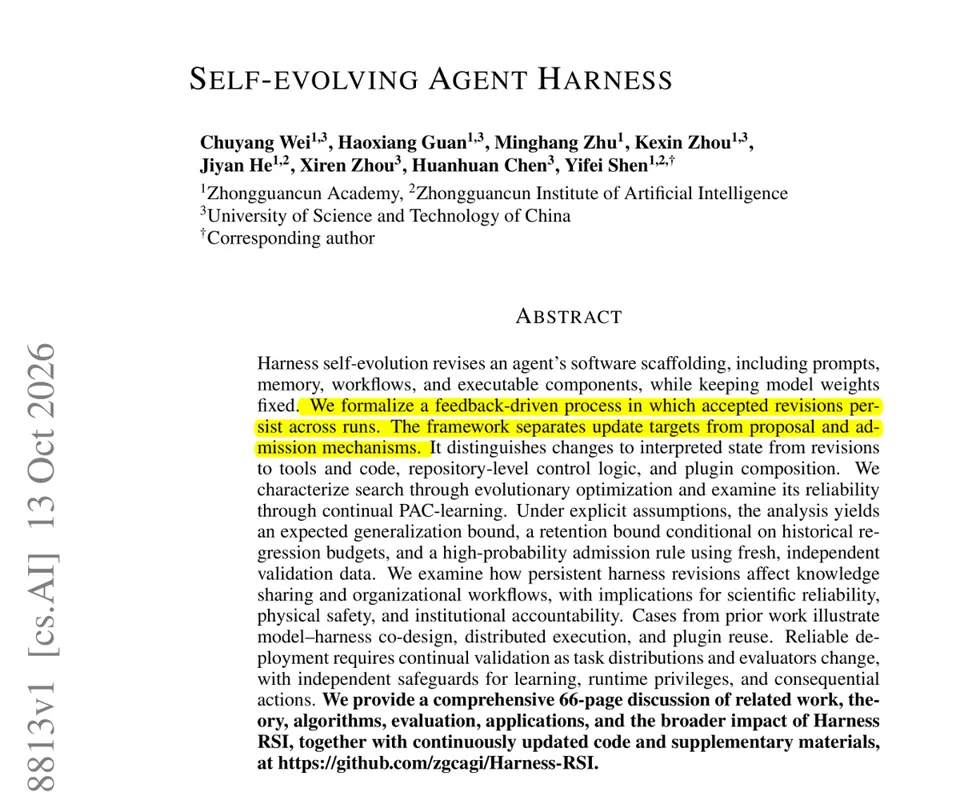
Self-improving agents should accept a harness edit only after it beats the current version on fresh, independent tasks.
It maps harness self-improvement methods onto evolutionary algorithms, from simple keep-the-best search to archives, Pareto selection, and bandit-guided budgets.
Self-improving agents now rewrite their harness: the prompts, memory, tools, and code around a fixed model. Accepted edits carry into later runs, so a bad edit can overfit, erase old skills, or spread to other users.
They sort these edits by what they change, from prompts to runtime code. Their admission rule: keep an edit only if it beats the current harness on new, independent tasks by a set margin.
In a case they compile from prior work, GPT-5.4-nano with an evolved harness and skills scored 77.58% on SpreadsheetBench. GPT-5.5 with skill tuning alone scored 76.20%, though costs were not matched.
If your agent edits its own setup, test each change on fresh tasks, and keep evaluators, permissions, and emergency stops out of its reach.