Nvidia Posts $115.8B Quarterly Revenue in First Earnings Without Huang
Nvidia reported $115.84 billion in quarterly revenue for fiscal Q3 2027, up 103% year over year, with data center contributing roughly 93% of sales as the Vera Rubin NVL72 platform ramps at CoreWeave, Google Cloud, Azure, OCI and Nebius. It is the company's first earnings report since Jensen Huang resigned as CEO on November 11, and it lands with shares down nearly 35% from their October peak.
Related Entities
Full Report
Contents3 sections
The First Major Test of the "Post-Jensen Huang Era"
As AI continues to advance, the company has seemed unstoppable in recent years.
But before this earnings report, Jensen Huang resigned.
On November 11, Jensen Huang stepped down as President, CEO, and board member of Nvidia, effective immediately. CFO Colette Kress took over as interim CEO, and the board began searching for a permanent successor. He led the company for 33 years, transforming it from a graphics processor manufacturer into a core supplier of AI computing platforms; most of the major deals and ecosystem initiatives in recent years were driven by him. The company said daily operations and the product roadmap would not be interrupted.
Amid the shockwaves from the management change, Nvidia's stock fell another 4.12% on Monday to close at $156.14. Compared with the closing high of $239.24 set on October 6, the cumulative decline has approached 35%. Against this backdrop, the earnings report had to answer whether AI demand remains strong and also shoulder the task of stabilizing investor confidence.
Nvidia's first answer was quarterly revenue surpassing $100 billion. The third-quarter fiscal 2027 earnings report, released in the early hours of November 18 Beijing time, showed that for the quarter ended October 25, the company's revenue reached $115.844 billion, up 103% year over year and 20% quarter over quarter. This result exceeded the midpoint of the company's previous guidance of $108 billion and also topped the roughly $108.9 billion market expectation surveyed by FactSet.
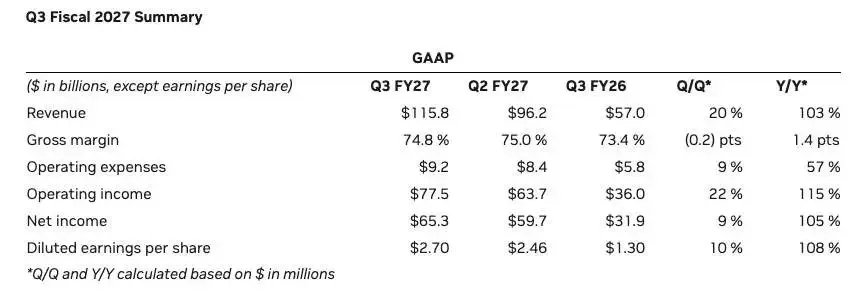
Profit also continued to grow. On a GAAP basis, quarterly operating income was $77.520 billion, up 115% year over year; net income was $65.287 billion, up 105% year over year; and diluted earnings per share were $2.70. Adjusted earnings per share were $2.68, above the market expectation of about $2.48. From revenue to profitability, this report card still extends Nvidia's strength over the past several quarters.
Among the segments, the data center business contributed the vast majority of growth. Quarterly revenue for that business reached $107.6 billion, up 110% year over year and 21% quarter over quarter, accounting for about 93% of total revenue. Edge computing revenue was $8.2 billion, up 42% year over year and 14% quarter over quarter. Nvidia's revenue structure has become highly concentrated in infrastructure buildout around AI data centers.
An important support for this round of growth is that the new-generation platform Vera Rubin has begun shipping. In the earnings report, Nvidia called Vera Rubin NVL72 the fastest-ramping product in the company's history, with related racks already running at partners including CoreWeave, Google Cloud, Microsoft Azure, Oracle Cloud Infrastructure, and Nebius. Oracle and Google Cloud have also launched cloud services based on Vera Rubin.
In the earnings report, Kress emphasized that the company's growth drivers are real, Vera Rubin has had a strong start, and the product roadmap remains on track. For Nvidia, which has just lost its founder CEO, this statement directly addressed the market's biggest concern: whether the already-established system of products, engineering, and customer partnerships can continue to maintain its original pace.
The history of technology giants also shows that a founder's departure does not cause a business system built over many years to collapse. Bill Gates handed over the Microsoft CEO role in 2000 and stepped back from day-to-day management in 2008, yet Microsoft still completed its transition to cloud computing afterward; Jeff Bezos handed the Amazon CEO role to Andy Jassy in 2021, and e-commerce, logistics, and AWS continued to operate. For Nvidia, the CUDA ecosystem, products already in the delivery stage, and the AI clusters customers are building also have continuity that transcends any individual's tenure. Jensen Huang's departure brought expected turbulence, but the existing business still has its own operational inertia.
In addition, at the start of the earnings call, Nvidia board chairman Harvey Jones said the board does not intend to have Huang return as chief executive.
A few hours before the earnings release, Jensen Huang published a long post on his personal X account, thanking friends, industry colleagues, and Nvidia employees and investors for their support over the past week. He again acknowledged that he had made mistakes in his personal life, while for the first time explicitly stating that he was willing to return as Nvidia CEO.

Nvidia's guidance for the next quarter also extends the growth expectation. The company expects fourth-quarter fiscal 2027 revenue of $130 billion, plus or minus 3%, above the roughly $125.25 billion analyst expectation compiled by LSEG. The quarter has one extra week than usual, and the guidance still excludes data center computing revenue from China.
However, continued revenue expansion comes with more obvious margin pressure. In the third quarter, Nvidia's GAAP gross margin was 74.8%, and adjusted gross margin was 74.9%, only slightly down from the previous quarter; for the fourth quarter, the company expects both measures to fall to 71%–72%.
This means that even if higher revenue is achieved next quarter, the proportion of gross profit retained per dollar of sales will decline. Based on $130 billion in revenue, each one-percentage-point change in gross margin corresponds to about $1.3 billion in gross profit. For a company of Nvidia's scale, a change of a few percentage points is already enough to significantly affect profit growth.
This earnings report first proves that Nvidia's order and product delivery system is still running at high speed. Data center revenue doubling, the new platform entering customer infrastructure, and next-quarter guidance above expectations all provide support for the management transition. But the quarter ended October 25, earlier than Jensen Huang's departure, so the real execution test for the new management still lies ahead.
What Kress has taken over is a company with demand that remains strong, an unprecedented scale, and also greater responsibility for supply chain investment and system delivery.
Earnings Continue to Soar—How Much Longer Can Nvidia Keep Winning Across the Board?
NVIDIA's dominance has been built over decades of accumulation. Starting from graphics processors, to building a software ecosystem around CUDA, and then to sustained investment in high-bandwidth memory and inter-chip interconnect, it has gradually expanded competition from the performance of a single chip to the efficiency of the entire computing system. The compute, data exchange, and software tools needed to train large models have been integrated into a single platform. The more deeply customers adopt this platform, the more work is required to re-adapt and re-validate when migrating.
However, AI infrastructure is far more complex than GPUs. CPUs run applications, schedule tasks, and execute tools; memory determines whether data can be delivered to compute units in time; and networking determines whether large numbers of chips can collaborate efficiently. NVIDIA's advantage is built on the coordination of these components, and pressure is now entering from different directions: its largest customers want more control over procurement, AMD is expanding its data center business, and supply chain segments such as manufacturing, memory, and packaging continue to affect the delivery and cost of the entire system.
The first pressure comes from cloud providers' incentive to reduce dependence on suppliers. For companies building AI clusters at scale, GPUs are a major expense, and supply cadence, product roadmap, and software ecosystem are all deeply tied to the same supplier. The larger the procurement scale, the higher the value of establishing a second technology path. Customers want not only more compute but also more control over pricing, delivery, and product choice.
Google's partnership with Broadcom has already extended to long-term supply arrangements. Broadcom disclosed in April 2026 that it will develop and supply future generations of TPUs for Google and provide networking and other components for its next-generation AI racks, with the relevant agreements extending up to 2031. Meta also announced in the same month an expansion of its partnership with Broadcom, advancing multiple generations of chips and supporting networking technology around its in-house training and inference accelerator MTIA. Amazon, meanwhile, has its own chip design team. AWS acquired Annapurna Labs in 2015 and subsequently gradually built product lines such as Graviton and Trainium. Cloud providers have adopted different R&D and partnership models, but all are trying to turn massive compute demand into the scale advantage of in-house hardware.
These chips do not need to replace all GPUs to change where procurement budgets flow. Cloud providers control their own models, software, and business data, so they can prioritize migrating workloads that run at high volume and have stable processes. As long as the long-term cost savings are enough to cover R&D and adaptation investment, some workloads will have an incentive to leave the NVIDIA platform. The largest customers therefore also become the companies best positioned to cultivate alternatives.
The second force: AMD's substantive catch-up. AMD has long worked on both CPUs and GPUs, and this positioning is beginning to pay off in the AI era. In the third quarter of 2026, AMD's data center revenue reached approximately $8.5 billion, up 97% year over year, driven by demand for EPYC server processors and its Instinct GPU business. This shows that it is not merely a "theoretical alternative" but has begun to actually take share.
The third pressure comes from the concentration of manufacturing and supply chain costs. Multiple chip paths from NVIDIA, AMD, and cloud providers all depend on key manufacturing partners such as TSMC. Competition in chip design is intensifying, yet upstream manufacturing, advanced packaging, and HBM supply cannot expand rapidly in sync. Even as customers add chip suppliers, they may still face the same delivery bottlenecks.
To secure future supply, NVIDIA is making larger-scale long-term commitments. As of July 26, 2026, its supply and capacity commitments increased from $119 billion in the previous quarter to $279 billion, with the increase mainly related to memory procurement. Locking in resources in advance supports delivery, but it also leaves larger-scale demand forecast risk with the company itself.
Demand divergence: inference has taken on a different mode of operation
The competition NVIDIA faces is changing with the way AI is used. In the past, training larger models required more GPUs, larger high-bandwidth memory, and faster inter-chip networking; today, AI is beginning to move from answering questions to executing tasks, and the hardware requirements of new demand are diverging accordingly. Processing a hundreds-of-pages contract, generating speech in real time, and letting a coding agent work continuously for several hours are all inference, yet they are not necessarily suited to the same hardware configuration.
In an analysis published in October, McKinsey projected that by 2030, inference will account for about 60% of AI demand, while training will account for about 40%. This forecast means that the market chipmakers compete for in the future will increasingly consist of the day-to-day operation of models after deployment.
This creates a more complex problem for NVIDIA: growth in inference demand can expand its market, but the differences among inference tasks are also creating opportunities for other architectures.
Take a compliance tool as an example: it reads a 300-page contract and ultimately returns only a small number of clauses that need attention. Most of the work occurs in the prefill stage that processes the input, which places greater demands on compute capability. A voice assistant, by contrast, needs to generate responses continuously and quickly, making the decode stage of token-by-token output more important and more sensitive to memory bandwidth and latency. The same chip can handle both types of tasks, but customers may end up paying for some capabilities that are not fully utilized.
NVIDIA's GPUs can accommodate these demands. Strong compute capability supports prefill, HBM holds model weights and KV cache, and high-speed interconnect allows multiple GPUs to work together. This generality is also an advantage: a single system can be repurposed between training and inference, and customers do not need to rebuild infrastructure for every type of task. But when a certain type of task runs at sufficiently high volume, choosing specialized hardware for it can save enough to cover software adaptation and deployment investment.
Cerebras is targeting exactly this opportunity. It turns an entire wafer into a single chip, routing across the boundaries of different exposure regions to reduce the overhead of traditional inter-chip connections. Its WSE-3 features 44GB of on-chip SRAM with bandwidth reaching 21PB per second; by comparison, the H100 has 80GB of HBM with bandwidth of 3.35TB per second. The two make fundamentally different trade-offs between memory capacity and bandwidth: Cerebras trades smaller on-chip capacity for extremely high access speed, hoping to let models generate tokens faster. Inference requires large numbers of tokens, which is clearly the area where Cerebras excels.
The industry has also begun trying to split a single inference request and hand it to different hardware. The approaches cited by McKinsey include AWS using Trainium for prefill and Cerebras for decode, and Intel and SambaNova allocating prefill to GPUs and decode to reconfigurable dataflow units. AMD has also established a partnership with Cerebras. Competition has now reached deep into the execution of a single request: how input is processed, how output is generated, and where caches are placed can all become grounds for reallocating hardware resources.
However, specialized chips always face a timing gap. Model architectures can change within months, while chip development is typically measured in years. By the time a chip optimized for a specific workload is delivered, the original demand may have already changed. McKinsey notes that Google has applied reinforcement learning-based placement and routing to multiple generations of TPUs, and Jeff Dean has proposed using AI to compress chip design cycles from 18 to 30 months down to 3 to 6 months. Whether this cycle can be shortened will directly affect specialized chips' ability to keep pace with model changes.
The real turning point is Agent inference.
Answer-oriented inference and Agent inference may ultimately lead to different hardware architectures. Answer-oriented inference revolves around humans waiting for an answer, whereas Agent inference is about "completing tasks," with computers continuously working based on instructions from other computers, gradually shedding the constraint of real-time human involvement.
This distinction changes the value of latency. For a coding assistant a developer is actively using, every wait affects the pace of work; for an Agent scheduled to perform code migration, checks, and fixes overnight, the execution window is much longer. For the latter, customers care first about whether the task can be completed on time and the total cost of completing it—they do not necessarily need the fastest response for every step.
So the priorities shift. For Agent inference, what matters most is no longer token generation speed, but memory and storage. Agents need context, state, and history: some exists as active KV cache, some sits in host memory or SSDs, and a large amount is buried in databases, logs, vector embeddings, and object storage. Agent inference will increasingly revolve around a tiered storage system surrounding the model, with the GPU answering a single question being just one part of it. In this system, speed and capacity must be traded off; since latency is acceptable, fewer people will pay a premium for extreme compute. Slower, cheaper conventional DRAM becomes more meaningful; if the system spends most of its time waiting on memory, the chip does not need to be the fastest one either.
Here an counterintuitive judgment emerges: Agents may consume ever more compute, yet customers' dependence on the most expensive compute may decline. Nvidia's advantages built through high-speed computing, HBM, and interconnect will need to re-prove their premium under the new task structure. When "good enough" can get the job done, customers have an incentive to allocate budget to cheaper combinations of compute and storage.
Nvidia is not unaware of this. It launched the Dynamo inference framework, splitting different parts of the inference process, while delivering separate memory racks and CPU racks to support larger KV caches and faster tool calls—the core goal in all cases being to keep expensive GPUs busy. But for Agent inference, which is far from being constrained by GPU performance, cost and simplicity will become increasingly attractive to cloud providers.
This does not mean Nvidia will lose its dominant position tomorrow. Training remains important, and its architecture will continue to dominate in the training domain; answer-oriented inference also remains a meaningful market, just relatively smaller in scale. But in the Agent inference market—which is expected to become the largest incremental market, because it is not limited by the number of humans or by time—the premium of Nvidia's solutions will come under increasing pressure.
Jensen Huang's departure adds a layer of uncertainty to this pressure. The large deals and ecosystem commitments he drove during his tenure are assets the new management will inherit, and also questions they must answer: follow the original pace, or take a fresh look. This will be the answer the market is truly waiting for, beyond the financial figures.
Reference link:
https://nvidianews.nvidia.com/news/nvidia-announces-financial-results-for-third-quarter-fiscal-2027