利用电视信号穿墙感知室内人体移动
作者利用软件无线电接收本地 ATSC 数字电视信号,发现选择性衰落状态下信号对附近人体移动极度敏感,从而可在隔壁房间通过频谱变化感知人员走动。该方法无需专用硬件,WiFi 或 LTE 等宽带信号同样可提取信道状态信息实现类似穿墙感知。
报道正文
This is a spectogram of the signal from a local TV station:
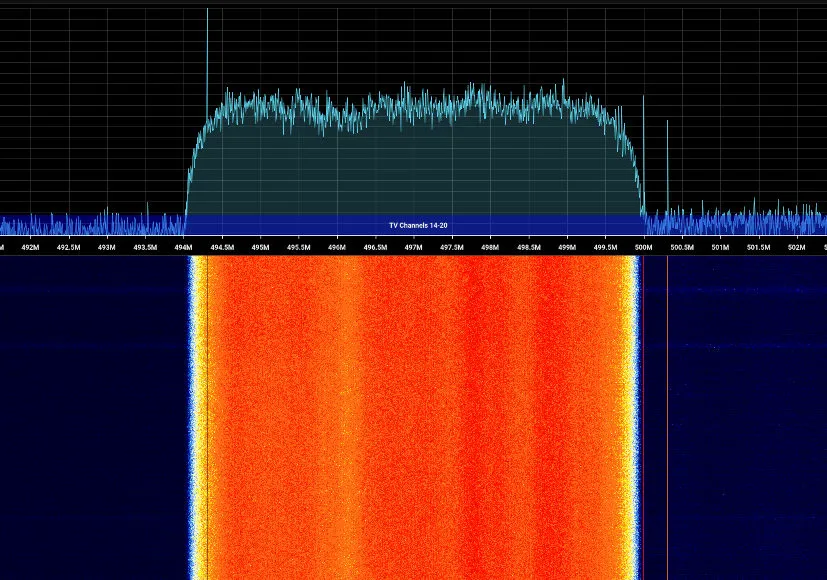
ATSC digital TV signal. (Recorded using an Ettus USRP B200)
Walking between the receiver and TV station causes a slight disturbance to the signal, but it's nothing to write home about:
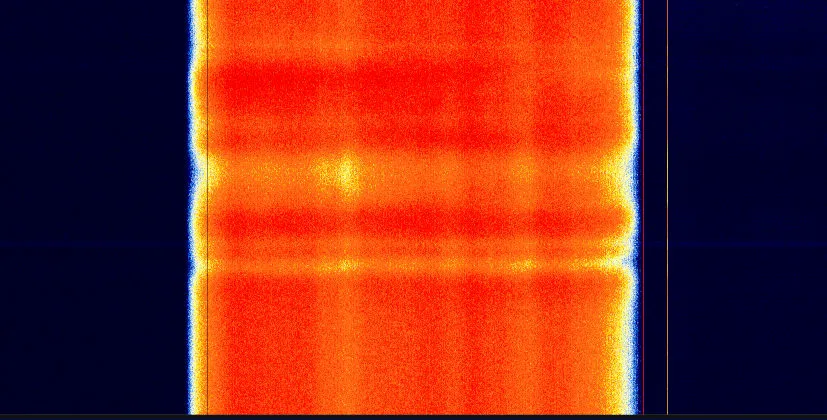
Walking through the signal path
For this capture, I moved the antenna a few centimeters:
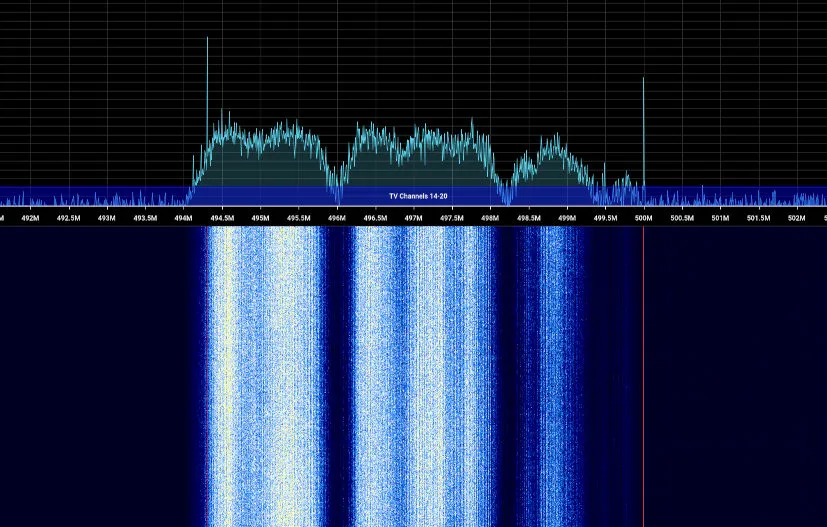
Where'd my signal go?
This is selective fading: The direct signal is being canceled out by a strong reflection. Because the phase of the reflection depends on frequency, this effect is not uniform over the whole signal. Apart from being annoying if you're trying to watch TV, this state is extremely sensitive to any nearby movement.
Here's what happened to the signal when I got up from my chair:
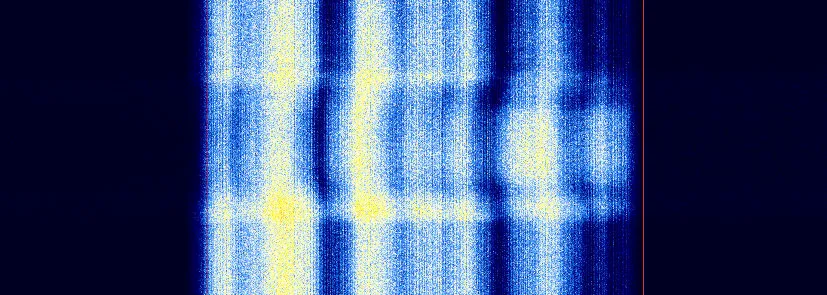
... and here's me walking around in a neighboring room:
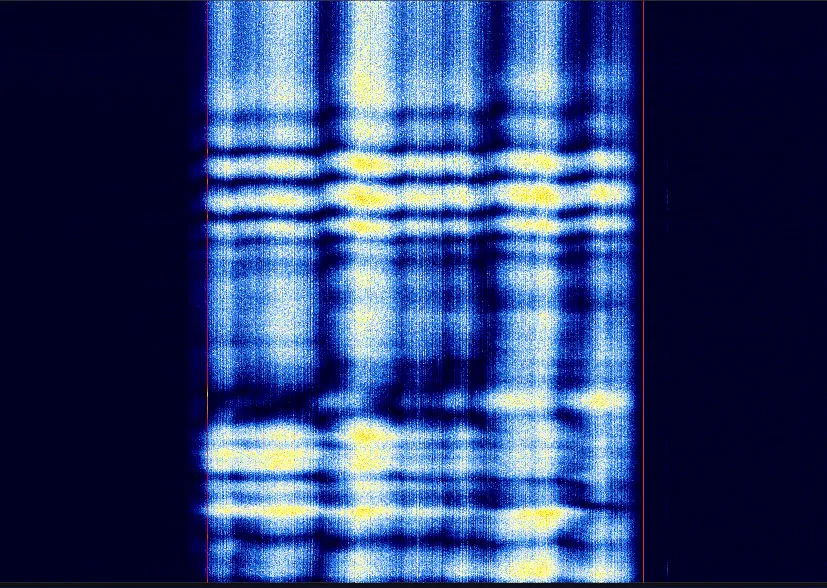
Stripes!
The gaps between the stripes happen when my reflection perfectly cancels out the residual signal, which happens each time the path length changes by one wavelength. Let's use this to figure out how fast I was walking:
The gap between each stripe is around 70 pixels, and the waterfall has an update rate of 150 Hz...
70 pixels * 1 second/150 pixels = 0.47 seconds = 2.1 Hz
speed of light / 490 MHz * 2.1 Hz = 1.3 m/s = 4.6 km/h
I was walking perpendicular to the direct signal path, so the speed can be used as is, without any adjustments for geometry.
So, a simple radio reciever is able to detect motion and provide an estimated speed — and it's not just TV that works for this: any wideband radio signal like WiFi or LTE can be used in much the same way. Those make worse demonstrations because they have a messy waterfall, but it's possible extract the same data with a bit of work.
Happy paranoia!