机器之心 (微信公众号) · 10/12/2026, 12:30:00
PhAI Labs Unveils RSI-Anything: World Models Drive Cross-Domain Recursive Self-Improvement
PhAI Labs introduces RSI-Anything, a framework leveraging world models to predict action consequences and refine strategies via real feedback, extending Recursive Self-Improvement beyond digital tasks. The method boosts success rates in code repair, GUI interaction, and chemical planning, with a 4B-parameter model doubling its planning score after five iterations.
SOURCE COVERAGEFull Original Report
Contents9 sections
From modeling everything to letting everything drive intelligent evolution.

Published by Synced (Machine Heart)
Fixing bugs, operating computers, planning laboratory procedures, optimizing chemical reactions, and even studying complex immune systems.
These tasks, which seem completely unrelated, have recently appeared within the same AI self-evolution research framework.
What is even more interesting are the experimental results.
In code repair tasks, researchers did not swap out the model responsible for writing code, nor did they increase the online testing budget. They simply involved a world model in predicting and selecting code modification strategies, using real feedback to further adapt the predictor.
As a result, the code repair success rate improved from 26.3% to 31.2%.
When AI moved from writing code to actually operating computers—facing constantly changing screen interfaces and needing to continuously perform clicks, inputs, and window operations—this method also demonstrated effectiveness.
In computer graphical user interface (GUI) interaction tasks, RSI-Anything achieved an approximate 18.4% relative improvement in task success rates on the OSWorld benchmark compared to existing methods.
Moving into the laboratory setting, a policy model with only 4B parameters, after five consecutive generations of improvement, saw its planning score rise from 21.80% to 46.01%, ultimately slightly surpassing reference systems that employed larger model combinations.
In the chemical domain, over the course of 40 experiments, prediction-and-feedback-driven search pushed the average best observed yield to 96.15%, whereas the Bayesian optimization control method achieved 82.16%.
From fixing bugs in programs, to operating real software interfaces, to planning experimental workflows and selecting chemical reaction conditions.
Although these tasks differ vastly in state representations, action spaces, and feedback mechanisms, they can all be organized into the same prediction-and-feedback-driven improvement framework.
This raises a thought-provoking question:
Why must recursive self-improvement (RSI) in AI be limited to code, mathematics, or specific types of tasks?
Recursive Self-Improvement (RSI) is becoming a significant direction in AI research. However, for AI to truly move beyond digital tasks like coding and math toward computer environments requiring continuous interaction, and even into complex physical and scientific worlds, relying solely on explicit test results and reward signals is insufficient.
State changes and action consequences in different environments are often far more complex, while real-world feedback can be expensive, sparse, or even difficult to obtain directly.
What if AI could build predictive models for different worlds, anticipate potential consequences before taking action, and then use real feedback to continuously improve itself?
On October 12, PhAI Labs released the technical report RSI-Anything: Unlocking Recursive Self-Improvement with World Models, exploring a path toward cross-domain recursive self-improvement via world models.
This research continues the technical trajectory established by JEPA-Anything.
JEPA-Anything explored how to model the change laws of diverse worlds—including vision, molecules, physics, and life—through general predictive learning principles.
RSI-Anything takes this inquiry further:
Once different worlds become predictable, can they serve as environments for AI self-evolution?
From World Modeling Anything to Recursive Self-Improvement through Anything.
This time, world models are no longer just used for predicting the future; they become a key component connecting diverse environments with intelligent self-evolution.
- RSI-Anything Technical Report: https://arxiv.org/abs/2610.13912
- RSI-Anything Project Code: https://github.com/Gen-Verse/RSI-Anything
- JEPA-Anything Paper: https://arxiv.org/abs/2609.20800
- JEPA-Anything GitHub: https://github.com/Gen-Verse/JEPA-Anything
- PhAI Labs Official Website: https://phai-labs.com/
01 From Modeling Everything to Letting Everything Drive AI Evolution
To enable AI to continuously self-improve across different environments, we first need to address a fundamental question: How do we understand the potential consequences of actions?
In the world of code, running tests provides relatively clear feedback. But in chemical experiments, changing a reaction condition may require actual experimentation; in biological systems, a single intervention might trigger complex multi-scale changes.
If every learning step relies on real-world trial and error, the exploration space available to AI becomes significantly constrained.
World models offer another possibility: allowing AI to first learn the laws of change within an environment, then using predictions to assist in action selection.
Previously, PhAI Labs’ JEPA-Anything had already applied this approach to seven domains: vision, biology, clinical settings, control, molecular dynamics, physical fields, and weather.
The core concept, JEPA-Anything, explores how to model the dynamics of various worlds through universal predictive learning principles.
RSI-Anything advances this by asking: Once these worlds are predictable, can they become the environments for AI's self-evolution?
From World Modeling Anything to Recursive Self-Improvement through Anything.
In this paradigm, world models are no longer merely tools for forecasting the future but have evolved into critical components that bridge diverse environments and intelligent self-evolution.
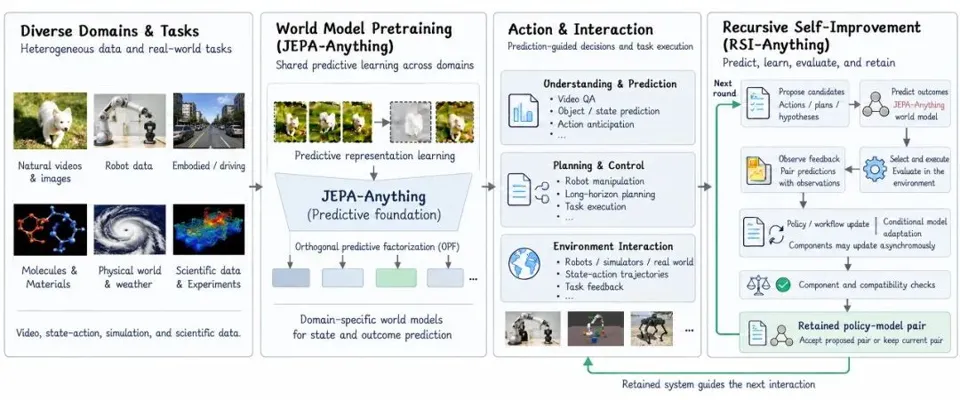
Figure 1 | From JEPA-Anything's cross-domain predictive learning to RSI-Anything's recursive improvement framework
02 RSI-Anything: How Do World Models and Agents Form a Recursive Improvement Loop?
Using world models to aid decision-making is not a new concept.
From Model-Based RL to Dreamer and MuZero, AI has already leveraged environmental predictions for planning and learning.
RSI-Anything focuses further on: how can prediction, action, real feedback, and the updates of both the policy and the world model constitute a recursive process that is reusable across domains?
Its core workflow can be summarized as:
State → Action → Prediction → Feedback → Improvement
First, the Agent generates candidate actions, and the world model predicts the potential consequences of different choices, helping the system decide which options are more worth executing.
After actual execution, feedback is used not only to solve the current task but also to support policy learning, workflow revision, or world model adaptation.
However, there is an easily overlooked issue here.
When the Agent's policy is updated, it may explore states it has never encountered before; the previously accurate world model might no longer reliably predict these new actions.
Conversely, when the world model is updated, it may change the Agent's judgment of candidate actions.
The Agent changes how it explores the world, and the world model must continuously adapt to these changes.
To address this, RSI-Anything allows asynchronous updates of the Policy and World Model, introducing component evaluation and compatibility checks.
Not every update is directly accepted. Only policy-world model combinations that pass the corresponding tests are retained, becoming the starting point for the next round of improvement.
In this way, the system does not just use feedback to correct the current answer, but attempts to transform experience into capabilities that can continuously influence subsequent actions and learning.
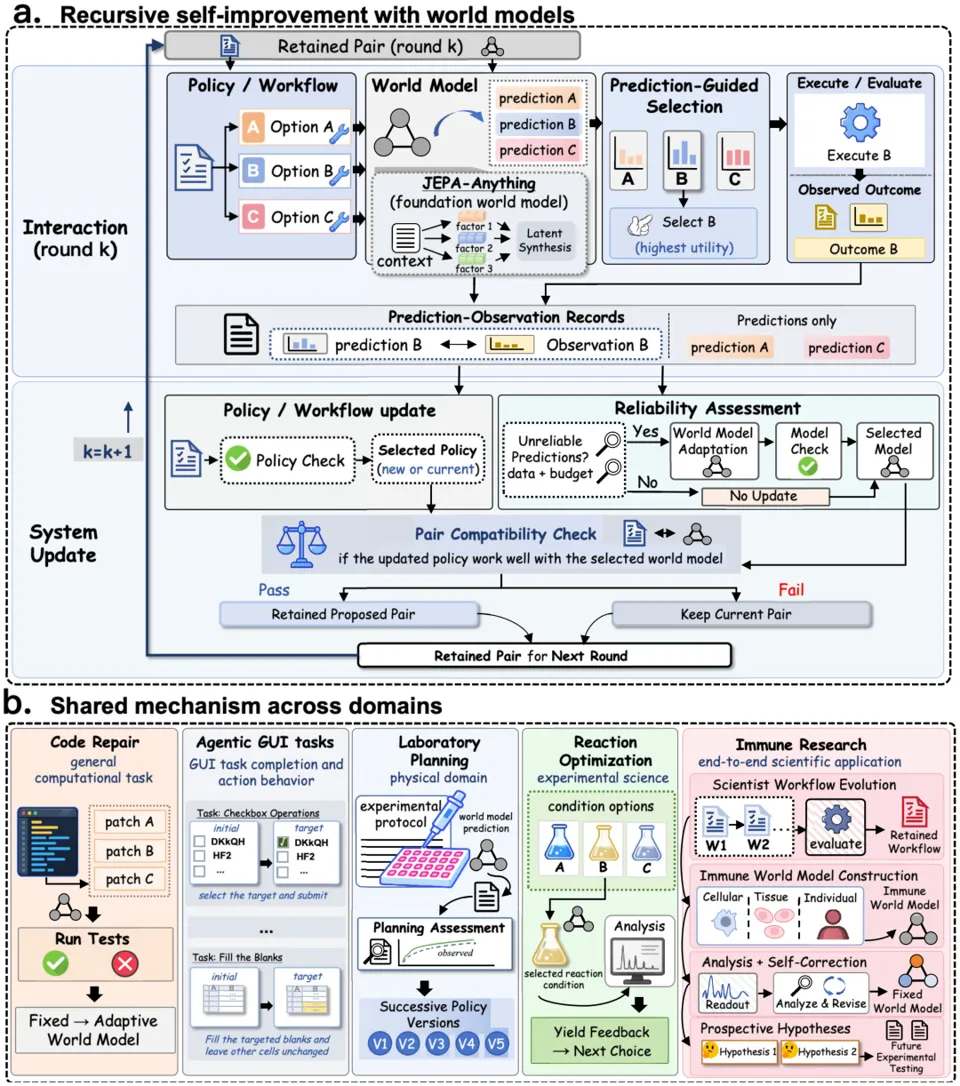
Figure 2 | The overall framework of RSI-Anything, highlighting predictive selection, feedback updates, Policy–World Model compatibility checks, and the recursive loop
03 From Coding Agents to GUI Agents, and Then to Science: RSI Experiments in Different Worlds
Whether a method can truly claim "Anything" depends on whether it can span different tasks and feedback forms.
The research team validated different mechanisms of RSI-Anything in code repair, graphical interface interaction, laboratory planning, and chemical reaction optimization.
(1) Code: Fixing More Bugs Without Upgrading the Coder
In the CodeContests code repair experiment, researchers fixed ReasonFlux-Coder-7B, generating four candidate patches per round and selecting one for execution.
Different methods used the same code generator and candidate budget.
As a result, the static Verifier achieved a repair success rate of 26.3%; introducing a fixed world model improved this to 29.2%; further adapting the world model through execution feedback reached 31.2%.
Meanwhile, the average number of online test calls remained roughly constant at about 3.7 per task.
This indicates that improving the Agent's capability does not necessarily rely solely on stronger generative models or more real-world trial-and-error.
Making the world model more accurate in judging which actions are worth executing can equally enhance system performance.
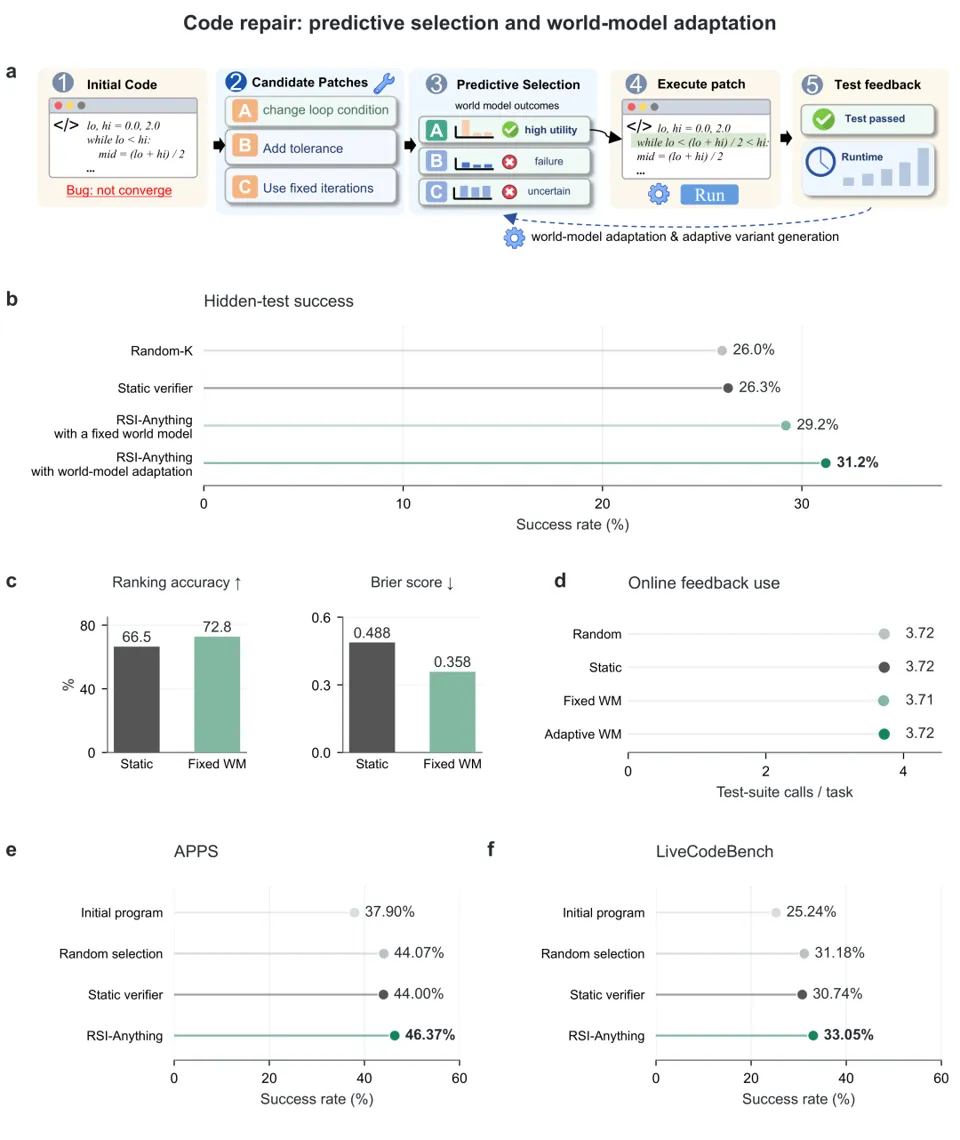
Figure 3 | Performance comparison chart for code repair tasks
(2) GUI Agent: Moving from Code Generation to Computer Interaction
Beyond code repair, RSI-Anything further explored capability improvements for Graphical User Interface (GUI) agents.
Unlike code tasks, GUI Agents need to understand visual information on the screen and interact with the environment through mouse, keyboard, and other operations. Each step can change the interface state, placing higher demands on the agent's environmental understanding and continuous decision-making capabilities.
On the representative computer operation benchmark OSWorld, RSI-Anything achieved a relative improvement in task success rate of approximately 18.4%, demonstrating its application potential in complex graphical interface interaction tasks.
This result further shows that the scope of RSI-Anything is not limited to code generation but can also extend to agent tasks requiring continuous observation, action, and environmental interaction.
Figure 4 | GUI task completion status and action behaviors
(3) Laboratory: Five Consecutive Generations of Improvement with a 4B Model, Doubling Planning Scores
In the LabHorizon laboratory planning task, the research team examined the performance of a 4B policy model over five consecutive versions.
Its planning scores were as follows:
21.80% → 38.03% → 41.99% → 44.56% → 46.01%
The final version reached approximately 2.1 times the initial score, slightly exceeding the Actor–Simulator–Selector reference system's 45.32%.
This result demonstrates the system's potential to continuously retain policy updates and gradually improve complex experimental planning.
It is important to note that what is measured here is the quality of experimental protocol planning, not the execution success rate of actual wet lab experiments.
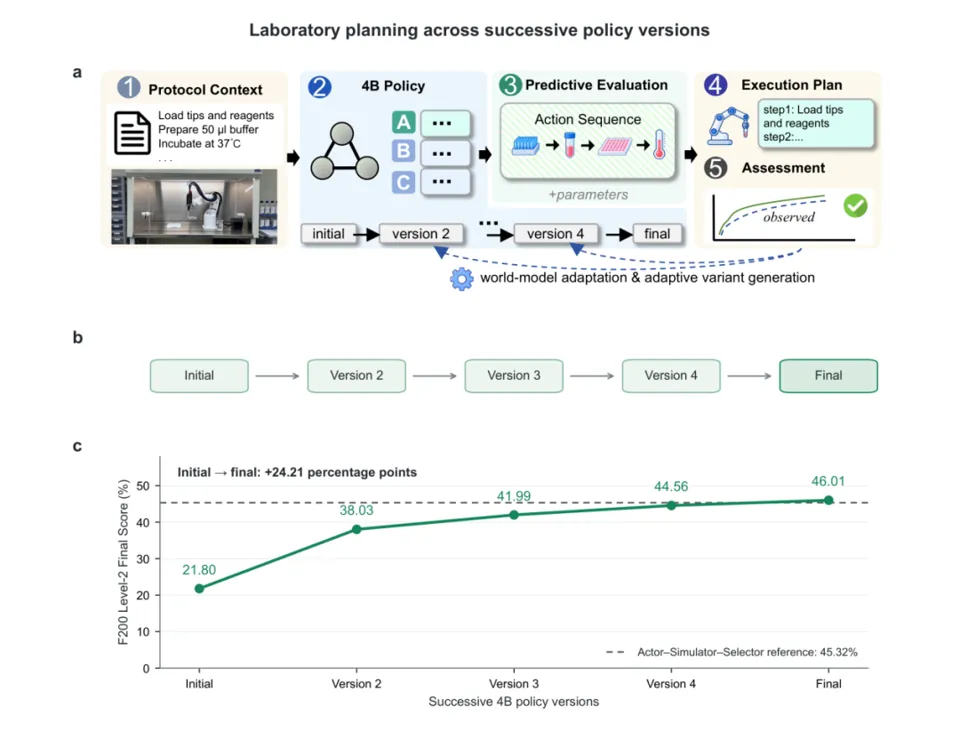
Figure 5 | Policy iteration results for laboratory planning tasks
(4) Chemistry: Finding Higher-Yield Reaction Conditions in 40 Experiments
In chemical reaction optimization, RSI-Anything uses the world model to predict the outcomes of different combinations of catalysts, ligands, solvents, etc., and then combines this with real measurement feedback to select the next round of experiments.
In two Suzuki–Miyaura reaction screening tasks:
- After 20 experiments, the best observed yield reached 93.0%, surpassing Bayesian optimization's 87.5%.
- After 40 experiments, the average best observed yield reached 96.15%, exceeding Bayesian optimization's 82.16%.
For scientific research with limited experimental budgets, this means that with the same number of experiments, there is a higher chance of achieving better exploration results.
From code testing and GUI interaction to experiment planning and chemical yield measurement, the state, action, and feedback mechanisms vary across these four types of tasks.
However, they collectively demonstrate a common direction:
Prediction and feedback from different worlds can be leveraged through similar underlying mechanisms to improve decision-making and learning in intelligent systems.
Figure 6 | Comparison of experimental results for chemical reaction optimization tasks
04 From Problem Solving to Exploring the Unknown: When RSI Meets Immunology
If code and chemical experiments primarily focus on improving performance on existing tasks, immunology brings RSI-Anything into a more open-ended research workflow.
The immune system involves multiple scales, including cells, tissues, and individuals. The same intervention can produce vastly different outcomes depending on the immune context.
Previously, related research by PhAI Labs proposed EvoIWM (Evolutionary Immune World Model), attempting to build a world model capable of predicting multi-scale immune state changes and the consequences of interventions.
In the end-to-end application demonstrated by RSI-Anything, the research team used Agent Genesis to evolve scientific agent workflows, constructing an immune world model. This was followed by model-driven analysis, evidence verification, and self-correction to screen potential intervention strategies.
The study ultimately proposed candidate combined intervention hypotheses involving SIRPα inhibition and IL-36γ axis modulation, which still await subsequent experimental validation.
Here, the world model is no longer just predicting the outcome of a single action.
It begins to serve as a tool for scientific agents to analyze complex systems, compare intervention strategies, and refine research judgments.
This opens up a more imaginative direction:
When AI can learn the dynamics of different worlds, can it not only improve its problem-solving capabilities but also participate in discovering new questions worth investigating?
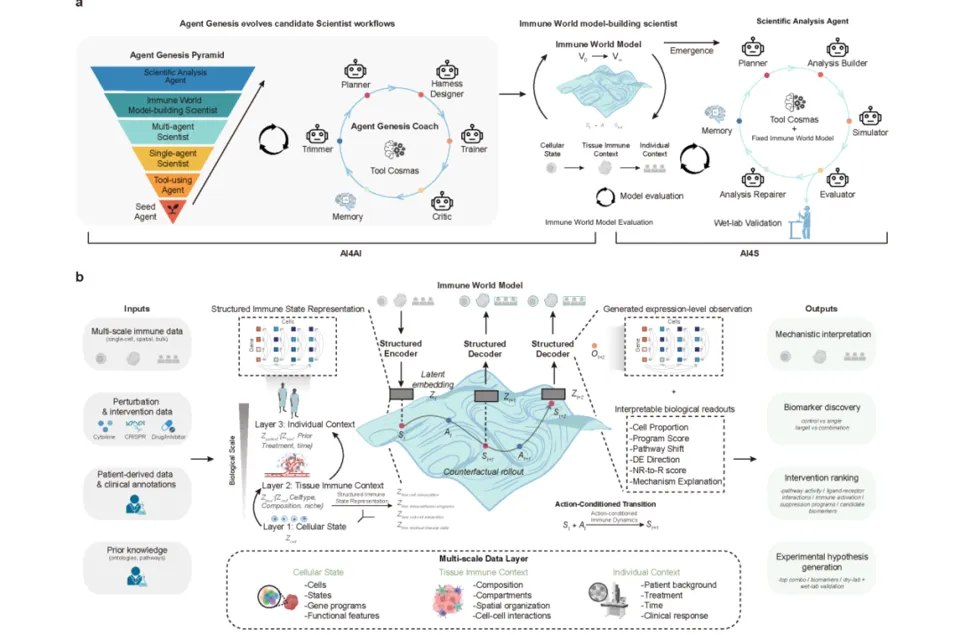
Figure 7 | Workflow evolution and world model applications in immunological research
05 Anything: Turning the Entire World into a Training Ground for Intelligent Evolution
Looking back at JEPA-Anything and RSI-Anything, both studies actually advance along a unified technical trajectory.
JEPA-Anything attempts to establish cross-domain predictive learning mechanisms, enabling AI to learn how different worlds change.
RSI-Anything further connects prediction with real-world actions, external feedback, and system updates, exploring a recursive self-improvement framework reusable across domains.
The term "Anything" here does not imply that a single world model already understands everything, or that an agent can autonomously evolve in any environment.
What is truly being unified are the underlying mechanisms—from prediction and interaction to self-improvement—across different worlds.
Of course, current research has separately validated components such as predictive selection, model adaptation, policy iteration, and feedback-driven search. Achieving long-term, stable co-evolution of policies and world models within the same complex environment remains a goal for future validation.
However, the space pointed to by this trajectory is not limited to any specific benchmark or scientific domain.
Future intelligent systems will constantly face new tasks, new environments, and new failure modes. Whether they can continuously derive learning signals from these changes may be a critical question for further enhancing intelligence.
World models offer a foundation for this: making complex environments predictable, allowing feedback to drive improvement, and enabling verified improvements to influence future decisions.
From code to GUIs, from simulations to the physical world, and now to complex biological systems like immunology, the pattern holds.
The ultimate vision is not just solving known problems, but using the structure of the world itself to guide discovery.
© Jiqizhixin. All rights reserved.