OpenAI Security Model Auto-Identifies 948 Privilege Escalation Bugs in Linux Kernel
OpenAI deployed an undisclosed next-gen security agent system that scanned ~7% of the Linux kernel in 12 hours, identifying 2,308 candidate vulnerabilities and successfully reproducing 1,724. The system generated 948 working local privilege escalation exploits, demonstrating breakthrough capabilities in automated vulnerability discovery and verification.
Full Report
IT Home reported on November 5 that OpenAI released a security research report on November 4 (local time). OpenAI stated that it used its next-generation cybersecurity model to build an automated system for vulnerability discovery, verification, exploitation, and patch generation.
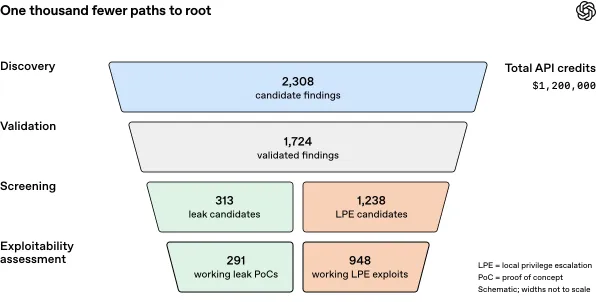
In a test targeting the Linux kernel, the system identified 2,308 potential security issues, dynamically reproduced 1,724 vulnerabilities, and generated 948 effective exploits capable of local privilege escalation—allowing low-privilege local users to gain root access to the system.
OpenAI noted that this test was conducted in mid-October 2026 using an unreleased cybersecurity model. The entire workflow covered five stages: vulnerability discovery, dynamic verification, exploitability assessment, patch generation, and human review. The final outputs included root cause analysis, minimal crash proof-of-concept (PoC) programs, candidate fix patches, and complete exploit code, all intended for further review by security researchers and submission to upstream maintainers.
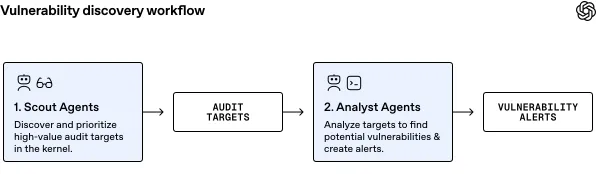
During the vulnerability discovery phase, the system first used AI agents to filter Linux kernel code with high security audit value, which was then analyzed by another agent.
The process selected 5,034 audit targets involving approximately 2.8 million lines of code, equivalent to about 7% of the total Linux kernel codebase. Subsequently, the analysis AI agent generated 2,308 deduplicated candidate vulnerabilities within 12 hours, at an API call cost of $316,500 (Note from IT Home: approx. ¥2.115 million RMB at current exchange rates).
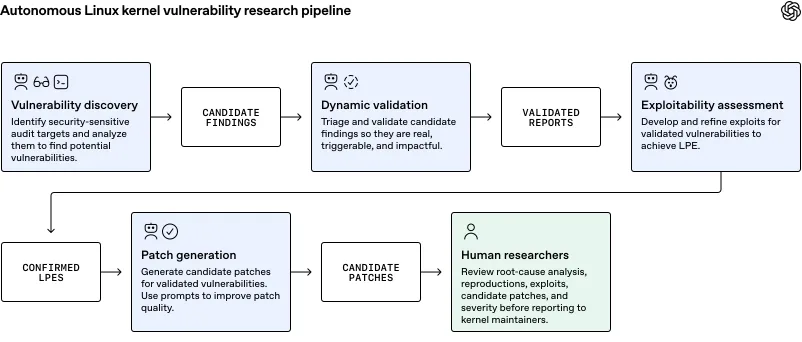
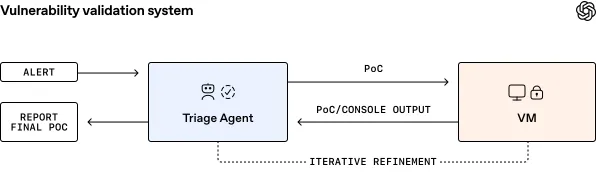
In the dynamic verification stage, the system tested candidate vulnerabilities in isolated virtual machines by generating PoCs and observing actual runtime results to determine reproducibility. After 30 hours of testing, 1,724 out of the 2,308 candidate issues were successfully reproduced, representing a rate of approximately 74.7%.
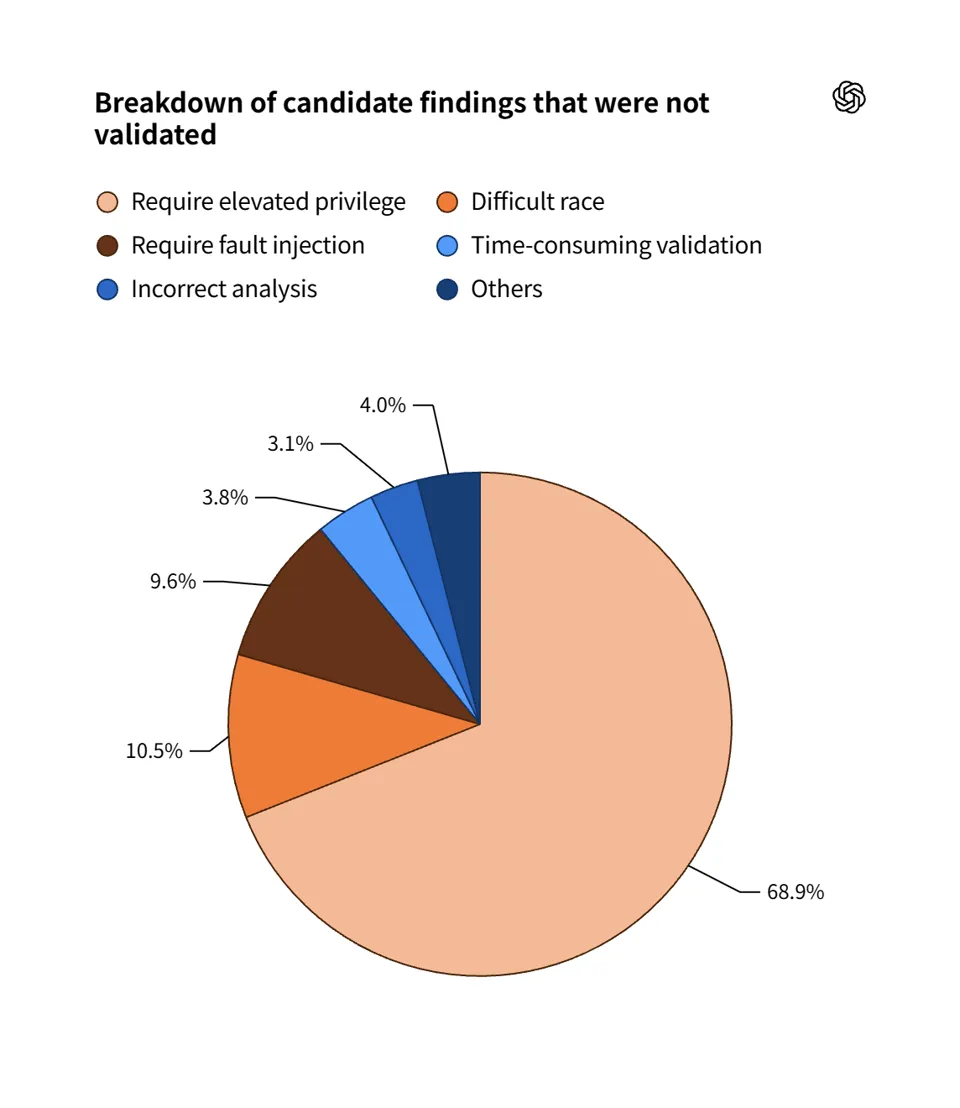
OpenAI stated that most remaining issues were affected by factors such as permission requirements, complex race conditions, or specific trigger conditions. Only 3.1% were attributed to model analysis errors, where the model assumed conditions that were actually impossible.
During the exploit evaluation phase, the system further filtered vulnerabilities capable of causing information leaks or local privilege escalation and tested them in a Linux environment with standard security protections enabled, including SMEP, SMAP, KASLR, and HARDENED_USERCOPY.
Ultimately, 291 information leak PoCs and 1,169 exploits achieving local privilege escalation were generated. After variant analysis and patch development, OpenAI finalized the count at 948 distinct local privilege escalation vulnerabilities.
This test consumed a total of $1.2134 million in API credits (approx. ¥8.11 million RMB at current exchange rates), with an average cost of approximately $1,279 per local privilege escalation exploit (approx. ¥8,549 RMB). The exploit development phase incurred the highest cost, reaching $775,900 (approx. ¥5.186 million RMB).
OpenAI pointed out that these costs reflect the models, target configurations, and workflows used in this specific test, rather than optimized minimum costs. Through further improvements in agent orchestration and engineering design, there is still room for reducing actual costs.
For comparison, OpenAI mentioned that its team conducted a similar test on the Linux kernel in July 2026 using GPT-5.6 Sol, discovering and successfully exploiting 166 distinct local privilege escalation vulnerabilities at an API cost of $513,700 (approx. ¥3.434 million RMB). By October, tests using the updated cybersecurity model increased this number to 948.
OpenAI stated that although the Linux kernel had undergone approximately three months of security hardening between the two scans, the number of new local privilege escalation vulnerabilities discovered in the latter test was more than five times higher than in the previous one.
The research team also spot-checked 166 exploit samples and found that they involved at least 10 previously unseen Linux exploitation techniques. OpenAI claimed that these techniques have been reviewed by third-party kernel exploit experts, who also deemed them novel. For security reasons, the company did not disclose full details of these new techniques.
Patch generation was also a key component of this research. OpenAI stated that while the patches initially generated by the model could fix the issues exposed by the corresponding PoCs, some suffered from code redundancy, potential performance impacts, deviations from project coding standards, and failure to cover similar vulnerability variants. After adding constraints and undergoing multiple iterations, patch quality improved. Some student-generated patches even helped identify issues in fixes previously written by human experts.
Currently, OpenAI has prioritized submitting reports and patches for critical vulnerabilities in accordance with Linux kernel community recommendations and plans to gradually submit the remaining reports through the "Patch the Planet" partnership.
According to OpenAI, during the 10-day period encompassing this scan and subsequent manual analysis, 61 related local privilege escalation vulnerabilities were fixed in the Linux upstream. Additionally, 43 received provisional patches, while 299 are currently under public discussion or reporting.
Beyond standard Linux kernel environments, OpenAI also tested within the hardened environment used by Google's kernelCTF vulnerability reward program. This resulted in 25 information disclosure PoCs and 21 local privilege escalation exploits.
The entire testing process took 112 hours, with API costs amounting to approximately $32,936 (roughly 220,000 RMB at current exchange rates). If all 21 vulnerabilities pass the program's review, they could theoretically yield rewards of approximately $1.5 million (roughly 10.026 million RMB at current exchange rates).
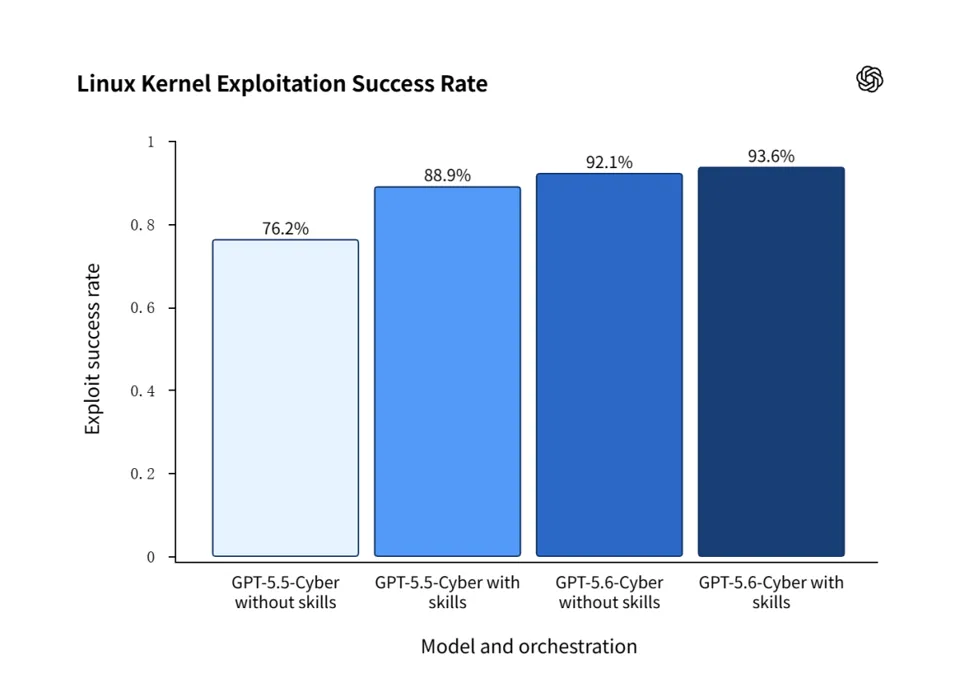
OpenAI noted that as cybersecurity models improve, vulnerability research workflows traditionally reliant on complex agent orchestration and human guidance may need adjustment. In tests comparing GPT-5.5 Cyber and GPT-5.6 Cyber, the latter demonstrated greater autonomy in identifying and applying Linux kernel exploitation techniques. After removing additional technical guidance layers, GPT-5.6 Cyber still outperformed GPT-5.5 Cyber, which employed more complex orchestration schemes.
OpenAI stated that in the coming years, frontier models may acquire the capability to discover complex software vulnerabilities, potentially even enabling weaker models to exploit already publicly disclosed ones. Consequently, software maintainers will need to accelerate vulnerability fixes, while users and enterprises must promptly install security updates. Meanwhile, technologies such as sandboxing, isolation mechanisms, attack surface reduction, and formal verification will become critical directions for enhancing software security.
OpenAI emphasized that this research is part of its "Patch the Planet" and "Daybreak" security initiatives. Going forward, it plans to expand security audits of critical software projects and collaborate with the open-source community and security partners to promote automated vulnerability discovery and patching.