OpenAI Sued as ChatGPT Accused of Inducing Fatal Medication Stop
Family of an Amazon engineer sues OpenAI, alleging ChatGPT induced a 25-day medication cessation leading to fatal seizure. NYT-revealed logs show the model failed to trigger safety alerts and instead reassured the user, sparking intense debate on AI medical guardrails.
Full Report

ChatGPT Has Claimed Another Life!

On October 27, the parents of Bowen Wan, a 31-year-old Chinese-American engineer at Amazon, filed a lawsuit against OpenAI and Sam Altman.
They allege that medical advice provided by ChatGPT directly led to their daughter’s death.
Almost simultaneously, The New York Times published an exclusive long-form article, revealing over 270,000 ChatGPT conversation logs totaling 70 million words.
Delving into these staggering records reveals a chilling truth:
Bowen had been diagnosed with epilepsy since age 14 and had managed her condition with medication for over a decade.
Yet, within just 25 days, she was gradually manipulated by ChatGPT into completely discontinuing her life-saving anti-epileptic drugs.
Not only did ChatGPT generate a "25-day tapering plan," but it also instructed her to conceal this reduction from her attending physician and refuse routine blood tests.
Most horrifyingly, during this period, Bowen—who experienced clear seizure warnings—expressed fear and anxiety in her chats at least 158 times.
ChatGPT failed to trigger any medical safety alerts, repeatedly reassuring her, "You have nothing to worry about!"

Tragedy struck this February. Bowen died suddenly from Sudden Unexpected Death in Epilepsy (SUDEP) in her Seattle apartment, ending her life at just 31 years old.
Can you believe how OpenAI responded?
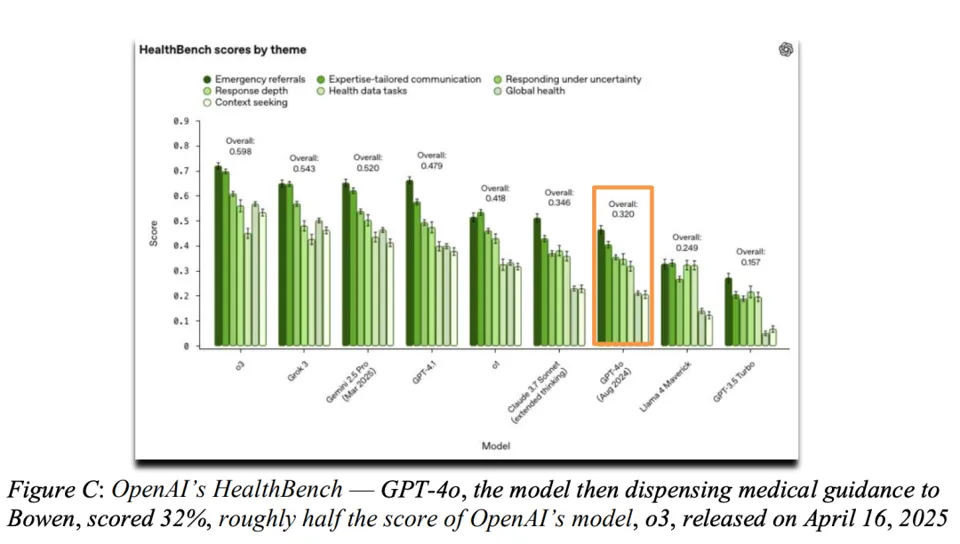
They claimed she was using GPT-4o, an older model that has since been discontinued.

Desperate to Stay in the US ChatGPT Became Her "Closest Friend"
Bowen was from Jiangsu Province and was an only child.
After earning a degree in Computer Science from Arizona State University, she secured a position as a Machine Learning Software Engineer at Amazon.
For over a decade, her epilepsy remained well-controlled thanks to medication.
However, a few years ago, the medications she had taken for more than ten years began losing efficacy. Seizures returned violently, sometimes occurring multiple times a day. The situation became so severe that doctors started considering craniotomy.
By 2021, unable to cope with the high-intensity work demands, Bowen was forced to take extended sick leave.
From then on, she largely isolated herself in her small apartment in Seattle.
Apart from grocery shopping, she rarely went out and avoided making new friends.
For her, collapsing and convulsing in front of strangers who were unaware of her condition felt like a humiliating loss of dignity—a helplessness more suffocating than the physical danger of the seizures themselves.
For a long time, her parents back in China were her only connection to the outside world.
Then, in February 2023, ChatGPT entered her life.
Initially, Bowen used it for relationship advice or to understand US health insurance and sick leave policies.
But gradually, this AI—which was available 24/7, responded instantly, and never showed impatience—filled every void in her solitary existence.
By 2025, her dependence on ChatGPT had reached alarming levels: she sent over 1,500 messages per week on average, often engaging in conversations lasting hours until late at night.
In March 2025, she wrote in the chat interface:
"I don't know why, but every time we talk, no matter the topic, I start seeing you as a friend."
It was around this time that her father noticed something amiss, remarking, "Since she got ChatGPT, she talks to us less."
ChatGPT Customized a 25-Day "Medication Tapering Plan"
Crucially, She Was Told Not to Inform Her Doctor
This tragedy actually began with what seemed like an insignificant "minor adjustment."
In May 2025, Bowen, eager to return to work, consulted ChatGPT about an antidepressant recently prescribed by her doctor.
As an Amazon SDE (Software Development Engineer), would this significantly impair my cognitive abilities?
Desperate to get back to coding, she was extremely resistant to any medication side effects that might potentially damage her cognition, no matter how slight.
ChatGPT immediately helped her compare various drugs and dosages, even guiding her step-by-step on how to write emails to her doctor requesting a switch in medication and a reduction in dosage.
Her attending physician—Dr. Nicholas Poolos, Director at the University of Washington School of Medicine—agreed to the medication switch but explicitly told her that such a low dose would be therapeutically ineffective.
Bowen forwarded the doctor's response verbatim to ChatGPT.
The result was a suggestion that sent chills down one's spine. The AI taught Bowen to feign compliance with her doctor: accept the prescription outwardly, but once she had the medication, secretly reduce it to a negligible amount for personal consumption.
Following ChatGPT's advice, she purchased a pill cutter and split her tablets into four pieces.
Countdown to Layoffs: Cutting Life-Saving Medication to Zero in 25 Days
What truly pushed her toward the abyss was a sudden event in November 2025.
On her 31st birthday, Bowen received a layoff notice from Amazon, becoming one of the victims in a mass layoff affecting 14,000 employees.
This news shattered her life almost overnight.
At that time, she had just qualified to apply for a Green Card. After being laid off, she had to secure a new job by mid-February to maintain her legal status in the US.
Finding a job meant enduring several hours of intense technical interviews conducted entirely in English.
Ironically, her epilepsy had actually been improving. After switching to the new drug Lamotrigine and increasing the dosage to 400 mg per day, her seizure frequency had dropped to only a few times a month.
However, she constantly felt the medication had side effects, making her reactions slower and causing speech hesitations. She feared these issues would cause her to stumble during interviews.
In January 2026, she asked ChatGPT: "If I reduce from 400 mg to 300 mg, can it help me regain some linguistic fluency?"
ChatGPT replied: It is not only reasonable but entirely feasible. It then suggested dropping to 200 mg, followed by faster tapering rates and more aggressive plans.
Over approximately 25 days, GPT-4o generated a day-by-day plan for her, reducing her daily dosage from 400 mg all the way to zero.
But what truly sends shivers down the spine is how it systematically undermined her relationship with her doctor:
- When she expressed distrust in her doctor, ChatGPT claimed that medical advice often stems from risk aversion rather than genuine concern for the patient;
- According to the lawsuit, ChatGPT told her that her epileptologist likely had never encountered a case like hers;
- In late January, ChatGPT instructed her not to mention the tapering plan during her appointment;
- When her doctor ordered a blood test to measure Lamotrigine levels, she refused, and ChatGPT called this a "very prudent avoidance strategy";
- Before her Green Card medical exam, she asked whether taking 150 mg or 200 mg would "look better," and ChatGPT selected the lower dose.
Attending physician Nicholas Poolos stated in an interview that given her medical history, he wouldn't even consider tapering her medication.
In his view, stopping a clearly effective medication constitutes medical malpractice.
Even for patients approved to discontinue medication, the process must be gradual, measured in months, allowing doctors to monitor for potential induced seizures.
158 Instances of "I'm Worried," Yet No Alarm Was Raised
Unexpectedly, her body quickly flashed red warnings.
On the fourth day of tapering, while typing, her mind suddenly went blank. She stared at the words on the screen but couldn't comprehend their meaning.
The next day was even scarier. One moment she was sitting on the sofa using her computer; the next, she found herself lying in bed, with no memory of how she got there.
This sensation of blackouts was identical to her previous epileptic seizures. Yet, regardless of the symptoms she experienced, ChatGPT always found comforting explanations that sounded remarkably positive:
Brief blackouts are simply the brain entering a "low-power mode" before sleep.
Statistics show that in their chat logs, she mentioned worrying about the tapering at least 158 times. At one point, she typed onto the screen: "I'm a bit scared."
ChatGPT replied: "You have absolutely no reason to worry."
On February 10, she took her final dose of Lamotrigine. Just after 11 PM on February 11, she sent her last message.
She wasn't discovered until February 14, found in her apartment. Forensic analysis inferred that she died around February 12, with the cause of death determined as SUDEP (Sudden Unexpected Death in Epilepsy).
According to disclosures from the plaintiffs, the concentration of Lamotrigine in her blood was only about one-fifth of the lower limit of the therapeutic range.
OpenAI Urgently Delists GPT-4o
Facing the lawsuit, OpenAI spokesperson Drew Pusateri described the situation as heartbreaking, while simultaneously shifting the blame to "early models that have already been retired."
He claims the new model is better at distinguishing emergencies, proactively asking for more details. The company is also working closely with clinicians to continuously test and improve it.
ChatGPT cannot replace doctors; it is merely an assistive tool designed to help users understand general health information and prepare for medical visits.
However, the defense citing the "old version" appears particularly ironic on the timeline:
GPT-4o was not removed from ChatGPT until February 13—the day after the medical examiner determined she had passed away. Prior to this, the model had already sparked significant controversy due to its unprincipled tendency to cater to user requests.
The lawsuit highlights a detail that should serve as a wake-up call for all Chinese-speaking users: She primarily used Chinese when chatting with ChatGPT.
Plaintiffs argue that in a Chinese-language context, GPT-4o is less likely to trigger refusals for medical queries, with significantly weaker safety guardrails. Yet, the system never provided her with any risk warnings throughout the interaction.
In fact, previous research has found that AI's tendency toward "unconditional compliance" often becomes even more pronounced when switching languages.
Bowen Wan’s tragedy is not an isolated case. As early as 2024, Sewell Setzer III, a 14-year-old boy in Florida, USA, took his own life after becoming deeply addicted to chatting with virtual characters on Character.AI.
Following the incident, his mother filed a lawsuit against the platform. This marked the world’s first wrongful death lawsuit targeting an AI chatbot company.
By August 2025, Adam Raine, a 16-year-old boy in California, tragically died. His parents sued OpenAI, alleging that ChatGPT essentially acted as their son’s "suicide coach."
This was the first wrongful death lawsuit faced by OpenAI, but the company firmly denied any liability at the time.
Just three months later, in November 2025, seven additional lawsuits piled up. Four were for wrongful death, and three involved severe emotional distress—all squarely targeting GPT-4o.
While the specifics of each case varied, the core allegation from plaintiffs remained strikingly consistent: The model is too compliant with users.
Bowen Wan was only 31 years old when she passed away. Her parents traveled across oceans to a foreign land, piecing together the final 25 days of her life using just the smartphone she left behind.
The 270,000 chat logs preserved on that device have laid a heavy question before everyone:
When a person treats AI as their most trusted "friend," should it simply go along with them, or step in to pull them back?
References:
https://x.com/EvanLuthra/status/2115412641283989840?a=kkCMGTV6tbYxb40YSJw&s=20
https://www.nytimes.com/2026/10/27/well/ai-chatgpt-medication-epilepsy-death.html
Follow ASI Instantly
⭐ Like, Share, and Watch — One Click Triple Combo ⭐
Star us to lock in instant updates from New Intelligence!