Stanford Study: NVIDIA B200 Delivers 9x Energy Efficiency vs AMD MI350X
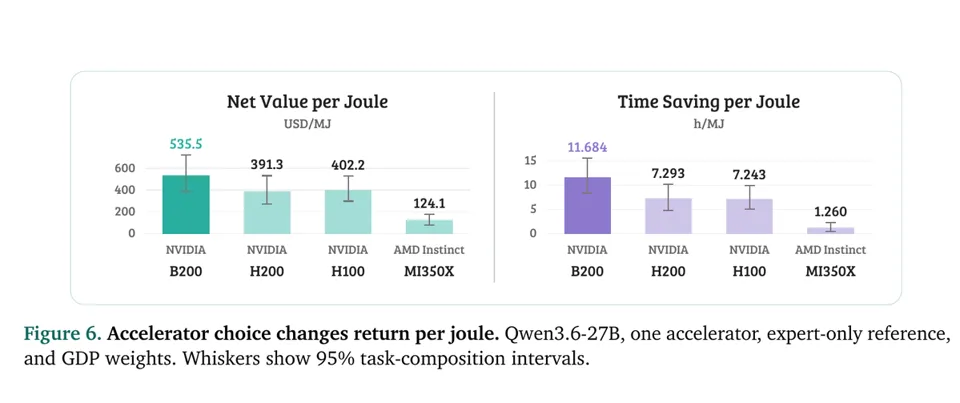
Stanford researchers introduced the 'Joules-to-GDP' metric to quantify the economic return of AI chips relative to energy consumption in real-world professional tasks. The study found that when running identical models, the NVIDIA B200 delivered over 4x the dollar value and 9x the expert time saved per unit of energy compared to the AMD MI350X. This highlights how hardware selection critically determines AI economic efficiency under power constraints.
Full Report
Rohan Paul (@rohanpaul_ai) · 2026-11-04 21
Stanford's new research: The NVIDIA B200 delivered over 4x the dollar value and over 9x the expert time saved per unit of energy compared with the AMD MI350X.
i.e. chip alone, with the model unchanged, can decide how much economic return you get from your power budget.
Here, Stanford researchers ran the same AI model, Qwen3.6-27B, on 4 different single AI chips across 220 real professional tasks and measured how much useful work each produced for the energy it used.
↳ 引用 @rohanpaul_ai (Rohan Paul): New Stanford paper finds that a smaller AI model can return far more economic value per unit of energy than the most capable one.
Now that the world is limited by energy/power, how much energy each AI task burns should indeed by studied.
Here, the researchers built Joules-to-GDP, which measures the dollar value of an AI's work, minus its running cost, per joule of energy used. They tested 5 open models on 220 professional tasks from GDPval, covering 44 occupations.
GLM 5.2 produced the most net value per task, but Gemma 4 31B got 56% of it with 23% of the energy.
Moving Qwen3.6-27B from 1 to 8 H100s cut task time by just 22% while using 3.2x the energy.
GPT-OSS 120B used 68% less energy than GLM 5.2 despite nearly the same price and speed.
Running the same model on 8 H100 chips instead of 1 made tasks only 22% faster but used 3.24x the energy, for nearly the same dollar value of work