Google and Penn State Introduce SIM to Carry Agent Self-Improvement Across Models
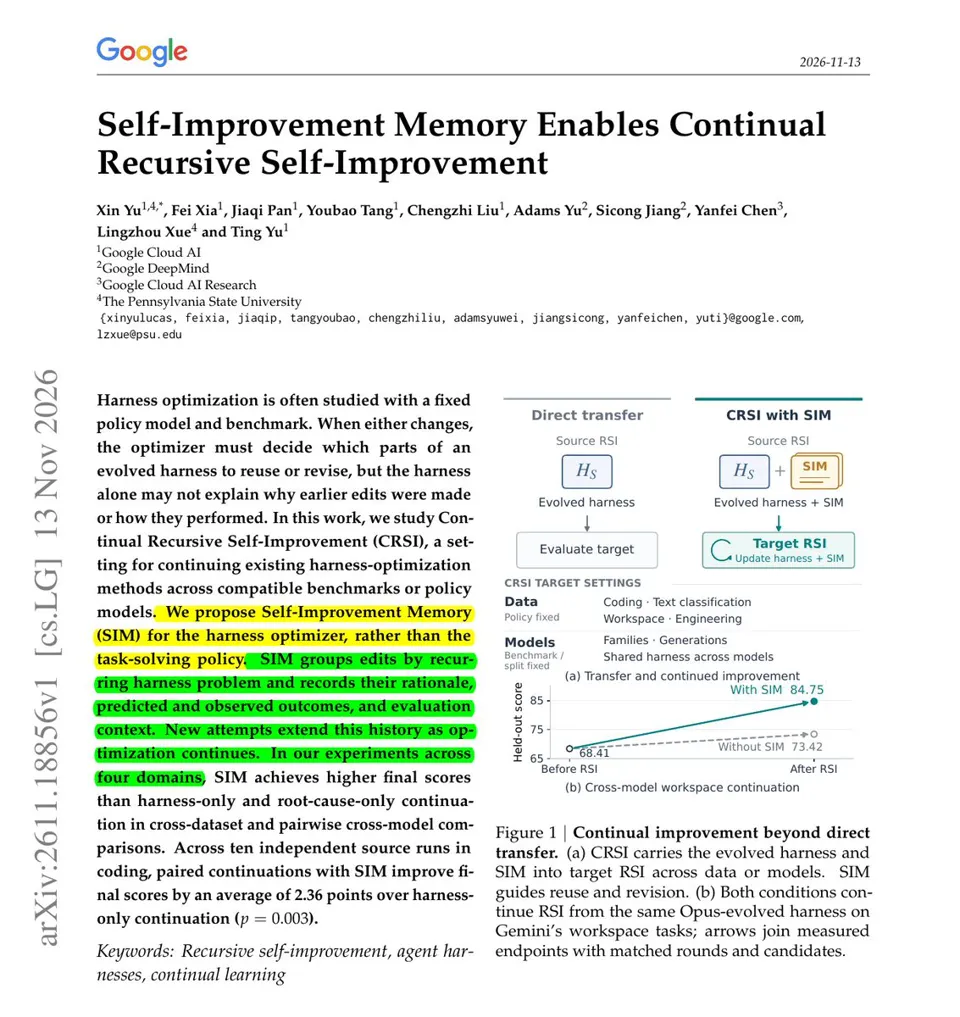
A new Google and Penn State paper proposes Self-Improvement Memory (SIM): when an LLM rewrites an agent's harness, the code that runs prompts and tools, each edit is logged with the problem it targeted, its reasoning and its measured result. After switching models or benchmarks, an optimizer reads this log to decide which prior edits to keep or revise, preventing regressions. Moving a Claude Opus 5.5 harness to Gemini 3.8 Flash workspace tasks, SIM raised scores from 68.41 to 84.75 versus 73.42 without the log, and led in 9 of 10 repeated coding runs by 2.36 points on average.
Related Entities
Full Report
Rohan Paul (@rohanpaul_ai) · 2026-11-17 20
New Google and Penn State paper finds that when one AI rewrites the code that gives another AI its instructions and tools, keeping notes on why each change was made helps the gains carry over to a new model.
LLMs can now rewrite an agent's harness, the code that runs prompts and tools. After a model or benchmark switch, it can score below the original, and its code hides why edits were made.
Self-Improvement Memory, or SIM, logs each edit with the problem it targeted, its reasoning and its measured result. The optimizer reads this log on the new setup to decide which old edits to keep or revise.
When a Claude Opus 5.5 harness moved to Gemini 3.8 Flash workspace tasks, SIM lifted it from 68.41 to 84.75, versus 73.42 without the log. Across 10 repeated coding runs, SIM finished ahead 9 times, by 2.36 points on average.
Store why each harness edit was made and how it scored, and carry that log to new models.