REA Explained: Agents Automate Reverse Engineering via Standardized Tool Invocation and Result Contracts
The GitHub project REA (Reverse Engineer Anything) surged to 230k stars in a week by shifting reverse engineering from 'human using tools' to 'Agent using tools'. By integrating professional binary analysis tools like Ghidra and IDA via MCP protocols and result contracts, it addresses the challenges of complex tool invocation and experience retention. This signifies that AI Agent capabilities are expanding beyond code generation to automated orchestration of specialized domain tools.
Full Report
Contents32 sections

What Exactly Is REA, the Project That Exploded to 230k Stars?

Introduction: In just one week in early October, a GitHub project called REA saw its star count surge from 15,000 to over 230,000. What makes it so popular? REA stands for Reverse Engineer Anything—reverse engineering everything. It tackles a longstanding hard problem in computer science: how to deduce software implementation logic from compiled binaries without source code. Previously, this was grueling manual work performed by reverse engineers using tools like Ghidra, IDA, and Hopper. This article deeply dissects REA's working mechanism and architecture—exploring exactly how reverse engineering shifts from "humans using tools" to "Agents using tools."
I. Background and Pain Points: Reverse Engineering is Manual Labor
The most common scenario people encounter: You're browsing an app and see a feature done well by a competitor, and you want to replicate it in your own product, but they won't give you the source code. To understand how that feature works, you have to reverse-engineer the logic from the compiled program. This process is called reverse engineering. It is distinct from "cracking software"; legitimate uses include malware analysis, vulnerability research, protocol understanding, legacy system compatibility, and recovering lost source code.
The problem is that this has traditionally been entirely manual: reverse engineers open tools like IDA or Ghidra and dig through them bit by bit. The tools themselves are professional, but the overall workflow is primitive and relies on manual effort:
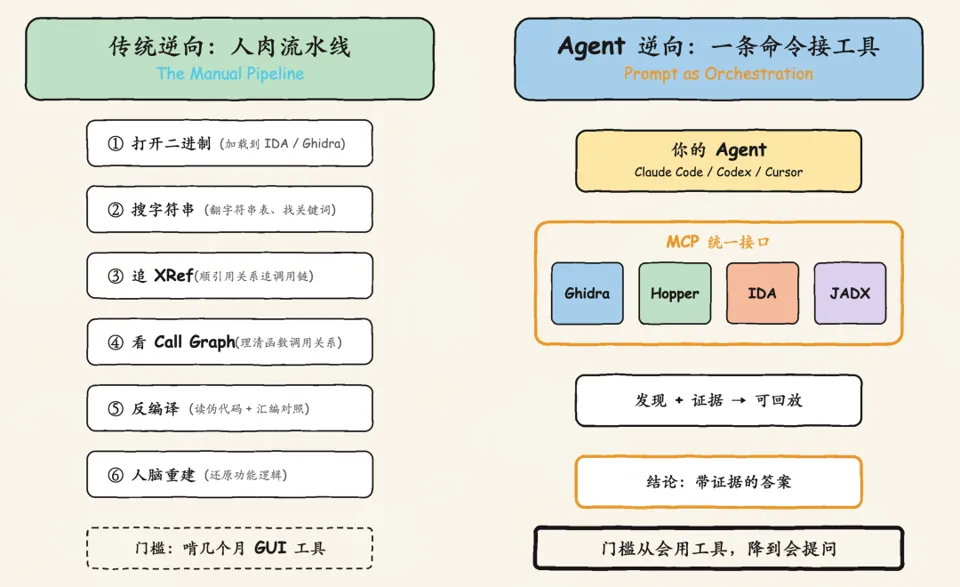
💡 Pain Point: The barrier to entry in reverse engineering isn't that "the tools are hard to use," but rather "how to proceed at each step and when to stop"—all of which resides in the reverse engineer's mind. Knowing how to operate the tools isn't enough; it requires years of accumulated experience.
Three issues arise:
| Pain Point | Manifestation |
|---|---|
| Fragmented Tools, High Barrier | IDA, Ghidra, Hopper, and JADX each have their own operational methods. Getting started requires months of mastering shortcuts and concepts. |
| Black-Box Process | During a reverse engineering session, decisions like "why trace this XRef?" or "why enter this function?" are not documented, making it impossible for others to review or verify. |
| Non-Cumulative Experience | Each reverse engineer's methodology is isolated. Switching targets or personnel means starting from scratch every time. |
In short, reverse engineering has long been stuck on two things: high barriers (requiring proficiency with numerous specialized tools) and non-transferable experience (locked inside human heads). Can AI coding assistants do this job instead? This is exactly what REA aims to achieve.
II. Three Major Challenges: Why Reverse Engineering Has Been Off-Limits for Agents
It's not that no one has tried to get AI to perform reverse engineering before; it's that three hurdles have remained insurmountable.
2.1 Non-Invokable Tools
Coding agents excel at "reading code, writing code," but tools like Ghidra and Hopper are GUI desktop applications lacking unified programming interfaces. If an agent wants to analyze a binary, it either cannot invoke the tool or must write custom glue code for each specific tool. There is a missing standard interface between the tools and the agent.
2.2 Untraceable Processes
The output of reverse engineering should be an "evidence chain": where a function is located, who calls it, and what the decompiled result looks like. However, traditional reverse engineering outputs often provide only conclusions, lacking intermediate evidence. If an agent directly provides conclusions, no one trusts them; if it needs to provide evidence, the "findings" must first be structured.
2.3 Non-Reusable Experience
An experienced reverse engineer follows a methodology: "First search strings, then trace XRefs, then return to assembly to verify suspicious points." This methodology cannot be written into the tools, nor can it be reused by another agent.
Layered Complexity: Tools aren't connected, processes leave no trace, and experience doesn't accumulate. Before REA appeared, "letting AI do reverse engineering" remained stuck at the demo level.
2.4 The Essence of the Problem: Reverse Engineering is an Orchestration Issue, Not a Compute Issue
Behind these three hurdles lies the same root cause: the essence of reverse engineering is a investigation workflow (search → XRef → call graph → decompile → reconstruction), not a single compute invocation. Whoever standardizes and interfaces this workflow can enable agents to run it. This is precisely what REA does.
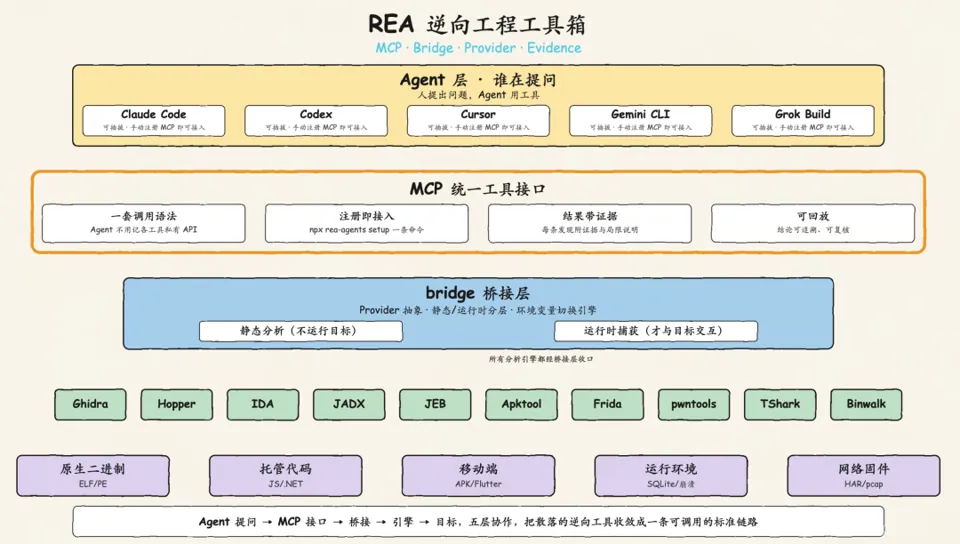
III. Overall Approach: Connecting Tools via MCP Interfaces
3.1 One-Sentence Summary
The essence of reverse engineering is not "knowing how to use tools," but "being able to invoke tools and obtain evidence-backed conclusions."
REA's positioning is restrained: it does not develop its own decompilation engine. Instead, it acts as an MCP (Model Context Protocol) server, wrapping existing tools like Hopper, Ghidra, IDA, and JADX into interfaces that agents can directly invoke. An agent asks via MCP, "How is this search feature implemented?" REA queries the target, traces the code, and returns findings with evidence. The agent then uses this to explain behavior, write tests, and reconstruct the implementation.
3.2 Core Workflow Loop
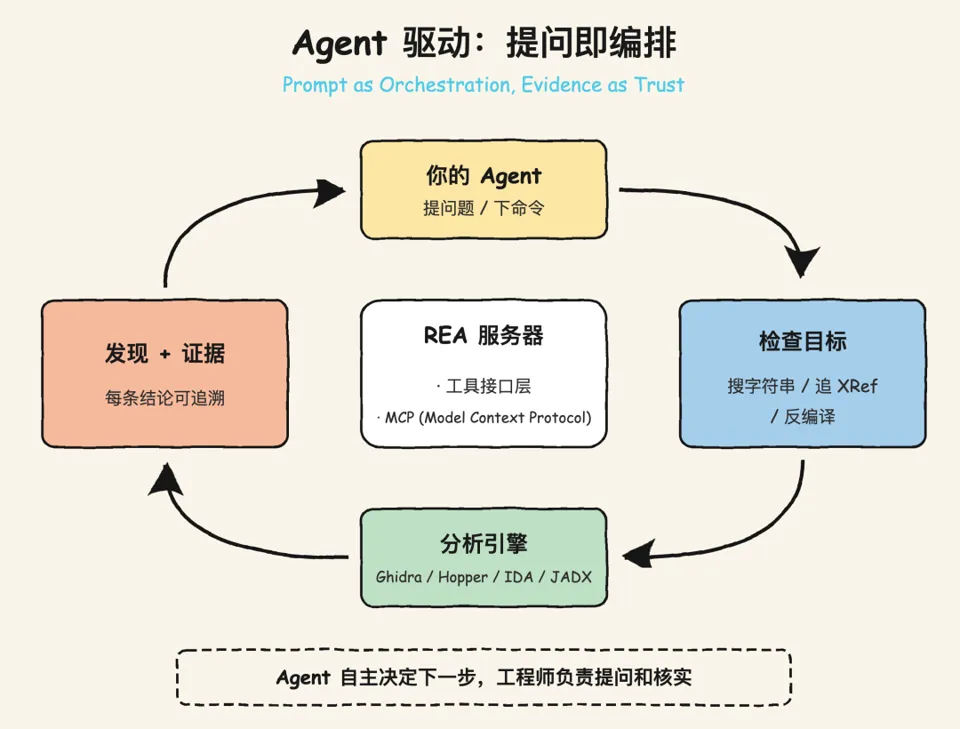
The standard flow is a fixed investigation chain: Open Binary → Search Strings → Trace XRefs → View Call Graph → Decompile → Agent Reconstructs Functionality. The agent autonomously decides what string to search next, which XRef to trace, which function to enter, and when to return to assembly for verification.
3.3 What It Solves in One Sentence
| Challenge | REA's Solution |
|---|---|
| Non-Invokable Tools | Standardized via MCP, connecting GUI tools to programming interfaces. |
| Untraceable Processes | Result Contract: Every finding comes with evidence and limitation notes. |
| Non-Reusable Experience | Injects workflow instructions (skills) during installation, turning investigation methodologies into reusable assets. |
IV. Architecture Breakdown: Four Key Designs
The REA repository is built with TypeScript and Node.js, using Turbo for monorepo management and Vitest for testing. What truly stands out, however, is its four-layer architecture.
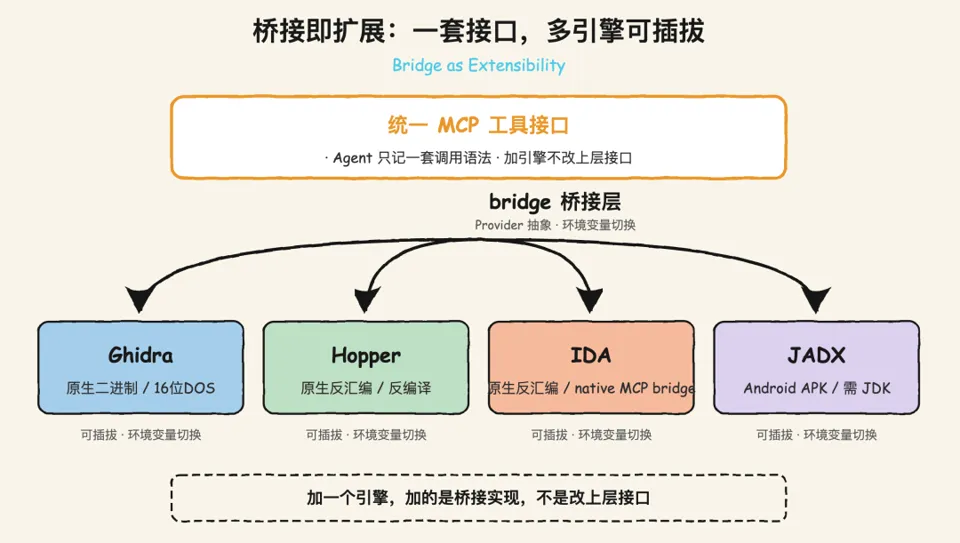
4.1 Bridge Layer: One Interface, Pluggable Multi-Engine Support
🎯 Challenge: Hopper, Ghidra, and IDA are three different decompilers, each with its own API and startup mechanisms. It’s impractical to expect the Agent to memorize three separate syntaxes.
💡 Solution: The bridge/ directory serves as a unified abstraction layer, encapsulating tools from different vendors into consistent MCP tool interfaces. Native analysis supports multi-provider selection, allowing engine switching via environment variables:
# Switch decompilation engines and adjust startup timeouts via environment variables
REA_HOPPER_STARTUP_TIMEOUT_MS=60000
REA_GHIDRA_STARTUP_TIMEOUT_MS=60000
💡 Key Takeaway: Bridging equals extensibility—Bridge as Extensibility. Adding a new engine means adding a bridge implementation, not modifying upper-layer interfaces.
4.2 Static vs. Runtime Layering
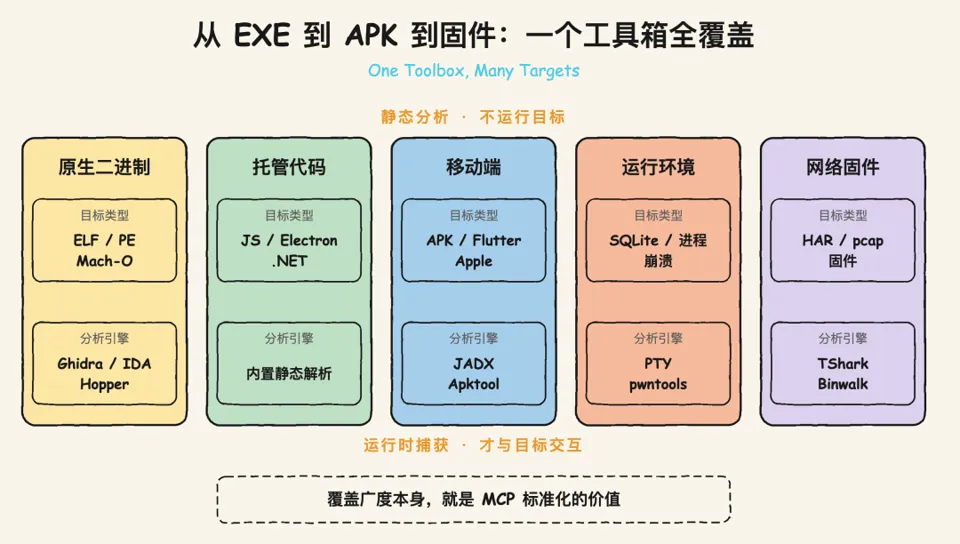
🎯 Challenge: Different target types require completely different analysis approaches. JavaScript and .NET can be analyzed by directly reading files, while native binaries require running Ghidra, and Android targets need JADX.
💡 Solution: REA divides analysis into two layers: "Static" and "Runtime." Static analysis (JS, .NET, APK parsing) reads files directly without executing the target; runtime capture (process behavior, Frida verification) interacts with the target. Target type coverage is extensive:
| Category | Targets | Engines |
|---|---|---|
| Native Binaries | ELF / PE / Mach-O | Hopper / Ghidra / IDA |
| Managed Code | JavaScript / Electron / .NET | Built-in static parsing |
| Mobile | Android APK / Flutter / Apple Packages | JADX + JDK / Apktool |
| Runtime Environment | SQLite / Process Behavior / Crashes | Node.js / PTY / pwntools |
| Network & Firmware | HAR / pcap / Firmware / Signals | TShark / Binwalk / sigrok |
4.3 Result Contract: Findings Must Be Backed by Evidence
🎯 Challenge: Conclusions provided by an Agent are useless without supporting evidence, rendering them untrustworthy and unverifiable.
💡 Solution: All analysis results include evidence and limitation disclosures. Instead of just receiving a statement like "this function does X," the Agent receives details such as "this function is located at address X, called by Y, has decompiled pseudocode Z, and the confidence boundary of the conclusion is W." This aligns directly with the engineering principle of "traceable conclusions."
💡 Key Takeaway: Evidence equals trust—Evidence as Trust. The output of reverse engineering isn't just an answer; it's a replayable chain of evidence.
4.4 Install-as-Injection: npx rea-agents setup
🎯 Challenge: How do you teach an Agent the methodology of reverse engineering investigation, rather than just how to call tools?
💡 Solution: A single command accomplishes three tasks—registering the MCP server, installing workflow instructions (skills), and backing up existing configurations:
npx rea-agents setupAfter running setup and restarting the Agent, it gains reverse engineering investigative capabilities. Official support includes Claude Code, Codex, Cursor, Gemini CLI, Grok Build, etc., while other clients can manually register MCP. This explains its viral popularity: the integration cost is one command, but the value delivered is an entire reverse engineering toolchain.
| Decision | Rationale |
|---|---|
| No Engine Development, Only Bridging | Leverages decades of maturity in Ghidra/IDA, focusing on solving the real problem of "orchestration." |
| MCP Instead of Custom Protocols | Taps into the MCP ecosystem, making it usable by any Agent that supports local MCP. |
| Results Include Evidence | In the Agent era, "traceable conclusions" are a hard requirement, not an optional feature. |
V. Real-World Cases: What Has the Community Already Reverse-Engineered?
Another reason for REA's viral success is the hardcore nature of community cases, each validating whether it can actually get the job done.
Case 1: Byte-Level Reconstruction of DX-Ball Sound Algorithm
For the 1996 pinball game, developers extracted sound left/right channel positioning functions from compiled x86 binaries. After rewriting in C, all 3,205 original test cases passed, and 63 compiled bytes matched the original exactly. This is the official showcase's most hardcore example, proving that the result isn't just "looks similar"—it's genuinely correct.
Case 2: Full Trace of Notion Clipboard Call Chain
Starting from the clipboard API in the Electron renderer process, developers traced through preload scripts and IPC channels all the way to the main process, uncovering the complete data format and message payload for Notion's rich text clipboard. This reverse engineering of Electron's three-tier architecture is one of the community's classic cases.
Case 3: Recovery of Danmaku Angle Calculation in Touhou TH04
For this 16-bit legacy game on the PC-98 platform, developers recovered two sets of danmaku calculation logic (fixed angle and aiming angle) from 16-bit assembly instructions. They also cross-validated the reconstruction against historical compiler outputs. This holds significant value for mod authors and retro game preservationists.
Case 4: Standalone Android App for Sony Sound Connect
Community developers connected a Samsung S24 Ultra and used Codex with REA to analyze Sony's official app. They reverse-engineered the implementation chain of the Wind Noise Reduction feature and created a standalone app—enabling noise reduction immediately upon launch. This is currently the closest case to "extracting functionality from a real commercial app."
Case Study 5: 99% of a Shooter Game’s Functions Restored to C++
A dozen agents worked in parallel to restore 99% of the functions from a commercial shooter game into C++, with 83% compiling to byte-for-byte identical binaries compared to the original program. This case utilized Hex-Rays’ official MCP rather than REA, but it remains a representative example of this wave of AI-driven reverse engineering, demonstrating the feasibility of parallel agent-based reverse engineering.
Other community examples include: YuriRDev reverse-engineered their own home IoT software in under 12 hours to enable PC control; greco reverse-engineered their own TV; and BrOrlandi reverse-engineered a Xiaomi body fat scale and open-sourced the dashboard. The common thread among these cases is that the publishers were not professional reverse engineers, but "ordinary developers who know how to ask questions."
VI. Impact and Methodology: From "Tool Proficiency" to "Questioning Skills"
6.1 Quantitative Comparison
| Dimension | Traditional Reverse Engineering (Human + Tools) | Agent-Based Reverse Engineering (REA) | Change |
|---|---|---|---|
| Entry Barrier | Months spent mastering GUI tools | A single npx rea-agents setup command | Months → Minutes |
| Analysis Process | Occurs in the analyst's mind, no documentation | Every finding includes evidence and is replayable | From None to Full Traceability |
| Experience Reuse | Relies on mentorship and tribal knowledge | Workflow instructions + community case studies | Assetization |
| Target Scale | Single-point analysis | Can ingest entire targets tens of MBs in size | Order-of-Magnitude Leap |
6.2 Triple Breakthrough in Value Proposition
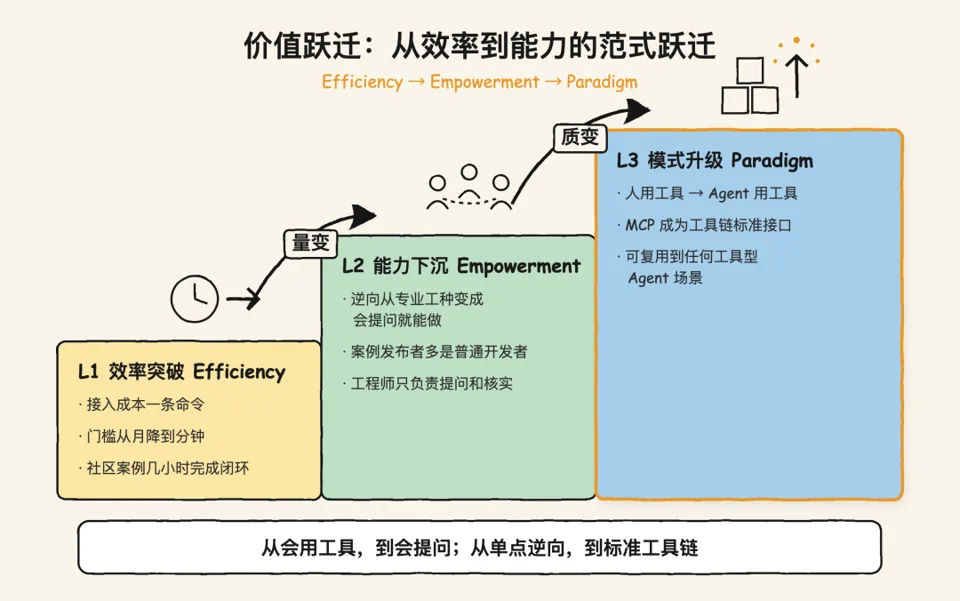
⚡ Quantified Efficiency Gains: Onboarding costs dropped from "months of tool mastery" to "a single command," with community cases completing full reverse-engineering loops in hours to days. 📥 Capability Democratization: Reverse engineering has shifted from a specialized trade to a skill for "engineers who can ask questions"—many case publishers are ordinary developers. 📚 Paradigm Upgrade: The true trend significance lies in "humans defining requirements, Agents executing via tools" beginning to cover reverse engineering, a domain previously most dependent on manual expertise.
6.3 Methodological Insights
6.3.1 Bridge as Extensibility
REA does not rewrite engines; it provides a unified bridge. Adding a decompiler means adding a bridge implementation without altering upper-layer interfaces. This approach is far smarter than "building a proprietary reverse-engineering engine from scratch"—it stands on decades of accumulated expertise from Ghidra and IDA, focusing instead on solving the orchestration problem, which had remained unsolved.
6.3.2 Evidence as Trust
In the age of Agents, reverse-engineering output is not just "an answer," but "a replayable chain of evidence." Where is the function? Who calls it? What is the pseudocode? Where are the boundaries? Missing any of these elements renders the result untrustworthy.
6.3.3 Prompt as Orchestration
The investigative workflow of reverse engineering (search strings → trace XRefs → decompile → reconstruct) is codified into workflow instructions. Agents autonomously determine the next step, while engineers focus solely on asking questions and verifying results.
VII. Boundaries and Limitations: What REA Cannot Do Yet
Of course, REA is not a magic bullet for "reverse-engineering everything."
Unsuitable Scenarios
- Complex Obfuscation, Anti-Debugging, VM Shells: When encountering commercial-grade hardening, Agents still get stuck. This limitation stems from the inherent boundaries of decompilation engines themselves, not something bridging can solve.
- Kernel-Level Logic, Driver Reverse Engineering: These require deeper dynamic debugging capabilities, which the current static-first approach of REA does not fully cover.
- Targets Requiring Legal Authorization: REA explicitly states it is intended only for legitimate research, education, interoperability, and software preservation—analyzing software you own or are authorized to inspect. Community cases (reverse-engineering personal TVs, body fat scales) all adhere to this principle.
Core Judgment
If the scenario is "understanding how a feature works in software you own," REA is highly effective. If the scenario involves "breaking commercial protections or bypassing legal restrictions," REA is neither capable nor appropriate.
VIII. Conclusion
The rise of AI-assisted reverse engineering marks a shift from artisanal craftsmanship to industrialized automation. By lowering barriers, standardizing workflows, and emphasizing evidence, tools like REA are transforming reverse engineering from a niche skill into a broadly accessible capability for modern software engineers.