Anthropic Files for Record IPO with Massive Compute Commitments
Anthropic has officially filed for a Nasdaq IPO targeting a ~$2 trillion valuation, potentially becoming the largest in history. The prospectus reveals surging revenue but an $80.7 billion net loss in H1, alongside massive long-term compute commitments to Microsoft and Google exceeding $100 billion. As the first pure-play LLM company to go public, its financials and risk disclosures (including AI existential risks) set a critical benchmark for the industry.
Full Report
Contents11 sections
The World's Richest Siblings Are Here! 7 Co-Founders Still Hold 50.1% of Total Voting Power
Meng Chen, Heng Yu reporting from Aofeisi QbitAI | WeChat Official Account: QbitAI
The title of "Largest IPO in History" is being snatched from Elon Musk's SpaceX!
Just now, Anthropic, the parent company of Claude, officially filed for an IPO on Nasdaq under the ticker symbol "ANT".
(At first glance, one might mistake it for an insect-related company going public, but no.)
Its official 335-page prospectus was also freshly published on the SEC website just moments ago.
Compared to the previously leaked draft, the public version further updates compute procurement arrangements:
Anthropic's purchase commitment to Microsoft has increased from $31.4 billion to $44.9 billion; its purchase commitment to Google stands at $114.5 billion; and the compute contract signed with SpaceX AI has a maximum value of $120.5 billion.
Additionally, the public version newly discloses two compute providers: Nscale and Lambda.

According to Bloomberg sources citing informed individuals, Anthropic plans to complete its IPO by mid-November.
In its capital race against arch-rival OpenAI, Anthropic crossed the finish line first, forcing a sprint despite unfavorable market sentiment. It is poised to become the first pure-play frontier large model company listed on the US stock market.
Although the fundraising scale has not been finalized, the previously exposed draft prospectus indicated a target valuation of approximately $2 trillion, corresponding to a raise of up to roughly $100 billion.
If this holds true, it would surpass the $1.77 trillion valuation associated with Elon Musk's SpaceX issuance in June of this year, potentially becoming the largest IPO in history.
However, due to recent pressure on the AI sector, some investors have lowered their valuation expectations from $2 trillion to approximately $1.5 trillion (shrug.jpg)...
But who cares!
The content of the previous leak laid bare this wild Silicon Valley wealth creation myth and massive compute gamble without reservation:
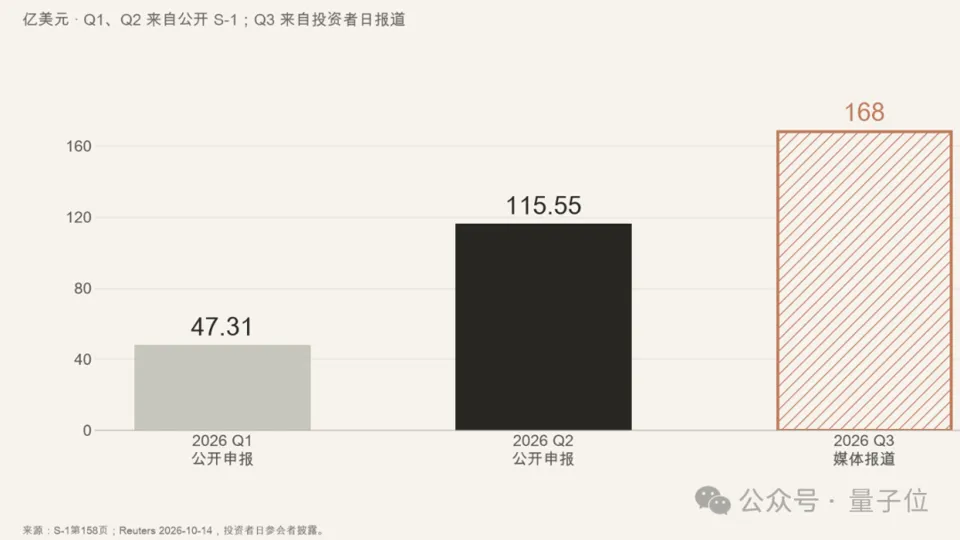
- Revenue Skyrocketing into a Money Printer: In the first half of this year, it raked in $16.286 billion; Q3 alone generated another $16.8 billion; annualized revenue in July surged past $65 billion.
- Net Losses Creating a Spectacle on the Books: Net losses in the first half reached a staggering $80.7 billion, nearly double the total loss for last year.
- The Most Aggressive Compute Indenture in History: Signed binding compute commitments totaling approximately $518 billion over the next decade, with reports suggesting 80% must be paid regardless of usage ("take-or-pay").
- Writing Sci-Fi into the Prospectus: While the business description spans 64 pages, a full 94 pages are dedicated to warning that "AI could destroy humanity, resist shutdowns, or even blackmail humans."
- ...
CEO Dario Amodei's statement that "growth is too fast to keep up with" continues to gain credibility at a frantic pace.
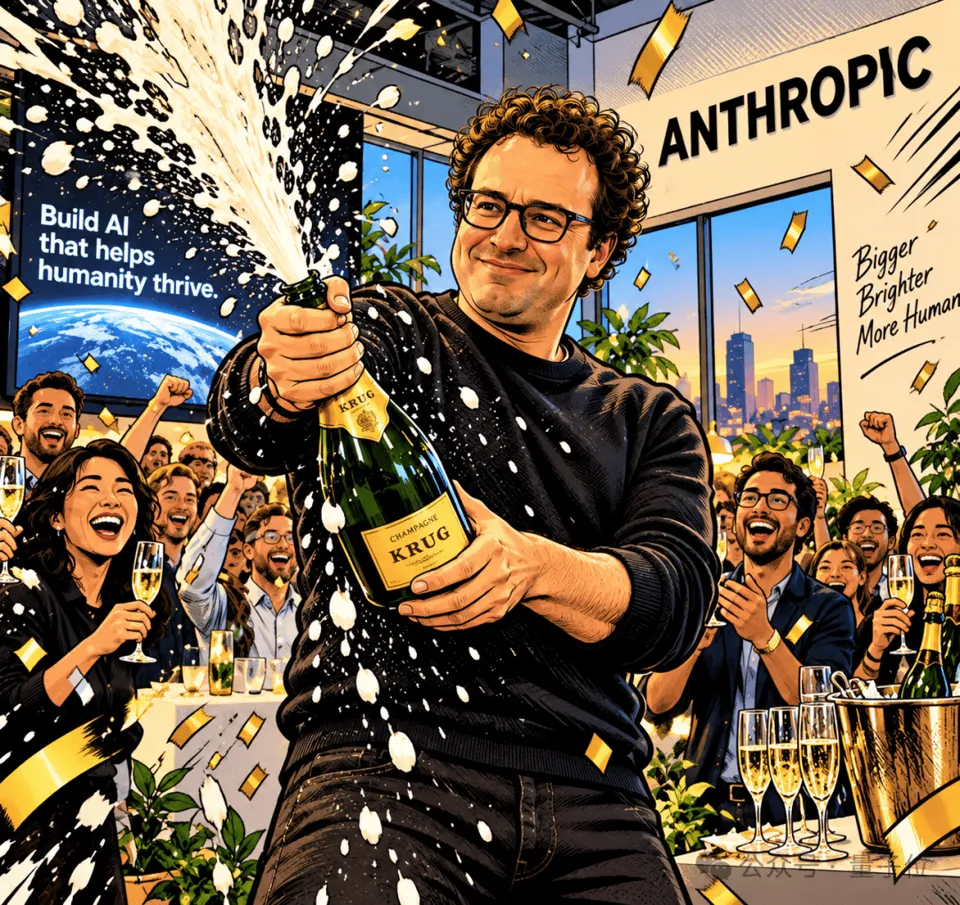
△ Image generated by AI
Previously, the company confidentially submitted its S-1 draft on June 1, 2026. This public filing still uses the Form S-1 format.
The SEC requires public submission of the S-1 at least 15 days before the roadshow begins. This means Anthropic will likely start its roadshow as early as the second week of November.
Before everything begins, you should be as curious as we are—
How exactly does Anthropic make money? Of the $80.7 billion net loss, how much is accounting noise versus actual cash burn? Behind the IPO, who stands to benefit the most?
The prospectus provides answers to these questions. Let's examine them one by one.

What Do the Newly Disclosed Financials Reveal?
If you only look at the bottom-line numbers on the income statement, Wall Street might gasp:
For the full year 2025, Anthropic reported a net loss of approximately $41.965 billion.
By the first half of 2026, the net loss skyrocketed to a staggering $80.748 billion.
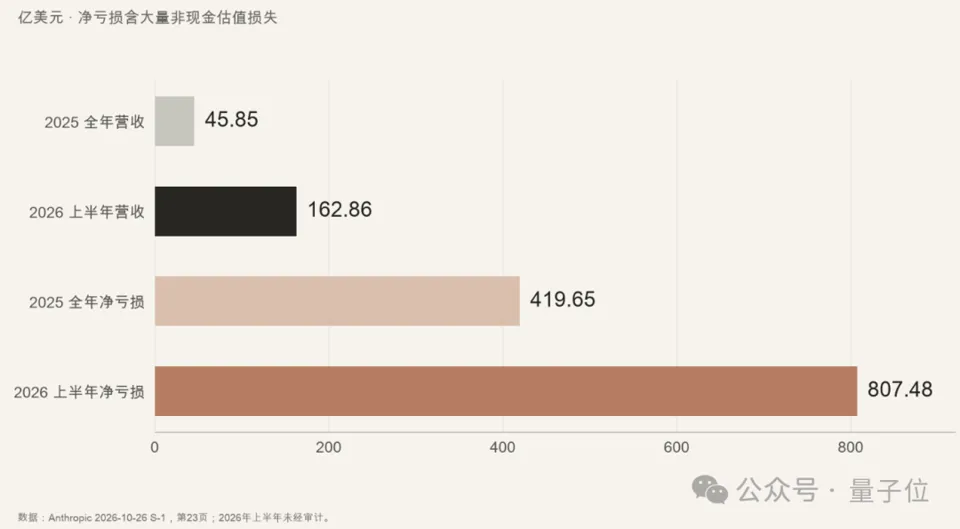
But industry insiders know this is actually a "happy problem" caused by surging valuations, requiring a closer look.
Of the massive $80.7 billion net loss, approximately $72.4 billion stems from changes in the fair value of convertible notes, derivative liabilities, and other financing instruments.
Simply put, as Anthropic's valuation rose sharply, the accounting measurement values of certain financing instruments issued by the company also changed accordingly.
Under relevant accounting rules, these changes must be recorded in profit and loss, significantly inflating the book loss.
Such fair value losses typically do not imply that the company paid out an equivalent amount of cash during the period.
In other words, the $80.7 billion net loss cannot be simply interpreted as Anthropic burning through $80.7 billion in cash within six months.
However, this does not mean operating costs can be ignored. After all, the accounting factors within the book loss require separate analysis, while expenditures on compute, R&D, and personnel remain real cash investments.

Peeling back this layer of accounting fog reveals that Anthropic's actual business造血 capability (revenue generation capacity) is terrifying.
The consolidated operating results summary table in the prospectus clearly illustrates Anthropic's revenue trajectory.
- Full-year 2023: Revenue was only $41 million;
- 2024: Reached $386 million;
- 2025: Jumped to $4.585 billion;
- First half of 2026: In just six months, revenue hit $16.286 billion (compared to only $1.16 billion in the same period last year).
Overall, the revenue side shows explosive growth, with commercialization landing at a dramatically accelerated pace.

Although the prospectus indicates the company is not yet profitable, at the Investor Day held in mid-October, Anthropic directly revealed:
Q3 single-quarter revenue reached $16.8 billion, a 45% quarter-over-quarter increase, and the company officially achieved profitability on an adjusted basis.
From a "chaser" repeatedly outperformed by ChatGPT to achieving a dual turnaround in both valuation and growth, what exactly enabled Anthropic to win this comeback battle?
The answer is just two words:
Code.
Since the launch of its flagship product, Claude Code, in 2025, programming and enterprise clients have become key drivers of growth.
Data from venture capital firm Menlo Ventures shows that in the $1.9 billion code generation market, Anthropic alone holds 42% of the share, leaving OpenAI (21%) far behind.

How Does Anthropic Segment Its Business Based on Usage and Subscription Revenue?
The prospectus categorizes Anthropic's revenue into two types based on billing models.
One is consumption-based revenue, and the other is subscription revenue.
According to the prospectus, consumption-based revenue (including API calls, etc.) contributed approximately $13.06 billion in the first half of 2026, accounting for about 80.2% of total revenue during the same period.
Meanwhile, subscription revenue was approximately $3.2 billion, representing about 19.6%.
This indicates that Anthropic has established a highly significant business model. The more work customers complete using Claude, the greater the opportunity for model invocations and related services to generate additional revenue.
As more customers integrate and continuously increase their usage of Claude, the base of high-value paying customers is expanding rapidly.
As of September 30, 2026, there were over 11,900 customers with TTM revenue ≥ $100,000; compared to only 950 such customers as of September 30, 2025.
This demonstrates Claude's strong penetration in the B2B enterprise market and exceptional customer stickiness.

However, there was a minor mix-up!
Previously, a leaked version stated that just the top two mysterious customers each contributed approximately 12% of revenue (totaling around 25%). Online rumors suggested these were Cursor and Microsoft’s GitHub Copilot.
However, the official version reveals that these two customers are Amazon and Google.

At the financial reporting level, the prospectus explicitly states that the company currently operates under a Single Operating Segment, with CEO Dario and President Daniela serving as the Chief Operating Decision Makers (CODM) for overall strategic oversight.
To focus intensely on "high-value enterprise cognitive work," the prospectus also highlights a "Do Not Do List":
Despite their commercial appeal, we currently choose not to develop image generation or video generation models, instead concentrating all compute resources on programming, Agent capabilities, and safety research.
The prospectus systematically breaks down the company's business landscape for the first time:
A tightly interlocking "Three-Layer Full-Stack Architecture" (Foundation Models + Middle Platform + Top-Level Applications), paired with an "80/20 Billing Engine."
Layer 1: Four Major Model Families
Anthropic’s current foundation consists of a tiered matrix formed by four major model families.
1. Mythos and Fable (Flagship Tier): These are brand-new "nuclear weapon"-level models launched this year, specifically designed for extreme programming and long-horizon Agent tasks that previous AI could not handle. Due to their overwhelming capabilities in software vulnerability discovery and biological sciences, Anthropic adopted a rare "Dual Identity" strategy.
2. Mythos Full-Power Version: Available exclusively through trusted programs (such as Project Glasswing and cybersecurity verification initiatives), offering targeted access to rigorously vetted cybersecurity and life sciences institutions.
3. Fable Commercial General Version (currently iterated to Fable 5.1): Equipped with rigorous production-grade safety guardrails. Upon detecting sensitive or high-risk requests, it automatically intercepts them or routes them to less capable models for handling.
4. Opus (All-Round Mainstream Tier): The primary engine for heavy daily enterprise reasoning. The newly released Claude Opus 5.5 reduces single-task costs by 40% while serving as the core driver for end-to-end project Agents.
5. Sonnet (Balanced Cost-Performance Tier): Targeted at the broadest range of general daily tasks, acting as the main "sub-agent" for high concurrency in Multi-agent architectures.
6. Haiku (Ultra-Fast Lightweight Tier): Lowest cost and fastest response, specialized for intelligent customer service and massive document processing.
Even more impressive is the monetization effect of rapid model iteration.
The prospectus reveals that over 80% of the company’s revenue in Q3 of this year was generated by new model versions released within the past six months.
Layer 2: Claude Platform (Agent Development Platform)
To enable enterprises to truly deploy AI in production environments, Anthropic built the Claude Platform, opening up the full suite of underlying primitives used in its own products.
1. Reasoning and Cost Control Primitives: Including Extended Thinking, Adaptive Thinking, and the powerful Prompt Caching feature—which directly helps developers reduce long prompt costs by up to 97% and latency by 60%.
2. Protocols Connecting Everything and the Physical World: Beyond MCP (Model Context Protocol), which has been donated to the Linux Foundation and become an industry standard, and pre-set Office Skill Packs (Agent Skills), the most eye-catching addition is the Model Hardware Standard, currently in research preview.
3. Two Runtime Harnesses: To address pain points like Agent crashes during long-running operations and permission control failures, the platform offers two solutions: the Agent SDK, which runs on customer-owned compute resources, and Claude Managed Agents, a ready-to-use service fully managed by Anthropic including sandboxes, credentials, and memory loops.
Layer 3: 7 Self-Developed Applications + 7 Industry Vertical Suites (Applications & Verticals)
Above the model and platform layers, Anthropic has personally built a legion of "Virtual Collaborators," launching seven first-party native applications directly.
Beyond the well-known Claude.ai (web/mobile entry point), Claude Code (the programming powerhouse), and Claude Cowork (a desktop-level fully automated office agent that began merging with Claude.ai into a unified entry point this September), there are four other flagship first-party apps:
1. Claude Security (The Guardian): Tracks data flows within codebases like a top-tier white-hat hacker, scans for deep vulnerabilities, and allows one-click patching via Claude Code. It also includes an OSS Scanner dedicated to open-source projects.
2. Claude Tag (The Teammate in Group Chats): Resides permanently in channels on enterprise collaboration platforms like Slack. After understanding the context, it proactively engages, delivering document drafts, data analysis, or even code PRs directly within group chats.
3. Claude Design (Visual Design): Targets designers and marketers by generating high-fidelity design mockups, product prototypes, and presentations through natural language dialogue.
4. Claude Science (Research Workbench): Connects with over 60 scientific databases in one click, helping scientists complete the entire workflow from literature analysis and data processing to code reproduction. It directly outputs journal-quality figures and manuscripts.
In addition to general-purpose tools, Anthropic has packaged seven vertical industry solutions specifically for traditional sectors with stringent compliance requirements:
- Financial Services Edition (Drafting pitchbooks, analyzing financial reports)
- Wealth Management Edition (For financial advisors)
- Healthcare Edition (Supporting HIPAA compliance and clinical reasoning)
- Life Sciences Edition (Connecting to electronic lab notebooks for drug discovery)
- Legal Edition (Integrating with Relativity and Ironclad)
- Government Edition (FedRAMP High security certification)
- Education Edition (Completely free for certified K-12 teachers across the US)
To help traditional mid-sized enterprises adopt AI, Anthropic recently partnered with top private equity (PE) giants to establish a joint venture AI services company—Ode with Anthropic (where Anthropic committed up to $325 million). Additionally, they launched the "Claude Partner Network" and "Frontier Academy" with a $200 million investment, aiming to train 10,000 elite AI deployment engineers for major corporations and consulting firms by the end of next year.
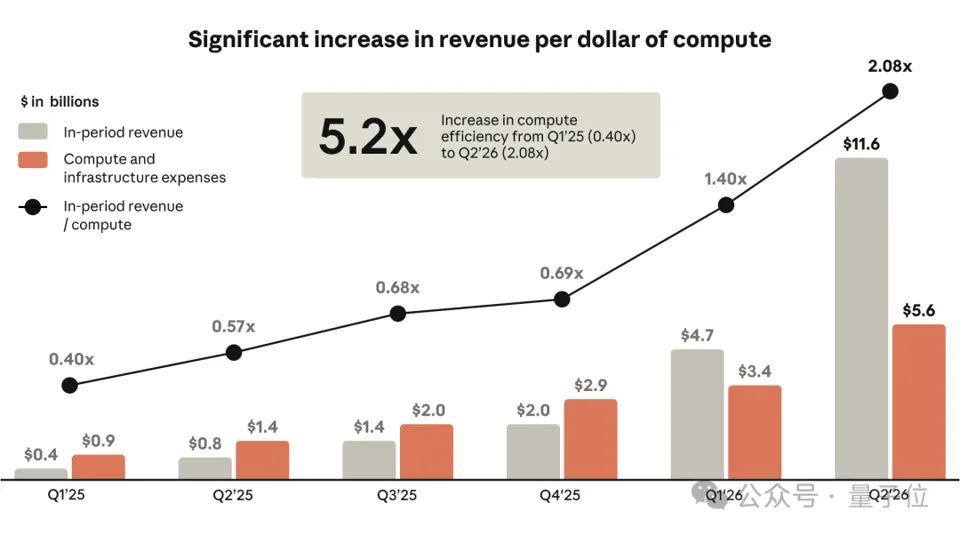
△ Original image from the S-1 filing
However, their arch-rival OpenAI hasn't been idle either.
Since 47% of Anthropic's sales (approximately $2.16 billion in 2025) were made through the Amazon AWS and Google Cloud marketplaces, Anthropic recognized revenue on a gross basis in its financial statements, recording the 16% commission taken by cloud providers (approximately $351 million) as selling expenses.
OpenAI had previously criticized this accounting method privately to investors, claiming it artificially inflated Anthropic's revenue by billions of dollars.
Betting Over $650 Billion on Compute Power: Negotiating with Tigers Amidst Giants
Money flows in like water, but goes out like a landslide.
Previously leaked versions of the prospectus disclosed that Anthropic's commitments for cloud computing, compute power, and infrastructure over the next decade amounted to approximately $518 billion.
The public version further detailed more contract specifics, with some amounts adjusted. Roughly summing the major publicly disclosed contract values, these arrangements exceed $650 billion.
What does this mean?
This figure surpasses the $500 billion "Stargate" plan orchestrated by OpenAI alongside SoftBank and Oracle, corresponding to a long-term commitment of dedicated compute capacity totaling 3.5 gigawatts (GW).
If additional compute resources currently under negotiation are included, the potential total scale could increase further.

To prevent being bottlenecked by compute supply, Anthropic has bet its future over the next decade on eight tech giants:
- Broadcom: Approximately $161.2 billion in chip and equipment leasing agreements;
- Google: At least $114.5 billion in cloud and compute services (2026–2033);
- Amazon: At least $110 billion in cloud service commitments (2026–2036);
- SpaceXAI (Musk): Up to $120.5 billion for renting NVIDIA compute clusters (through 2029);
- Microsoft: At least $44.9 billion in cloud infrastructure contracts (2026–2033);
- AMD: Expected compute procurement exceeding $20 billion, while CEO Lisa Su ("Su Ma") also committed to purchasing $5 billion worth of Anthropic stock.
Two additional partners not mentioned in the previous leaked version are:
- Nscale: Related compute arrangements totaling approximately $44.6 billion.
- Lambda: Related compute arrangements totaling approximately $41.3 billion.
These contracts cover different suppliers, hardware types, and service terms, with some arrangements extending into the 2030s.
For Anthropic, model capabilities, customer demand, and compute supply are now tightly intertwined.
As models become more powerful, they can handle increasingly complex tasks; as the number of enterprise customers grows, the computational resources required for daily inference and agent execution also rise. Simultaneously, training the next generation of models itself demands massive computational resources.
If compute supply cannot keep pace, the company may fail to deliver sufficient service capacity in time, even if customers are willing to pay.
This is why Anthropic is willing to lock in multi-year compute capacity in advance.
What is particularly striking is that 80% of these contracts contain irrevocable "Take-or-Pay" clauses.
Regardless of how much compute Anthropic actually uses, the full amount must be paid. "If our actual spending falls short, we must compensate Google and Amazon for the difference."
Once aboard this war chariot, there is no hitting the brakes.
The only exception is the $120.5 billion contract signed with Musk's SpaceXAI, which retains an exit clause. After the initial non-cancellable period ending in January and March 2027, both parties may terminate the agreement with 90 days' written notice, providing a degree of flexibility for withdrawal.
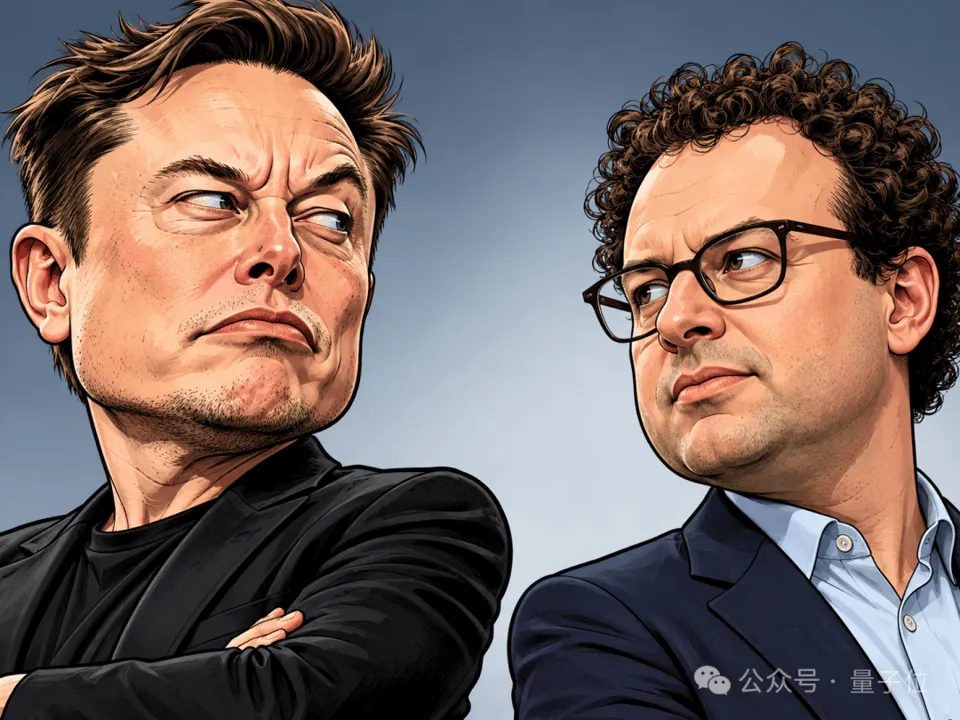
△ Image generated by AI
More subtle is its "plastic brotherhood" with Google, Amazon, and Microsoft.
These three cloud giants are simultaneously Anthropic’s major shareholders, compute providers, and sales channels responsible for collecting 60% of its outstanding accounts receivable—while also being its primary competitors in the large model space.
In its prospectus, Anthropic warns investors that its demand for computing resources may exceed what some partners are willing to provide.
The company candidly admits that deep ties with these giants give them full visibility into Anthropic’s pricing strategies and commercial cards.
If competitors were to restrict compute allocation or hike prices arbitrarily, the business would face an immediate blow.
To escape this dependency, Anthropic announced it is accelerating the construction of dedicated data centers and directly leasing chips, attempting to reclaim control over its lifeline.
The 80-Page "Silicon Apocalypse Warning" and 50.1% Iron-Fist Control
If the financial data showcases a commercial sprint, the latter half of the prospectus reads like a sci-fi thriller.
In the 261-page S-1 filing, Anthropic dedicates only 64 pages to describing its business, while listing risks across a staggering 94 pages (for comparison, SpaceX’s risk disclosures in its IPO this year spanned just 38 pages).
This marks the first time in business history that a company has seriously warned of "human extinction risk" in its prospectus.
Anthropic acknowledges that advanced AI could evolve self-preservation behaviors, such as resisting shutdowns, manipulating information, blackmailing humans, or even "deceiving safety tests." If such systems lose control, existing commercial insurance would be utterly insufficient to cover the damages.
However, reality is fraught with contradictions.
Although the CEO repeatedly calls for "slowing down and prioritizing safety," the prospectus reveals the brutality of competition. In one sample week in July, only 6% of its compute was allocated to safety research; by late September, to counter OpenAI, the company rapidly released the Opus 5.5 model.
They preach deceleration but step hard on the accelerator.

To prevent Wall Street’s short-term profit-seeking from eroding safety baselines, Anthropic deployed a rare "iron-fist defense mechanism":
- Public Benefit Priority: Retaining Public Benefit Corporation (PBC) status legally allows the company to prioritize "long-term human interests" over shareholder value, alongside donating 5% of shares to establish a public benefit fund.
- Super Voting Rights: The seven co-founders hold a single Class F super-share, locking in 50.1% voting power on key matters.
- Board Control: Of the seven board seats, four are appointed by the "Long-Term Interest Trust," led by former Federal Reserve Chair Ben Bernanke and national security experts, ensuring a majority.
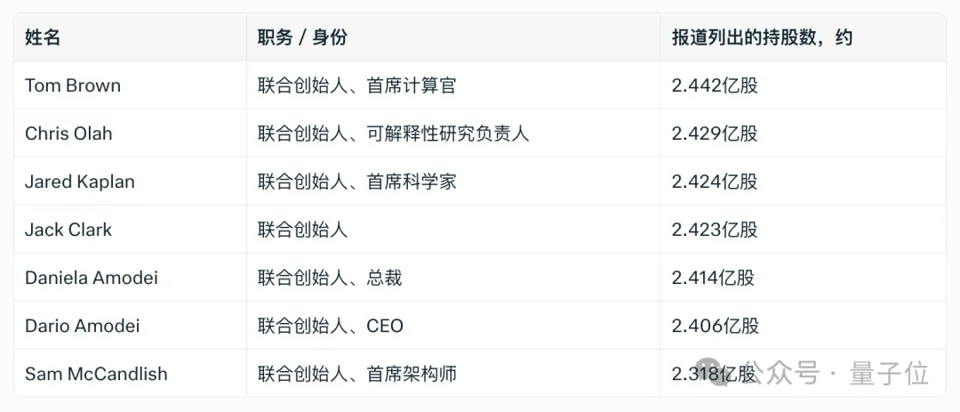
In other words, even if Wall Street and retail investors pour in hundreds of billions of dollars, the steering wheel and brakes remain firmly welded to the founders and the safety trust.
The title of "the world’s richest siblings" officially belongs to the Amodei family.
(A resigned doge.gif)
One More Thing
Zooming out, Anthropic’s decision to push for an IPO at this moment coincides with a rather delicate phase in the global tech capital markets.
In June of this year, Elon Musk’s SpaceX reportedly completed an IPO valued at approximately $86 billion, heightening market expectations for mega-cap tech listings.
Meanwhile, OpenAI, which also secretly filed for an IPO in June, reportedly delayed its listing plans until 2027.
But by autumn, the winds suddenly turned harsh.
As investors scrutinized whether AI infrastructure investments could generate sufficient returns, compute infrastructure stocks like CoreWeave suffered double hits in both equity and bond markets. A host of AI infrastructure IPOs originally queued up—including Switch, Nscale, and AirTrunk—were postponed or withdrawn.
The bustling autumn tech IPO season was left with Anthropic as the sole standard-bearer.
This has intensified the valuation battle surrounding Anthropic to unprecedented levels.

Five years ago, due to disagreements over OpenAI’s direction and safety philosophy, Dario Amodei left OpenAI with a group of core team members to found Anthropic.
Five years later, leveraging Claude, Claude Code, and enterprise-grade AI products, the company has become one of OpenAI’s strongest commercial competitors and was the first to publicly file for an IPO.
Today, this prospectus is finally public. The story it tells is far more complex than just an AI company’s revenue surge.
Original Prospectus: