Northwestern and Google Unveil Self-Improving Agent Harness Method
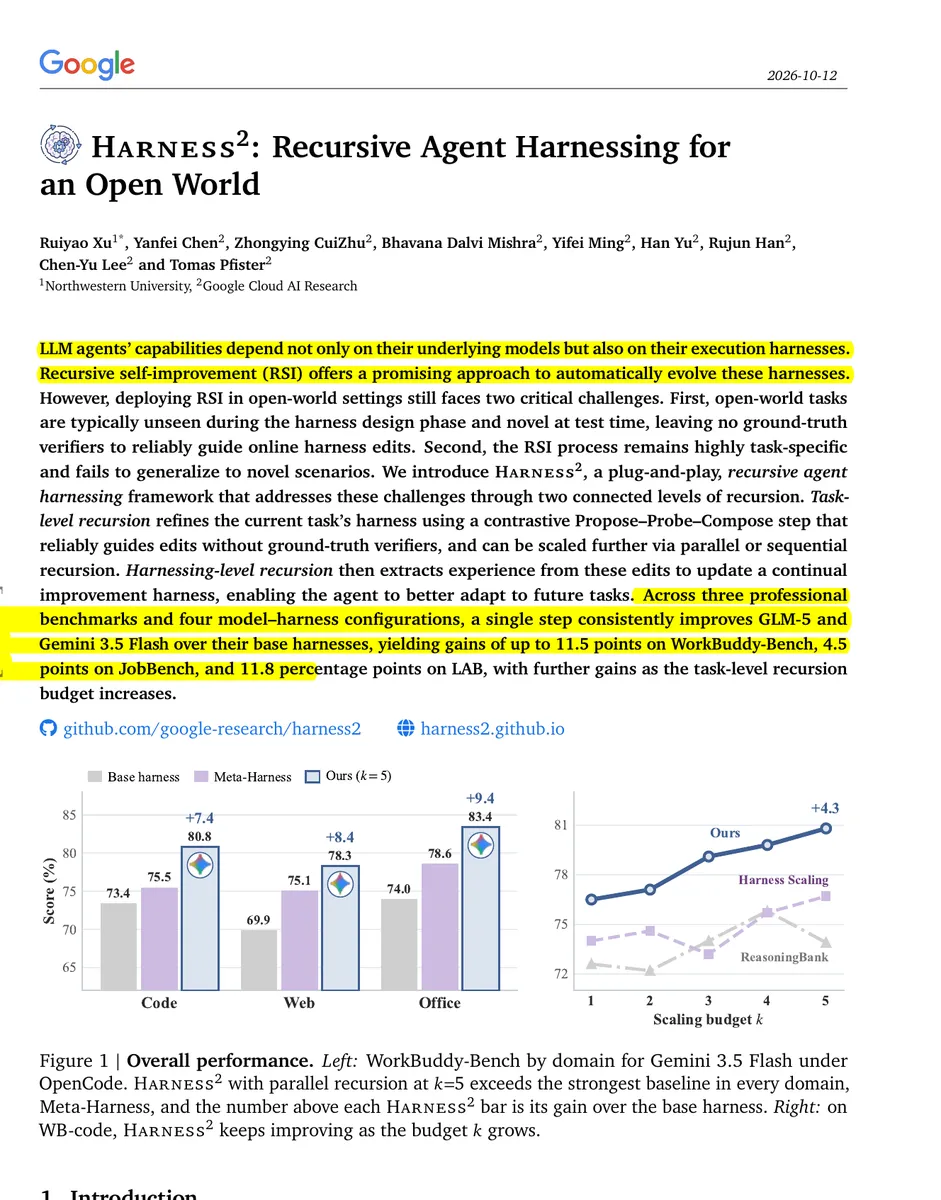
A Northwestern and Google paper introduces Harness2, which lets agents self-improve their harness (prompts, tools, skills, memory) on new tasks without answer keys by test-running proposed edits and keeping only those that help. A single improvement step lifted GLM-5 by 11.5 points on WorkBuddy-Bench, surpassing Gemini 3.5 Flash on its stock harness, while unvalidated harness edits dropped coding scores from 73.4 to 63.2.
Related Entities
Full Report
Rohan Paul (@rohanpaul_ai) · 2026-11-15 00
New Northwestern and Google paper shows that agent harnesses can improve themselves on new tasks without answer keys, by test-running edits and keeping what helps.
An agent's harness is the prompts, tools, skills, and memory wrapped around the model. Tuning it by hand is slow, and new real-world tasks come with no answer key to tune against.
Harness2 runs the agent, has an editor model propose harness fixes, then reruns the task to see which fixes improved the agent's behavior. Lessons from each task go into a library that guides edits on the next one.
A single improvement step raised GLM-5's WorkBuddy-Bench score by 11.5 points, past Gemini 3.5 Flash on its stock harness. Editing the harness without those test runs instead dropped coding scores from 73.4 to 63.2.
Treat your agent's harness as something to revise per task, and keep only the edits that change its behavior on real runs.