XPeng & Universities Release GroundingPI, Outperforming GPT-6 in Embodied Perception
XPeng, Peking University, and HKU released GroundingPI, an embodied perception foundation model. Adopting a 'perception-first' approach trained on action-free data, it outperforms OpenAI's GPT-6 Astra across 34 benchmarks. The model aims to enhance robotic spatial grounding and reduce demonstration costs. Currently a research prototype, its code and weights are open-source.
Full Report
IT Home reported on November 4 that XPeng Group, in collaboration with research teams from Peking University, the University of Hong Kong, and other institutions, has released its latest research findings on an embodied perception foundation model: GroundingPI.
According to official statements, this study proposes a "perception-first" technical approach. With approximately 4 billion parameters, GroundingPI ranked first in comprehensive evaluations across 34 public perception benchmarks. It also demonstrated higher data processing efficiency and stronger scene generalization capabilities in robotic simulation tasks.
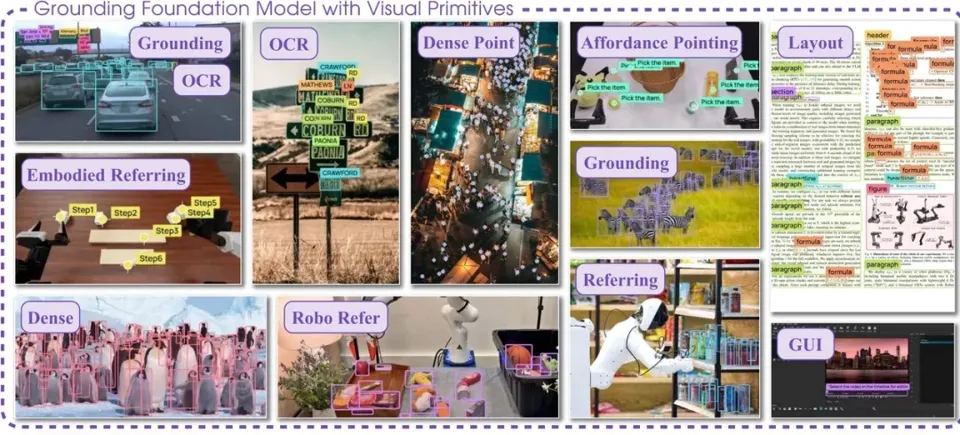
▲ GroundingPI demonstrates perception capabilities based on visual primitives (the smallest building blocks of an image) across various scenarios and abilities.
The research team compared GroundingPI with OpenAI's frontier model, GPT-6 Astra, using the same set of 34 perception benchmarks. Calculating the equal-weighted average across these 11 capability categories, GroundingPI scored 73.68, while Astra scored 71.54.
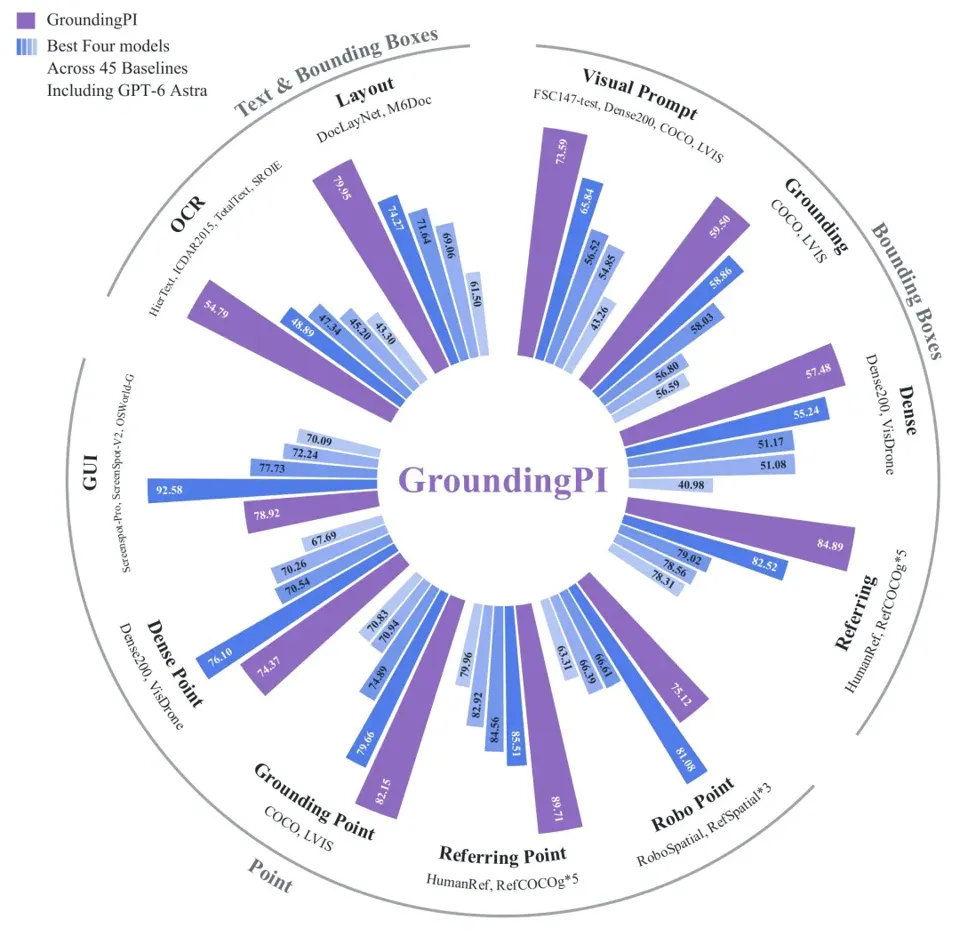
▲ Comparison of multi-category perception benchmarks: Purple represents GroundingPI, while blue represents the top 4 competing models in each capability category, including GPT-6 Astra.
The report explains that GroundingPI posits that precise perception of spatial positions—both of the agent itself and surrounding objects—is the primary prerequisite for embodied intelligence. Perceptual representation is crucial for Physical AI. If a model cannot accurately locate targets within an image, no amount of learned action knowledge can be effectively implemented.
Based on this premise, during the training phase, GroundingPI does not use robot data labeled with joint actions. Instead, it relies entirely on pure perception data without action labels. This data covers 11 categories of perception capabilities, including general detection, dense small object detection, referring expression grounding, text recognition, document layout analysis, UI element detection, and robotic spatial localization. The goal is to ensure the model first understands "what the object is and where it is located in the image."
For example, if we ask the model to find "the handle of the cup on the right," it must mark the specific locations of the cup and the handle using points or bounding boxes. Simply answering "there is a cup in the image" is insufficient; the target described in language must correspond to a specific region in the visual input. The project name derives from this concept: "Grounding" refers to the core perceptual capability of visual localization, while "PI" stands for Physical Intelligence.
Official sources state that while this research is currently at the scientific prototype stage, its experimental design already indicates a clear direction for implementation in the embodied AI field. Current simulation results directly address two core challenges in quantitative deployment:
- First, significantly reducing teaching costs. Typically, robots require thousands of manually collected demonstration data points to complete each new task. Systems using GroundingPI as their visual foundation achieved success rates exceeding those of comparison models trained on 75% of the data, using only 50% of the demonstration data. This efficiency stems from GroundingPI directly handling the task of learning "where objects are," which traditional Vision-Language-Action (VLA) models struggle with. This implies that in actual deployments, the volume of manual demonstrations required to achieve equivalent success rates can be drastically reduced.
- Second, enhancing scene generalization. A major pain point in current robotics deployment is performance degradation when switching spaces or changing objects; tasks previously mastered often fail under new conditions. GroundingPI’s robust perception capabilities allow robots to maintain high stability when facing variables such as changes in material, object category, container type, or background, ensuring execution performance is not compromised by environmental shifts. In high-density simulation scenarios like bulk sorting and bin counting, GroundingPI-based systems can classify and grasp similar workpieces and quickly adapt to item shapes. This provides experimental support for the concept of "reusing a single set of weights across different workstations."
Links provided by IT Home:
- Website: https://groundingpi.github.io/
- Paper: https://arxiv.org/abs/2609.39601
- Code: https://github.com/groundingpi/GroundingPI
- Model: https://huggingface.co/GroundingPI/GroundingPI
Advertisement Disclaimer: External links contained in this article (including but not limited to hyperlinks, QR codes, and passcodes) are provided to convey additional information and save selection time. Results are for reference only. All IT Home articles containing external links include this disclaimer.