Ant Group's Lingbo Open-Sources Embodied Base Models with Cross-Task Spatial Memory
Ant Group's Lingbo released and open-sourced two spatial-memory-native base models: LingBot-Map 2.0, a streaming 3D reconstruction model that natively self-corrects drift mid-mapping, and LingBot-Navi, a navigation model built on it that carries spatial memory across tasks and supports local map updates. Both embed spatial memory directly in the robot's general-purpose brain and run on-device, with checkpoints and datasets openly published.
Related Entities
Full Report
Contents3 sections
Maps can be corrected at any time, and memories can be reused across tasks
Luyu, reporting from the Non-Linear Zone QuantumBit | WeChat Official Account QbitAI
No way, why is it so hard to get a robot to find something in a scene...
Mobile operation in unfamiliar environments requires building a map first, yet real-time mapping errors are unavoidable:
During a two-kilometer inspection of an underground parking garage, even if the drift is only half a meter per hundred meters, the accumulated error by the time it returns to the starting point leaves the map misaligned by ten meters; the same pillar appears twice, and all subsequent localization and navigation go haywire.
Then there's memory.
Upon receiving the first instruction, the robot traverses the entire office and finally finds the printer in the corner. The second time, the printer it needs to find was clearly seen on the previous pass, yet the robot has no recollection of it and starts searching from scratch all over again.
Time-consuming and laborious.
The model simply didn't retain any memory of "where it saw it"—the same thing happens whether it runs 10 times or 100 times.

Fortunately, this recurring failure finally has a solution this time—
The robot has trained itself into a "living map", where memories can be corrected in time, and its familiarity with space grows the more it moves around.
The results look like this:

Clearly, in the left image, the accumulated drift is corrected by the model's self-correction, and the corridors captured before and after are now better aligned. On the right, the robot has switched tasks but can still recall the three local spatial memories from before.
Without further ado, these are the two "spatial memory" native foundation models just released by Ant Lingbo:
- LingBot-Map 2.0: a streaming 3D reconstruction model responsible for real-time mapping and accurately remembering the route, with native on-the-fly correction, so subsequent frames can continue building on the corrected results.
- LingBot-Navi: built on LingBot-Map 2.0, a navigation model with cross-task spatial memory that records what it sees along the way for querying in the next navigation task. When it sees changes on site, it can also update locally.
And! Without exception, both package spatial memory directly into the robot's general-purpose brain—what Ant has always called embodied native.
The benefits are obvious: "first time unfamiliar, second time familiar"—the robot works more efficiently and can, like a human, hold down a steady job, continuing to work in the same place.
Even Andrew Davison, a towering figure in the SLAM field and a professor at Imperial College London, personally gave it a thumbs-up—Looks impressive!

Just how strong is it? Hold on, let's start with that line in the map that drifts further off the more you walk.
Even a half-drawn map can be corrected at any time
Honestly, everyone is probably familiar with robot inspection.
Especially in fixed scenarios like campuses and factory buildings, robots handle it like a pro:
Typically, you build a map first, set waypoints, and then the robot dutifully follows the route.
This is already a relatively mature approach in the industry.
But it has drawbacks—running this way relies far too much on upfront preparation... Change the location or the target, and the original corridors and waypoints have to change accordingly.

Is there anything more convenient? Yes, yes—the situation has reversed in the past two years:
The emergence of streaming 3D reconstruction allows robots to build maps while walking.
A single RGB camera continuously sends frames, and the model simultaneously estimates the camera's position, orientation, and the depth of objects in the frame, then stitches the observed space together.
LingBot-Map 1.0, open-sourced in April this year, could already do this: walk a short distance, and the map is drawn along the way.
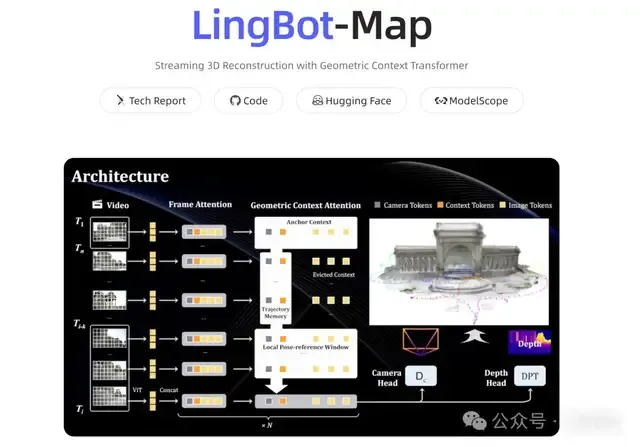
The hard part is connecting one segment to the next without errors. If the initial position is estimated incorrectly, subsequent frames will also use that reference, and the error may become large enough to be visible in the trajectory and point cloud.
This is also why some teams introduce a SLAM loop-closure backend.
Take CLoSeR as an example: the system first uses place retrieval to find possible revisited locations, then uses these associations to perform pose graph optimization and correct the trajectory.
Still a bit cumbersome, and this approach has a major flaw: it does not correct the model's internal spatial memory. As the robot continues moving, it still makes incorrect judgments based on this already-biased memory.
Can't this be done entirely natively through model inference, correcting native memory at any time? Be like:

Following the camera's trajectory, the same exhibition hall in the museum is captured several times before and after. Before correction, the local point cloud observations are somewhat misaligned; after re-estimation, they are aligned in real time.

This is what LingBot-Map 2.0 achieves—it puts the correction step directly into the model's inference process.
Abbreviated as Geometric Context Reshaping (GCR).
Normally, the model uses the already-stored geometric information to process the next frame. But once correction is invoked, it makes the keyframes it has already seen reference each other again, giving earlier frames their first chance to see frames captured later.
Specifically in terms of architecture, the features already computed in the lower 12 layers can be reused, while the upper 12 layers recompute cross-frame relationships using bidirectional attention.
The poses and depths of historical keyframes are updated accordingly, and the corrected geometric context is written back into the model cache. When the next frame comes in, what it reads is this revised memory reference.

The specific changes are crucial, and this is also the most fundamental difference from external correction.
Previously, only the answer was changed, and the trajectory was considered corrected once it was pulled back. But if you look carefully at the model's internal memory, it actually did not change at all. Subsequent new frames still read the old memory, and the robot would still make wrong judgments based on the erroneous memory.
Lingbo's core judgment is that the root cause lies in memory, so the memory itself should be changed.
So when can it be changed? The answer is at any point in time.
LingBot-Map 2.0's correction can be invoked at any point during travel. It does not rely on an external loop-closure detection module, nor does it use "recognizing a revisited location" as a trigger condition.
During training, the same set of weights also has to switch among three states: forward mapping, bidirectional correction, and continuing mapping with the corrected memory.
As for the results? Let's look at a set of controlled experiments.
On 7 long trajectories of tens of thousands of frames in the kilometer-scale large-scene VBR, the team triggered one correction when 75% of the keyframes had been retained, and then resumed streaming mapping.
Compared with streaming mapping throughout, the average absolute trajectory error on the already-processed portion dropped from 13.57 meters to 6.63 meters. In the remaining quarter, the error also dropped from 23.58 meters to 14.87 meters.

Pay special attention to the latter set of numbers. This shows that the frames in the final quarter were fed in one after another only after the correction was completed, and they indeed benefited from the geometric relationships that had already been calibrated.
Compared with LingBot-Map 1.0, on the other three datasets, Map 2.0's average absolute trajectory error during online mapping was already lower than 1.0. After performing one correction at the end of the sequence, the error could drop further.
Taking VBR as an example, the error dropped from 31.12 meters in 1.0 to 17.01 meters in 2.0's online mode, and further dropped to 4.72 meters after correction. In the same order, Oxford Spires' error dropped from 8.25 meters to 6.17 meters and then to 3.92 meters, while KITTI dropped from 24.07 meters to 17.56 meters and then to 9.42 meters.
If an external loop-closure backend baseline is used, the lowest errors measured on the kilometer-level evaluations VBR and KITTI were 9.98 meters and 12.79 meters, respectively.
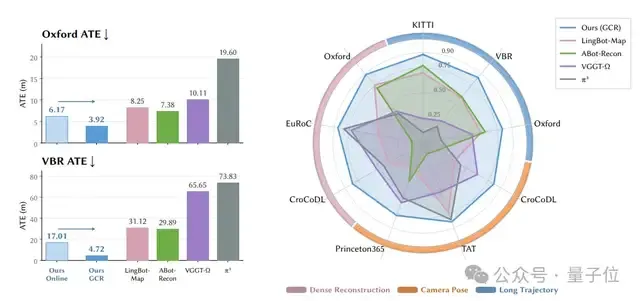
Clearly, the route is remembered more accurately.
But for the object to be found in the second task, can the robot still recall where it saw it on the previous trip?
This question is handed off to the next model, LingBot-Navi.
First time unfamiliar, second time familiar: go directly to what has been seen before
Let's look at a demonstration of continuously "taking orders."
The first task is to deliver a gift box to the front desk; the second task is to go to the lounge area to find a blue-and-white statue.
The two tasks have different destinations, but if you look carefully at the second task, the upper right corner still retains the spatial memory accumulated from the first task, while the lower right corner marks the new observations just added.

Taken together, they actually point to the same problem:
Most VLN (vision-language navigation) models have to start from scratch every time they perform a navigation task. After the task ends, their understanding of the environment is cleared, and the next time they enter the same space, they still need to observe and search again.
LingBot-Navi's cross-task spatial memory focuses precisely on this: no need to explore from scratch when re-entering.
When the target is already in the existing memory, the robot can first check where it is, and then plan a route from its current position.
Even if it has only partial information about the site, it can use known clues to choose the next area to explore, store the new frames, and check again.
This significantly improves efficiency.
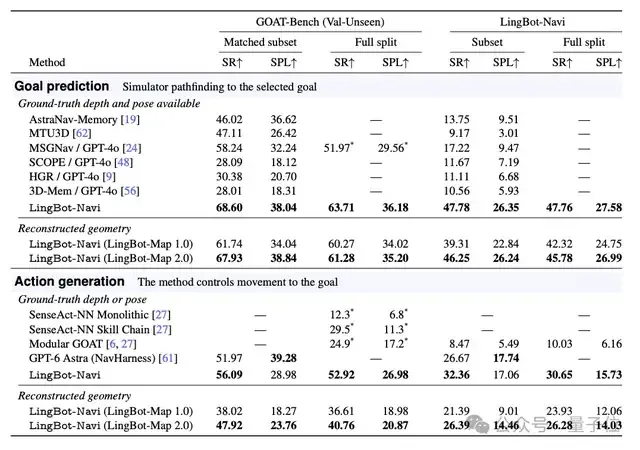
In end-to-end full navigation tests where the model autonomously completes path planning and directly drives movement execution, LingBot-Navi's success rates on GOAT-Bench and a self-built evaluation subset were 56.09% and 32.36%, respectively.
What deserves special attention here is the SPL metric:
SPL is the success rate weighted by path length. It measures both whether navigation successfully reaches the destination and whether the path is efficient. The shorter the path and the fewer ineffective detours, the higher the SPL score.
Navi's SPL on the two datasets reached 38.04% and 26.35%, respectively, improving by 1.42 and 16.84 percentage points over the best values in the control group.
So what exactly does it remember?
The model stores local space as an explicit 3D point cloud, and then attaches features extracted by a vision-language model to the sampled points.
Simply put, the 3D points provide positions, and the visual features retain clues about objects and their surrounding environment.
Only in this way can a rough instruction such as "find the chair next to the vase" have a chance to land on a specific location in the site.
These memory blocks are then retained as independent scene data for the navigation model to read during inference.
Scene encoding and task query are separated. If the instruction changes, the existing site encoding can continue to be used.
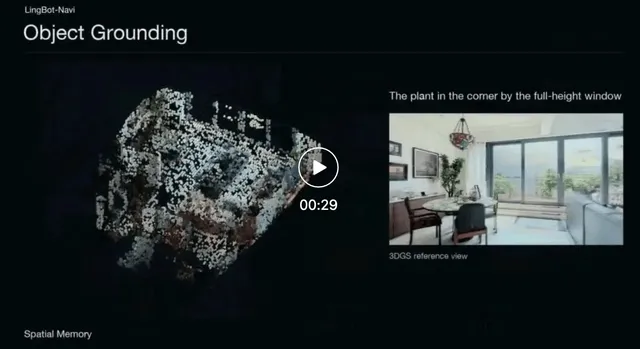
For example, in the scene below, there are two chairs that look almost identical. The only difference is the style of the vase next to them.
By modifying the description of the vase in the instruction, the model can find the corresponding chair in the same spatial memory.
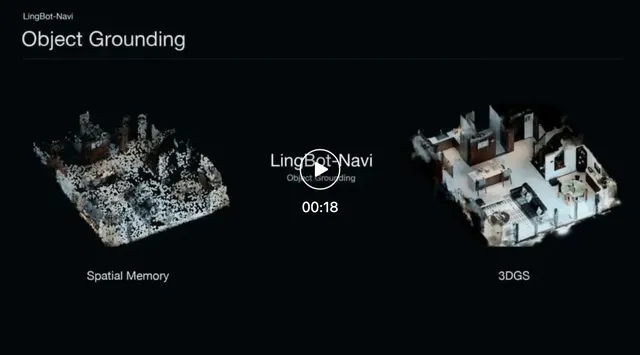
Video link: https://mp.weixin.qq.com/s/Cm9E4MKLYTNNPLKlBYWHOQ
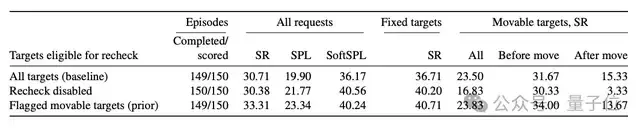
The model can also go to a previous location to recheck memory. When refresh conditions are met, it uses new observations to update the nearby local memory, and then decides whether to check again or continue searching.
In 225 experimental requests after the target was moved, the success rate of runs that allowed on-site rechecking was 15.33%, while runs with rechecking disabled achieved only 3.33%.
To put it plainly, memory changes along with the scene.
As for how the model then moves, LingBot-Navi delegates this to two layers:
- Global layer: responsible for checking memory, finding docking points, and determining routes;
- Local layer: focuses on the immediate view, responsible for short-distance movement and obstacle avoidance.
Both layers can run on-device. The experiments present a set of module tests on Jetson Thor: given an existing scene encoding, a single global planning pass based on an object description takes about 577 milliseconds, while a single local planning step takes about 95 milliseconds.
Video link: https://mp.weixin.qq.com/s/Cm9E4MKLYTNNPLKlBYWHOQ
The relationship between the two models also becomes clear:
Map 2.0 can provide local 3D geometry, and Navi associates the appearance and semantics it sees along the way with the corresponding locations, then uses that to find targets and determine routes.
Here we can also compare the effect of switching from Map 1.0 to Map 2.0: using the same set of navigation weights and only changing the geometry source at inference time, the subtask success rate rises from 23.93% to 26.28%.
The results show that better upstream geometric input can directly benefit the downstream.
Incidentally, released alongside LingBot-Navi is a dedicated benchmark:
511 real-world collected scenes covering 7 types of locations, of which 475 are used for training and 36 are held out for evaluation.
This benchmark tests the robot's ability to reuse historical observations and spatial memory across continuous multi-task scenarios within the same site.

Spatial Memory Becomes a Battleground in 2026
Looking back over these two models, both emphasize the same thing: memory.
LingBot-Map 2.0 continuously updates spatial memory within the model, tackling the challenge of kilometer-level drift; LingBot-Navi comes with reusable spatial memory, allowing the robot to become more familiar and navigate faster the more it moves around.
Spatial memory is genuinely changing the benchmark for embodied navigation, and memory has been elevated from an intermediate product within the system to a focal point of model design.
Similar changes are also happening in the LLM field, specifically the shift from stateless single calls toward agents that can carry memory from one task to the next.
But to be honest, the physical world has a much lower tolerance for "misremembering":
In the digital world, a wrong answer can be overturned and redone; but when a robot misremembers a location, the cost can range from small to large.
From as small as a wasted trip, to as large as colliding with an obstacle and totaling the entire machine.

In addition, the LingBot-Navi navigation model can be directly deployed to run locally on the robot's edge device, with site images and user instructions kept locally, balancing real-time responsiveness and privacy security.
For deployers, robots entering a new site no longer need to first complete full mapping and point-by-point annotation, and the preparation cycle before going on duty is expected to shorten; once in daily operation, it can quickly reuse experience, enabling faster real-world deployment of robots.
This also benefits robot body manufacturers: navigation has the opportunity to evolve from an integrated full system into a basic capability that comes built into the robot at the factory, which is more conducive to advancing large-scale deployment.
Following this line of thinking, looking at Lingbo's recent moves individually, the overall trajectory becomes clearer:
When robots enter real sites and start working, what capabilities should a general-purpose brain possess?
Last time it was about seeing the physical world accurately; this time what's added is spatial memory. Interlocking with each other, spatial perception, memory, and continuous navigation are thus gradually connected within Lingbo's embodied-native general-purpose robot brain.

Admittedly, adding spatial memory does not mean robots can immediately stand on their own. Complex environments, long-duration operation, and cross-embodiment transfer remain tough nuts to crack.
The pits still need to be filled one by one, but it is undeniable that the industry's undercurrent has begun to surge toward a more foundational memory substrate.
The path traveled on the last trip can be used for the next task—this is how robots gradually move toward truly being deployed and getting work done.
LingBot-Map 2.0 links: Website: https://technology.robbyant.com/lingbot-map-v2 GitHub: https://github.com/robbyant/lingbot-map-v2 Checkpoints: https://huggingface.co/collections/robbyant/lingbot-map-v2
LingBot-Navi links: Website: https://technology.robbyant.com/lingbot-navi GitHub: https://github.com/Robbyant/lingbot-navi Checkpoints: https://huggingface.co/robbyant/lingbot-navi
Datasets: https://huggingface.co/datasets/robbyant/LingBot-Navi https://www.modelscope.cn/datasets/Robbyant/LingBot-Navi