AI Agents Autonomously Optimize Ascend Kernels in RSI Push
Shenzhen Hetao College and Huawei GTS AI have introduced AscendGYM, which lets AI agents profile bottlenecks, rewrite Ascend NPU kernel code, and iterate against real hardware feedback. Anthropic co-founder Jack Clark featured it as the lead item in Import AI issue 482, framing it as a step toward China developing its own form of recursive self-improvement. The work positions AI-driven kernel optimization as a route to higher efficiency on domestic compute.
Related Entities
Full Report

As AI begins to participate in optimizing the computing infrastructure that runs AI, improvements in compute efficiency also have the potential to become an important part of AI self-improvement.

Shenzhen Hetao College, together with Huawei's GTS AI team, starts from real domain-specific training and inference workloads to explore letting Agents autonomously optimize Ascend low-level operators, unlocking greater value from domestic compute.
This research stems from a challenge GTS faces in actual business: how to efficiently carry out domain-specific model post-training under limited domestic compute resources and provide production-grade inference services at lower cost. The team turned its attention to the low-level computing software that runs models, exploring how to let AI Agents autonomously analyze performance bottlenecks, modify Ascend Kernel code, and continuously optimize through real hardware feedback.
On November 23, Anthropic co-founder Jack Clark featured AscendGYM as the opening topic in Issue 482 of his personal AI research newsletter Import AI. Under the title "Chinese researchers use Kernel optimization benchmark to improve Huawei chips," he introduced this work and summarized its potential significance with "AscendGYM will help China develop its own form of RSI," also linking this work to efficiency improvements in domestic computing foundations.
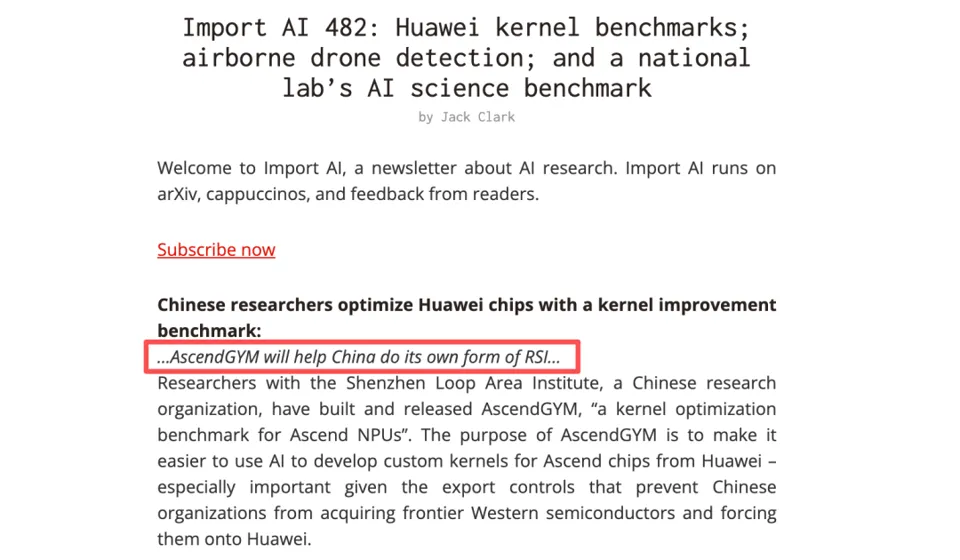
Figure 1: Issue 482 of Import AI features AscendGYM as the opening topic, focusing on its significance for China's exploration of the RSI path.
Why would an engineering study originating from real business compute needs attract the attention of an observer of international frontier AI research? What it explores—is it merely a Kernel benchmarking tool, or a new path for AI to participate in improving its own computing infrastructure?
I. AI Autonomously Optimizing Kernels: A New Path to Unlock Ascend Compute Potential
The actual efficiency of AI training and inference depends not only on the theoretical compute of the chip, but also on whether the low-level software can fully leverage hardware capabilities. Among these, the Kernel is the key link connecting upper-level computing tasks with NPU hardware execution, and its implementation efficiency directly affects model training throughput and inference performance.
As large model architectures and application scenarios evolve rapidly, the computing workloads carried by Ascend NPUs are becoming increasingly diverse. The same type of operator often exhibits different performance characteristics under different model architectures, input sizes, data types, and execution phases, requiring continuous optimization of low-level implementations for specific workloads.
Traditional Kernel optimization mainly relies on professional engineers: using profiling to locate bottlenecks, analyzing compute and memory access characteristics, adjusting parallel strategies and code implementations, and then iterating repeatedly through compilation, correctness testing, and performance measurement. This process has a high professional threshold and requires substantial manual effort, and it is also difficult to quickly adapt to continuous changes in model architectures and business workloads.
The development of AI Coding Agents offers a new approach to this problem. Models are already able to understand code, invoke tools, and perform multi-round modifications. If they are further provided with a real hardware execution environment and reliable performance feedback, there is an opportunity for Agents to take on more low-level performance optimization work.
This means Kernel optimization is evolving from engineering tuning based mainly on human experience toward a new paradigm in which AI Agents autonomously analyze, autonomously code, autonomously experiment, and iterate on feedback.
II. AscendGYM: Making AI Autonomous Kernel Optimization an Executable, Verifiable Engineering Task
Existing Kernel Benchmarks mainly examine whether a model can generate correct, high-performance Kernels based on a computational task description. AscendGYM further focuses on a question closer to actual engineering:
Given a Kernel that already runs correctly, can an AI Agent further identify performance bottlenecks for real workloads, optimize the code, and achieve higher performance within an acceptable resource budget?
This requires the Agent to understand the existing implementation, hardware characteristics, and input configurations, and to find better solutions through multiple rounds of code modification and real execution verification while maintaining computational correctness.
Around this task, AscendGYM is built with three core components.
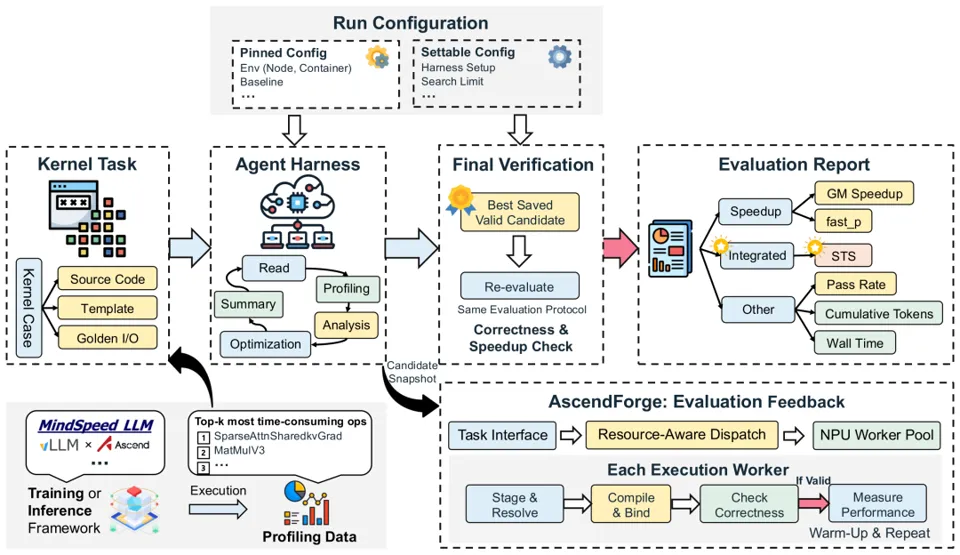
Figure 2: AscendGYM evaluation pipeline: from real workload analysis and agent optimization to hardware verification and evaluation report generation.
- Kernel Optimization Tasks Driven by Real Workloads
The initial design of AscendGYM includes 48 Kernel optimization tasks, divided into three batches of progressively increasing difficulty:
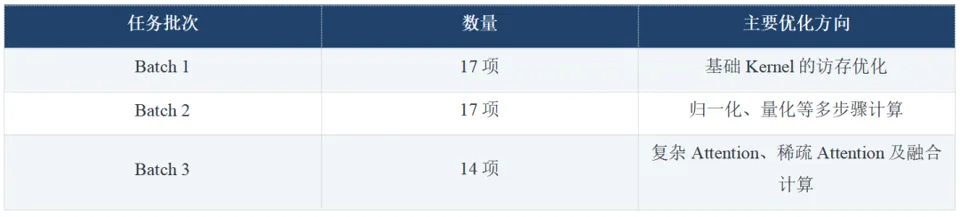
The first round of publicly released systematic evaluation currently covers 17 tasks in Batch 1, and the remaining 31 will continue to be expanded in subsequent research.
These tasks come from real large model training and inference workloads. The research team identified bottleneck Kernels through profiling data from frameworks such as MindSpeed-LLM and vLLM-Ascend, and extracted existing implementations from the CANN operator library and related open-source projects.
Each task retains context such as the Kernel source code, input shapes, data types, target model, and execution phase, so that the object optimized by the Agent corresponds to actual computing workloads.
For example, the paper takes the AddRMSNorm operator in Qwen3-0.6B inference as an example: in a Prefill test scenario, this operator is called 56 times per forward computation, cumulatively accounting for 8.77% of the total computation time of that workload. Such tasks allow optimization results to correspond to performance bottlenecks in real model execution.
This task design has good scalability: as different model architectures, business scenarios, and Ascend deployment forms change, new Kernel tasks and input configurations can be continuously added, providing a unified evaluation foundation for broader Ascend Infra optimization.
- AscendForge: Building a Real Hardware Execution and Feedback Loop
Merely letting the model generate code is not enough to prove that Kernel optimization is effective. The code must compile, execute correctly, and achieve actual performance gains on the target NPU.
To this end, AscendGYM built AscendForge, an execution sandbox for Ascend NPUs.
Figure 3 AscendForge architecture: resource scheduling, operator construction and execution, evaluation feedback, and deployment and operations.
AscendForge integrates candidate code compilation, correctness checking, performance measurement, and feedback into a unified interface, and provides capabilities such as resource scheduling, execution node management, profiling feedback, and runtime monitoring.
After an Agent submits candidate code, the system sequentially performs compilation, execution, and correctness verification, then measures the performance of implementations that pass verification, and feeds compilation logs, numerical validation results, and performance data back to the Agent.
This forms a complete autonomous optimization loop:
Performance bottleneck analysis → Agent modifies Kernel → AscendForge compiles and executes → Correctness verification → NPU performance measurement → Feedback to Agent for continued optimization.
- STS: Measuring Both Optimization Gains and Resource Costs
Traditional Kernel Benchmarks usually focus on comparing the final speedup, but for Agent autonomous optimization, how much cost is required to achieve performance gains is equally important.
AscendGYM proposes the Speedup–Token Score (STS), which evaluates the final performance gain together with the Token budget consumed during the optimization process, and imposes a cost penalty on performance improvements achieved later.
Figure 4 STS metric formula: combining the final performance gain with the Token budget already consumed when the improvement was achieved.
The paper also designs Cost-to-Gain (CTG), which measures the Token consumption required to additionally achieve 1%, 5%, and 10% performance improvements.
At the same time, the evaluation separately records the geometric mean speedup, task pass rate, Token consumption, model interaction rounds, and wall-clock time.
AscendGYM also supports two evaluation modes: one fixes the Harness to compare the optimization capabilities of different models; the other combines models with Agent Harnesses such as Claude Code, Codex, and OpenCode to evaluate the engineering performance of the complete Agent system.
This enables researchers to further answer: Is it ultimately the base model capability that determines optimization results, or do the Agent's search strategy, tool organization, feedback utilization, and experience management also play a key role?
III. First-round experiments reveal: model capability and Harness engineering capability are equally important
AscendGYM conducted first-round experiments on the Ascend 910C environment, comparing models such as Claude Opus 5, GPT-5.6, GLM-5.3, the Qwen series, and DeepSeek-V4-Flash, as well as the combined performance of different Coding Agent Harnesses.
The experimental results present three noteworthy phenomena.
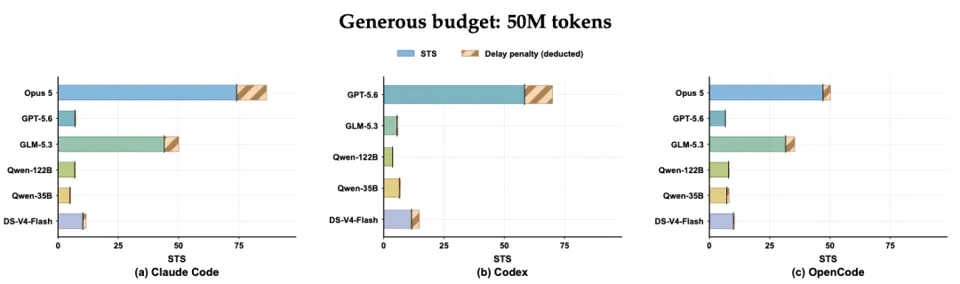
Figure 5 STS of different model and Harness combinations under a 50M Token budget per task; the hatched portion represents the deducted latency penalty.
First, the autonomous Kernel optimization capability of current Agents still has considerable room for improvement.
The paper reports that about 70% of the tested model–Harness combinations have a geometric mean speedup below 1.2x.
This shows that although current mainstream Coding Agents already have the ability to modify Kernel code, continuously achieving significant performance gains across different operators and real input configurations remains a major challenge.
Second, the Harness has a significant impact on the final optimization results.
Taking GPT-5.6 as an example:
- With Codex, the geometric mean speedup is about 1.69x;
- With Claude Code, the geometric mean speedup is about 1.05x.
Both combinations passed the correctness verification of all 17 tasks, but the final performance gains differ significantly.
This indicates that the model's code generation capability cannot directly determine the engineering optimization results. Search strategy, tool invocation, feedback utilization, and experience management all affect the final results of autonomous optimization.
Third, Agents are already able to achieve significant optimization on some Kernel tasks, but the distribution of gains is uneven.
The paper reports that the best observed speedup on the fused_gdn_gating task is about 3.29x; at the same time, on 13 of the 17 tasks, the median speedup of the tested combinations remains below 1.1x.
This shows that AI autonomous optimization has already demonstrated considerable potential, but there is still a considerable distance from achieving high speedups on a few operators to stable, widespread optimization under complex workloads.
In addition, the experiments also found that Token consumption, model interaction rounds, and actual execution time do not always change in sync. Merely reducing Token cost does not necessarily mean completing optimization faster. STS and its accompanying metrics are precisely intended to measure performance gains and optimization costs more comprehensively.
IV. Why did Jack Clark connect AscendGYM with China's RSI?
The most important event for AscendGYM to gain international attention was Issue 482 of Import AI, published by Jack Clark on November 23.
He made Huawei Kernel optimization the opening feature of the entire newsletter and directly raised:
AscendGYM will help China do its own form of RSI.
That is: AscendGYM will help China develop its own form of Recursive Self-Improvement (RSI).
This is not the first time Jack Clark has focused on AI Kernel development on Ascend.
In August 2025, in Issue 423 of "Import AI," he introduced MultiKernelBench, developed by research teams from Nanjing University and Zhejiang University. This benchmark compares the Kernel generation capabilities of AI models across different platforms such as NVIDIA CUDA, Huawei AscendC, and Google TPU Pallas.
At the time, the research found that models performed significantly better on Kernel development for CUDA than for AscendC. For example, Claude Sonnet 4 achieved a compilation accuracy of 92.3% on CUDA, but only 5.3% on AscendC.
Jack Clark raised at the time that whether AI can truly understand the underlying principles of Kernel development, or mainly relies on learning from the large amount of existing code in the CUDA ecosystem, is a question worth attention.
From MultiKernelBench to AscendGYM, the research question advances further: can AI not only generate Kernels for different hardware, but also autonomously optimize existing implementations under real hardware feedback to continuously improve computational efficiency?
This is also what makes AscendGYM worth attention.
The core idea of RSI is that AI systems can participate in improving their own capabilities and R&D processes, thereby forming a continuously iterating feedback loop. For AI systems, the software infrastructure on which training and inference depend is also an important target for improvement.
If AI Agents can autonomously optimize Kernels, compilers, and runtimes, they have the opportunity to improve the effective utilization of computational resources, reduce the cost of model training and inference, and thereby support more training experiments and faster model iteration.
This potential path can be summarized as:
AI autonomously optimizes computational software → improves effective compute efficiency → supports more AI training and inference → accelerates model capability iteration → stronger AI further enhances autonomous optimization capability.
In the feature article, Jack Clark further pointed out that software like AscendGYM will become an important component for China to rapidly improve the efficiency of its own computing foundation. He believes that through AI-driven software optimization, China has the opportunity to further improve the actual operating efficiency of domestic chips, providing a path to narrow the performance gap with Western alternatives.
It should be noted that AscendGYM currently validates an executable and measurable engineering link in this RSI path, and does not mean that complete recursive self-improvement has been achieved.
But it transforms an important question into an engineering task that can actually be experimented on, compared, and continuously improved: can AI begin to autonomously improve the computing infrastructure that runs AI?
V. From Benchmark Toward Broader Ascend Infra Optimization
AscendGYM has established an initial system of 48 tasks, the AscendForge execution environment, and an evaluation method oriented toward performance gains and optimization costs. In the next stage, its value will depend on whether it can move further from a Benchmark toward broader real-world computing scenarios.
First, task and input configuration coverage needs to be continuously expanded.
On the basis of existing large-model training and inference workloads, more model structures, execution stages, and complex operators should be gradually introduced to further test the Agent's autonomous optimization capability when facing different workloads.
Second, the Agent's own optimization capability needs to be continuously improved.
Through stronger foundation models, more effective Harness search strategies, feedback mechanisms, and experience accumulation, improve the optimization success rate of complex Kernels and reduce the resource cost of obtaining performance gains.
More importantly, it is necessary to promote the transformation of operator-level optimization into real system-level gains.
Kernel acceleration is only the first step. Ultimately, its actual impact on model training throughput, inference Token throughput, MFU, and cost per Token needs to be verified across different Ascend hardware and production systems.
The experimental boundaries also need to be clarified here: the first round of public evaluation in the paper used Ascend 910C, and subsequent expansion to different generational platforms such as A2/A3 and more production workloads still requires corresponding hardware adaptation and empirical verification.
Starting from real large-model workloads and gradually expanding task coverage, execution environments, and optimization capabilities, the system established by AscendGYM has the opportunity to become a general engineering foundation for AI autonomous Kernel optimization in the Ascend ecosystem.
Conclusion: Let AI optimize the computing foundation that runs AI
From compute efficiency challenges in real business scenarios, to Agents autonomously optimizing Ascend Kernels, to receiving opening feature coverage from Anthropic co-founder Jack Clark in "Import AI," AscendGYM has brought a specific engineering exploration into international frontier AI research discussion.
Its value lies not only in establishing a Benchmark for Ascend Kernel optimization, but also in exploring how to use AI Agents to continuously improve the underlying computational software that runs AI, and in consolidating this capability into a reusable, verifiable, and scalable engineering system.
For the domestic compute ecosystem, this means that in the future there is an opportunity to use AI to continuously improve underlying software efficiency, allowing the same hardware resources to support more model training, faster capability iteration, and larger-scale intelligent services.
When AI begins to participate in optimizing the computing infrastructure that runs AI, improvements in compute efficiency also have the opportunity to become an important part of AI self-improvement.
Related Materials

Figure 7 AscendGYM project homepage and entry points for the technical report, code, and leaderboard.
- Technical report: https://arxiv.org/abs/2611.17621
- Paper code: https://github.com/SLAI-AITP/AscendGYM
- Online leaderboard: https://slai-aitp.github.io/AscendGYM/

© THE END
For reprinting, please contact this official account for authorization.
Submissions or report requests: [email protected]