Tsinghua et al. Propose Collective Experience Learning for Robot Swarms
Tsinghua University, together with Infinigence and AgiBot, introduced a new paradigm called Collective Experience Learning (CEL) to address the scarcity of human demonstration data in scaling embodied AI. CEL enables robots to learn from peers' successful experiences rather than relying solely on human guidance. Validated on a cluster of 96 real robots, untrained agents achieved a 97.5% success rate across five complex tasks, surpassing average human operators. The study demonstrates a positive scaling trend where performance improves as the number of participating robots increases.
Full Report
Contents4 sections
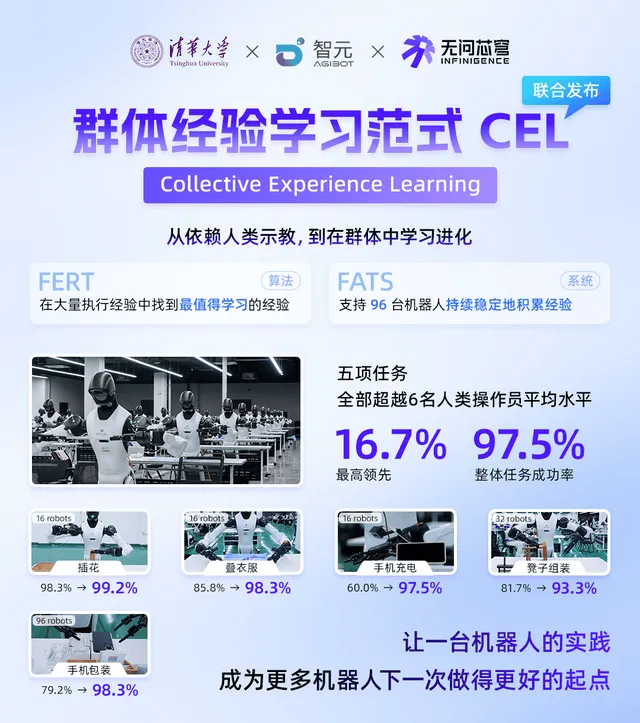
Recently, Tsinghua University, Infinigence AI, and AgiBot jointly proposed a new paradigm called Collective Experience Learning (CEL), completing large-scale validation on a cluster of 96 real-world robots. CEL enables robots to learn not only from human demonstrations but also by leveraging the successful experiences of their peers within the group: when a robot encounters difficulties during task execution, it can seek solutions from the past experiences of its companions, continuously improving its performance. By sharing and accumulating experience, robotic swarms can collectively enhance their capabilities through continuous practice, providing a new technical pathway for advancing autonomous robot evolution and scalable deployment.
I. Robots as Each Other’s "Teachers": A New Direction for Scalable Robotics Development
As embodied intelligence gradually transitions from laboratories to the real world, robots are required to operate in increasingly complex environments. To ensure high performance, it is crucial that they continuously accumulate real-world experience. The prevailing approach currently relies on human instruction: either humans repeatedly demonstrate actions for the robot to observe, or humans manually correct errors after the robot fails.
However, a core bottleneck exists: while robots can be deployed in batches numbering in the hundreds or thousands, experienced operators are scarce and cannot scale proportionally with robot production. This has become a major impediment to the development of embodied intelligence.
The concept behind CEL is to shift the learning source—rather than relying primarily on human instruction, robots learn from their "peers." Successful experiences discovered by one robot during practice can be distilled and shared across the entire robotic swarm for reuse. This allows robots to learn and grow independently from the collective accumulated experience, rather than waiting indefinitely for human guidance.
As the number of robots increases, the depth of the group's accumulated experience grows. Through a unified learning mechanism that continuously optimizes strategies, robot capabilities improve with usage, becoming smarter and more effective over time.
II. Nearly 100 Robots "Learning Together": Task Success Rates Exceed Human Average
Tests in real-world scenarios further validated the effectiveness of CEL.
The experimental settings included both domestic service and industrial production tasks, specifically: flower arranging, clothes folding, phone charging, stool assembly, and phone packaging. The results were impressive: Two robots that had not participated in prior training underwent 600 tests, failing only 15 times, achieving an overall success rate of 97.5%. Moreover, the success rates for all five tasks exceeded the average performance of six human operators.
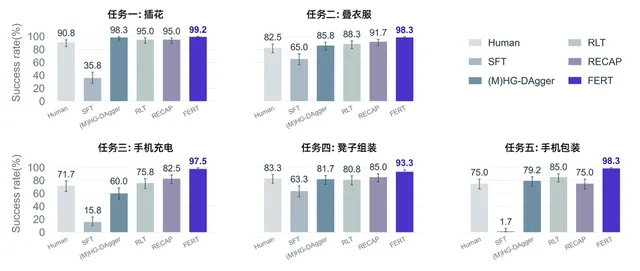
Phone packaging, an industrial task requiring the sequential completion of multiple steps, saw its success rate rise from 79.2% to 98.3% after collective experience learning. In 120 consecutive tests, there were only two failures. This demonstrates that the learned strategies are not only effective but also sufficiently stable for complex tasks.

The study also observed a scaling trend where "more robots lead to stronger performance": when the number of robots participating in training increased from 16 to 96, the success rate rose from 86.7% to 98.3%. In other words, within the same amount of actual training time, a larger scale of participating robots accumulates more real-world experience, which continuously translates into learning benefits, making the entire swarm progressively smarter.
III. Flexible High-Fault-Tolerance System Supports Algorithmic Innovation, Closing the Loop for Continuous Robot Learning
The successful implementation of CEL relies on coordinated efforts between the "underlying system" and the "upper-layer algorithms."
At the system level, the team built the "Fault-Tolerant Asynchronous Training System (FATS)" based on the open-source framework RLinf for large-scale reinforcement learning training, supporting continuous and stable collaborative learning among nearly 100 robots. It unifies the scheduling of real robots and computational resources: once a robot completes a task, it immediately uploads its operational experience without waiting for others, allowing the training system to optimize the model at any time. Additionally, the system proactively handles common issues in real environments such as network fluctuations, device disconnections, and hardware failures—even if some devices go offline, the entire cluster continues to operate stably. In system tests involving 96 robots, the cluster collected 9,834 rounds of execution experience. During this period, 22 robots experienced a total of 30 faults, yet the time lost due to these faults accounted for only 1.3% of the total operational uptime. This indicates that the system is robust enough to withstand the challenges of real-world environments at a hundred-robot scale.
At the algorithmic level, the team proposed the "Failure-Guided Experience Retrieval Fine-Tuning (FERT)" algorithm, helping robots identify directions for improvement based on task outcomes. A practical challenge exists: a single robot operation may last several minutes and involve thousands of action steps, yet the final feedback is often just "success" or "failure," providing insufficient information to determine which specific actions need improvement. FERT addresses this by leveraging two types of experience: learning "what to do" from successful operations and identifying "what went wrong" from failed ones. When a robot encounters difficulty, the algorithm retrieves effective methods from similar scenarios in past successful experiences, guiding the robot to focus on learning these approaches, thereby incrementally improving its capabilities.
IV. Industry-Academia-Research Collaboration: Exploring a New Future for Embodied Intelligence Industrialization
The key to industrializing embodied intelligence lies not merely in enabling a robot to "perform one task well." The collective learning paradigm jointly launched by Tsinghua University, Infinigence AI, and AgiBot provides a pathway from "enhancing individual robot capabilities" to "continuous evolution of the entire swarm."
Its value extends far beyond the technology itself.
First, it addresses a long-standing obstacle hindering the development of embodied intelligence: the shortage of human resources. Previously, improving robot capabilities relied heavily on continuous demonstration and manual correction by experienced operators. Humans are a scarce resource and can never keep pace with the rapid batch deployment of robots. By enabling robots to learn from each other, the situation changes completely: the more robots there are, the faster experience accumulates, and the quicker capabilities grow. The bottleneck of "insufficient manpower" transforms into the scalability advantage of "more robots, stronger performance."
More notably, this collaboration serves as a prime example of industry-academia-research synergy. Tsinghua University represents the academic frontier, Infinigence AI leads in AI infrastructure, and AgiBot possesses full-stack integration and real-world scenarios. Each party contributes its strengths, effectively bridging the most difficult gap between "methods in papers" and "capabilities on the production line," ensuring that cutting-edge algorithms no longer remain theoretical but are deployed directly into the real world.
Furthermore, what was validated here is not just an algorithm, but a complete pipeline: real-world scenarios generate experience, collective learning distills capabilities, and scalable deployment feeds back into more scenarios. Once this pipeline is established, other enterprises and scenarios can directly adopt it, significantly clarifying the growth path for the entire embodied intelligence industry.
Ultimately, when robots are no longer merely isolated execution units but evolve into communities that learn from one another and progress together, large-scale deployment ceases to be just the endpoint of capability application; it also becomes the starting point for continuous capability evolution. This represents not only a shift in how robots learn, but also a true breakthrough for embodied AI as it transitions from technical validation to industrial implementation.
This article was provided by Infinigence AI and republished with permission by QbitAI. The views expressed belong to the original author.