Meta Proposes Routed CL to Boost Agent Performance via Task-Specific Memory Isolation
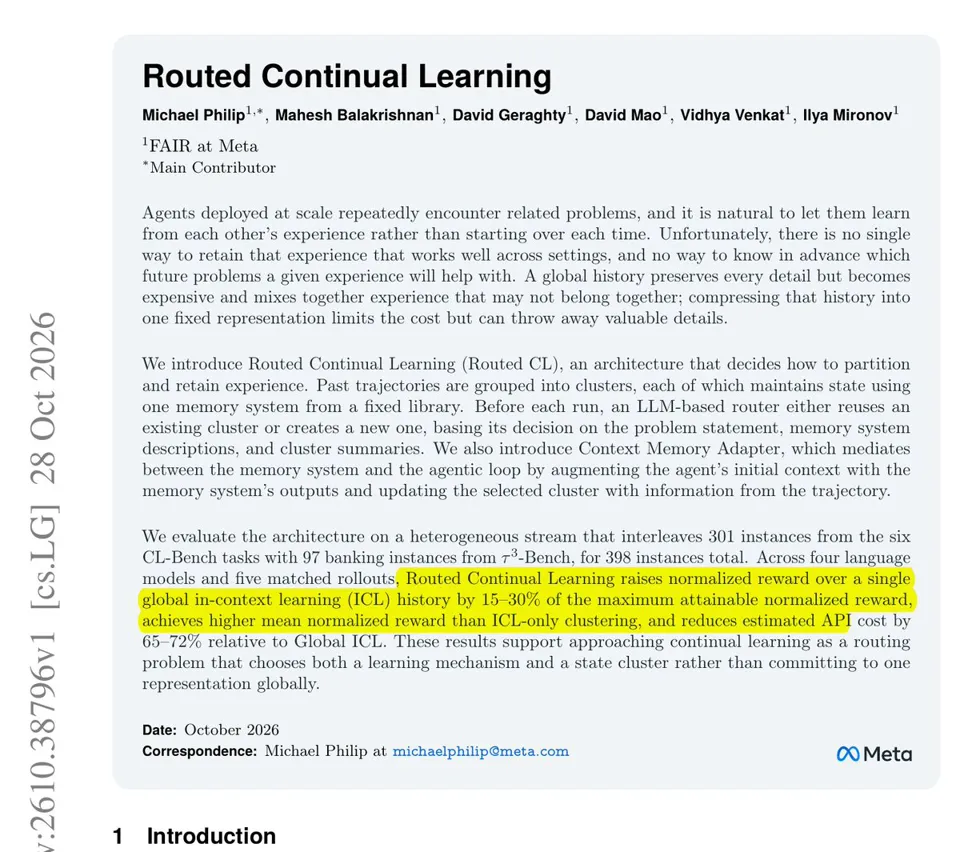
Meta's new paper introduces Routed CL, an architecture that uses an LLM router to cluster agent memories by problem type instead of maintaining a single shared history. Experiments show this approach improves scores by 15-30% of the maximum possible gain and reduces estimated API costs by 65-72% compared to shared memory baselines.
Full Report
Rohan Paul (@rohanpaul_ai) · 2026-11-02 18
New Meta paper finds that AI agents improve more from their past attempts when each new problem is matched to notes from similar problems, instead of one shared record of everything they have done.
A simple way to let agents learn from past runs is one shared history. With mixed tasks, it gets costly and mixes unrelated experience.
Routed CL adds an LLM router that reuses a memory cluster or starts a new one before each run. Each cluster uses 1 of 5 memory types, such as raw past runs or distilled lessons.
Across 398 mixed problems and 4 models, the shared history barely beat no memory, with a mean gain of 0.015 out of 1. Routed CL beat it by 15% to 30% of the maximum possible score and cut estimated API cost by 65% to 72%.
If your agents handle mixed task types, split their memory into separate pools by problem type instead of sharing one history.