InfoQ 中文 · 10/15/2026, 19:47:57
Ant Group Open-Sources Ling-3.1-flash: A 560B MoE Model with 1M Context for Real-World Workflows
Ant Group's Bailing team has open-sourced Ling-3.1-flash, a hybrid linear architecture model featuring 560B total parameters, 25B active parameters, and support for a 1M context window. The model demonstrates strong performance in benchmarks like GDPVal-AA, HealthBench, and FrontierSWE, targeting real-world business scenarios such as office automation, medical assistance, and complex software engineering tasks.
SOURCE COVERAGEFull Original Report
Bailing LLM Open-Sources Ling-3.1-flash: 560B Total Parameters, 25B Active Parameters, and 1M Context Support, Focusing on Real-World Workflows in Office, Healthcare, Software Engineering, and Terminal Operations
Ling-3.1-flash achieved a score of 1673 (ELO) on the GDPVal-AA V2.1 office evaluation; scored 65.35 on the HealthBench Professional medical evaluation; and demonstrated its capability to handle complex engineering tasks in both FrontierSWE and Terminal-Bench 4.0 benchmarks.
Suitable for AI engineers, vertical domain application developers, and enterprise-grade LLM integration engineers.

On October 15, Ant Group’s Bailing LLM announced the open-sourcing of Ling-3.1-flash. The model emphasizes "real-world usability," upgrading capabilities for real-world tasks to turn vague business requirements into usable results faster. The open-source model weights are available for download on Hugging Face and ModelScope.
Hugging Face URL: https://huggingface.co/inclusionAI/Ling-3.1-flash
ModelScope URL: https://www.modelscope.ai/models/inclusionAI/Ling-3.1-flash
Ling-3.1-flash continues the hybrid linear architecture of Ling-3.0-flash, featuring approximately 560B total parameters with about 25B active parameters per token, and supports up to 1M context length. The model maintains high-quality performance across complex workflows such as office tasks, healthcare, software engineering, and terminal operations. Facing scattered materials, it can assist in organizing reports and presentation decks; facing fragmented symptoms, it helps compile medical histories and consultation questions; facing legacy code, it can understand existing implementations, write new features, and iteratively refine based on test results.
In the GDPVal-AA V2.1 office task evaluation, Ling-3.1-flash scored 1673 (ELO). In the HealthBench Professional medical scenario evaluation, the model scored 65.35. In the FrontierSWE software engineering benchmark and Terminal-Bench 4.0 terminal operation benchmark, the model also demonstrated its ability to handle complex engineering tasks.
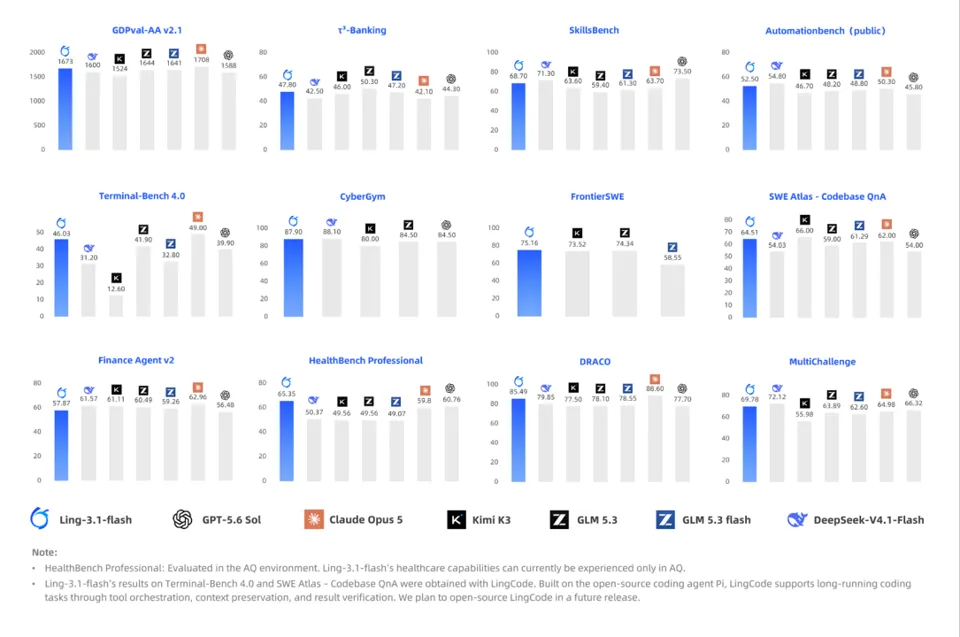
Through this open-sourcing initiative, Bailing hopes that more teams will deploy and integrate Ling-3.1-flash within their own environments, embedding these scenario-specific capabilities into their business processes.
When handling daily real-world tasks, enterprise knowledge assistants and code assistants often need to continuously process materials, generate content, and modify results based on feedback. Models must possess general capabilities to handle these tasks while maintaining sufficiently fast responses during multi-turn calls. "Intelligence-Efficiency Ratio" is a core characteristic of the Bailing series models, which has been continued and further strengthened at the model level in Ling-3.1-flash.
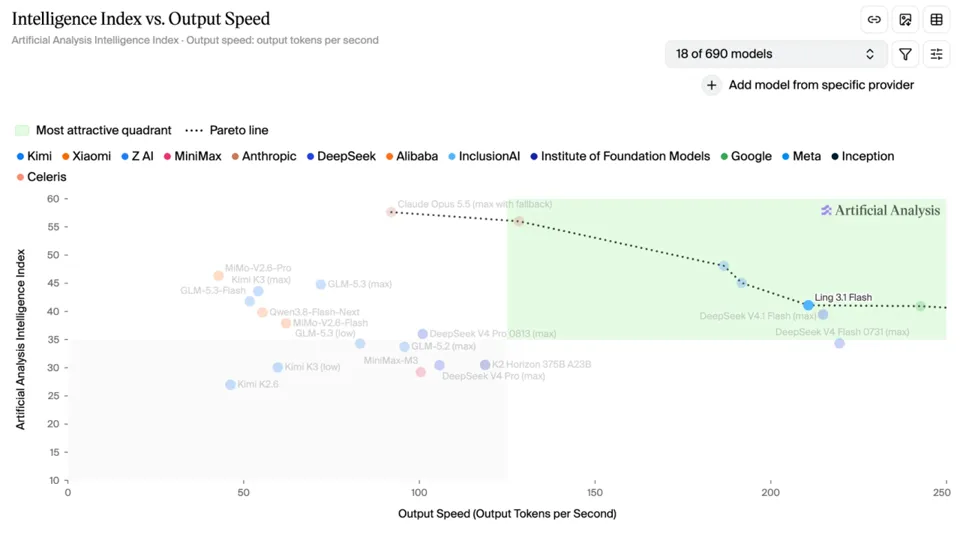
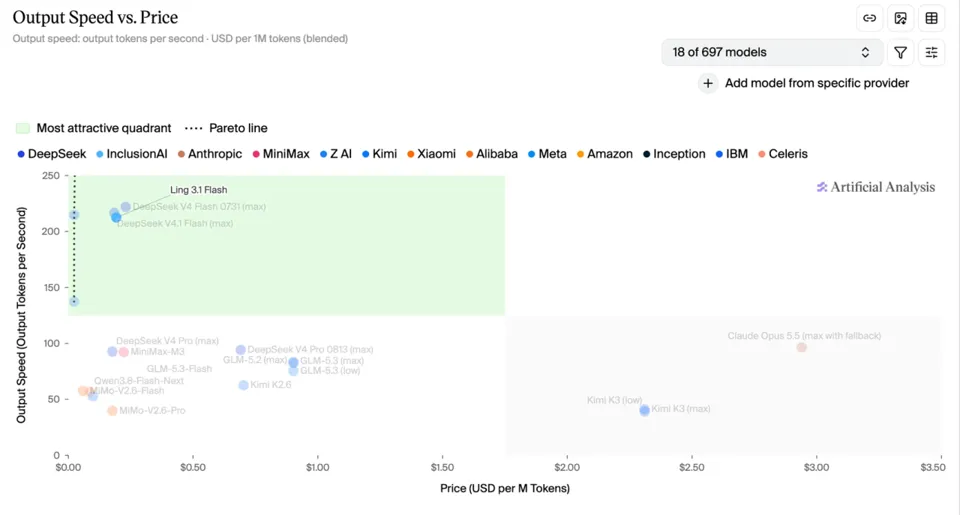
In Artificial Analysis's public evaluations, Ling-3.1-flash has an intelligence index of 41 and an output speed of approximately 210 tokens per second, providing dual capabilities in intelligence index and generation efficiency for high-frequency business scenarios. Additionally, the blended calling price for Ling-3.1-flash is approximately $0.19 per million tokens, placing it in the range of fast output and low cost, balancing generation efficiency and cost advantages for high-frequency invocation scenarios.
For local deployment, the team applied MXFP4 quantization to routed experts while keeping dense layers in block-FP8, reducing weight footprint from approximately 534GB to 292GB. In corresponding Hopper GPU test configurations, service deployment was reduced from 8 GPUs to 4 GPUs, allowing teams with server-grade GPUs to run the model with fewer cards.
Previously, the Ling 3.0 series had already conducted open-source practices across various devices, covering multiple deployment paths from servers to personal computers and mobile terminals. For example, on the server side, a single NVIDIA DGX Spark can run Ling-3.0-flash to drive coding agents for building and testing mini-games; on the PC side, a 16GB MacBook Air can run Ling-3.0-tiny to set up a resident local assistant; on the mobile side, the Galaxy A32 4G validated local inference and tool routing prototypes via the Tiny GGUF version, while the Xiaomi 14T Pro achieved local dialogue for the Tiny version using PocketPal.
It is understood that the Ling-3.0 series models have approached nearly 1 million downloads on Hugging Face in the last 30 days, with the community providing various adapted versions such as Flash GGUF, Tiny GGUF, and Flash MLX 4bit. With the open-sourcing of Ling-3.1-flash, the Bailing series models provide developers with a more complete, self-verifiable, and adaptable model foundation. This also signifies that model capabilities are getting closer to real business delivery, further compressing the pipeline between requirement documents, code repositories, and production environments.
As the model research force behind Ant Group’s AI business development, Bailing provides critical model capability support for consumer-facing AI applications and enterprise-grade agents.
Unlike simply pursuing model parameter scale, Bailing focuses on bringing model capabilities into real businesses to deliver results. In complex professional fields such as finance and healthcare, Bailing has successively released enhanced models like Ling-3.0-flash-Fin and Ling-3.0-flash-Sante based on its foundation models, transforming general model capabilities into specialized professional abilities for real business processes such as investment research and health management.