TimeNet Open Sources Unified TimeF Format for Time-Series Data
TimeNet is an open-source data infrastructure project for temporal foundation models that unifies incompatible time-series dataset layouts under a single storage format, TimeF, and one API for finding, building, downloading and loading data. It deliberately leaves training, inference and evaluation to the user's framework of choice. Backed by researchers from Aionic Labs, Stanford, ETH Zurich, Google and others, it is a pre-release whose public API and TimeF format may change before 1.0.
Related Entities
Full Report
Contents2 sections
TimeNet
Find, build, and load time-series datasets through one shared format.
[!NOTE] TimeNet is a pre-release project. Its public API and the TimeF format can change before 1.0.
Time-series datasets use many incompatible layouts. TimeF gives them one storage format. TimeNet provides one API to find, build, download, and load them.
TimeNet handles the data layer. Model training, inference, and evaluation stay in your chosen framework.
TimeNet Hackathon
TimeNet Online Hackathon is live. Pick a time-series problem, onboard a dataset in TimeNet format, then train or fine-tune a Temporal AI Model (e.g. OpenTSLM) to explore what it can do. Choose any use case, from forecasting and classification to explanation, reasoning and beyond.
Register here: challenge.timenet.ai
Quick start
uv add 'timenet[cli]'
uv tool install timenet-connectors
timenet-build build timenet/hello-world
The build lands in the local registry at ~/.timenet/registry/timenet/hello-world/1.0.0/. Load it
with Python:
from timenet import TimeNet

dataset = TimeNet().load("timenet/[email protected]")
dataset.describe()

signal = dataset.records[0].signals[0]
values = signal.to_numpy()
TimeNet() reads the local registry first, and the local registry holds this exact version.
So the example works without registry credentials or network access.
See the Get started guide for installation options and a longer example.
How it fits together
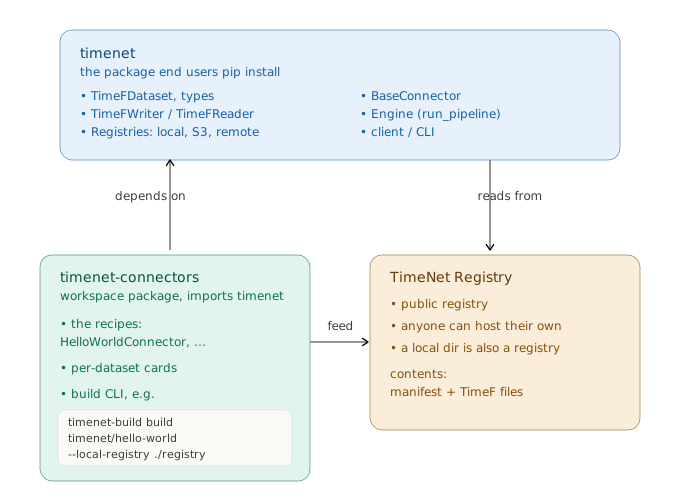
A connector converts a raw source into a TimeF version. The version contains:
manifest.json, which identifies the dataset and lists its filescontrol.duckdb, which stores the hierarchy and relationships- a Parquet or Zarr values plane, which stores Signal values
A registry stores immutable TimeF versions. The client reads a version without importing its connector.
The repository is a uv workspace with two packages:
| Package | Purpose |
|---|---|
timenet | The TimeF model, reader, writer, registries, SDK, and consumer CLI. |
timenet-connectors | Dataset connectors and the timenet-build producer CLI. |
Read the architecture guide for the complete design.
作者发帖说明(HN):
Hi HN,
Current frontier LLMs show incredible results across text, video, and audio. However, when looking at real world scenarios like production lines, trading, drilling operations, or demand supply forecasting, they are not capable of comprehending this data, especially given a limited context.
That’s why we need models that are able to understand temporal information natively: temporal foundation models (TFMs). However, there is a data problem: unlike all the public information that frontier models train on, temporal information though is still scattered across organizations without a unified way to access it.
That’s why we built TimeNet. It's like ImageNet for temporal data:
-
One uniform data layer for either our repository or your own data
-
Define tasks on top temporal data around classification, question answering, scalar prediction, temporal localization, forecasting, generation, editing, and correspondence (more to come)
-
Simple and performant API to integrate into ML frameworks.
-
First experimental results: training on multiple temporal datasets increased F1 performance on each dataset respectively by an average of 14% and 22% for OpenTSLM and SLIP respectively.
-
Install via ‘uv add timenet’
TimeNet is the result of a growing open and global collaboration between researchers from Aionic Labs, Stanford, ETH Zurich, UNSW Sydney, Sun Yat-sen University, Griffith University, Google, UCLA, TimeCopilot, Dartmouth, Harvard, Cambridge, Eindhoven University of T...