OpenAI Opens GPT-Live-1.1 API for Full-Duplex Voice Agents
OpenAI has opened its GPT-Live-1.1 voice model API to third-party developers. Built on a full-duplex architecture, the model listens and speaks simultaneously while detecting pauses, interruptions, and pace changes. Its key advance is delegating deep reasoning and tool-calling tasks to a developer-chosen backend model without interrupting the live conversation, merging real-time voice interaction with multi-step agent workflows.
Related Entities
Full Report
IT之家 November 20 news: OpenAI today announced that it is opening the GPT-Live-1.1 API voice model to developers, allowing third-party developers to integrate it into their own applications to build AI voice agents that can listen, respond, and execute complex tasks in real time.
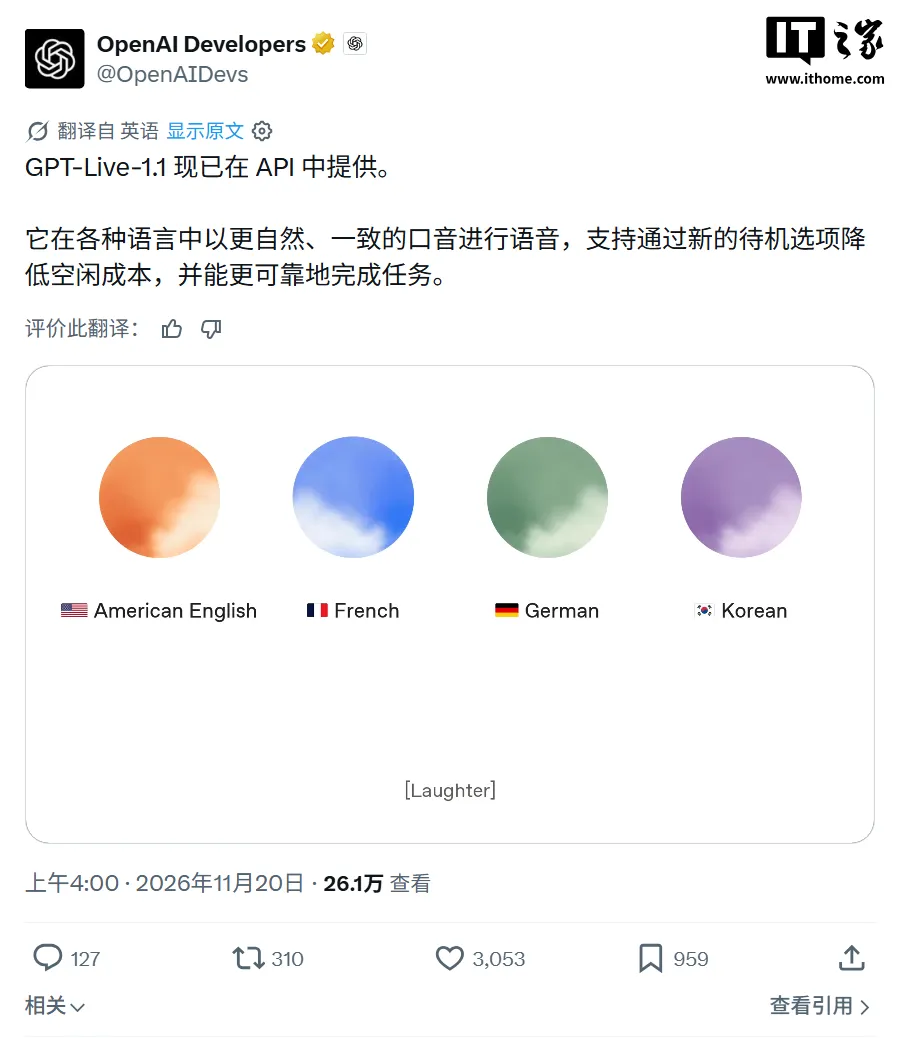
According to OpenAI, GPT-Live-1.1 is an upgraded version of GPT-Live-1, featuring full-duplex voice interaction capabilities. It can listen and speak simultaneously, without having to wait for the user to finish a complete sentence before starting processing. The model can recognize pauses, interruptions, and changes in speaking rate during the user's speech, and determine in real time whether it should continue listening or respond.
IT之家 note: GPT-Live-1.1 has been the default voice model for ChatGPT Plus and higher-tier subscribers since October 15, 2026. This API opening further extends the relevant capabilities to third-party developers.
In terms of specific capabilities, OpenAI stated that GPT-Live-1.1 improves multilingual voice processing, instruction-following ability, and voice fidelity. It can more reliably handle information that requires precise recognition, such as letters and numbers, reducing comprehension deviations during voice interactions.
In addition, the model supports delegating tasks that require deeper reasoning or tool calls to a backend model chosen by the developer. Developers can use either OpenAI's models or third-party models. While the backend model handles complex tasks, the voice conversation can continue without interrupting the current interaction.
This means developers can combine real-time voice interaction with the reasoning and tool-calling capabilities of backend models, enabling voice agents to handle complex workflows requiring multi-step execution while answering user questions.
According to OpenAI's official API documentation, the GPT-Live series adopts a full-duplex architecture that can directly process input and output audio, reducing the latency caused by the serial connection of speech recognition (STT), large language models (LLMs), and speech synthesis (TTS) in traditional voice systems.
OpenAI has provided technical documentation and integration guides for the GPT-Live-1.1 API. Developers can learn about the model's capabilities, configuration methods, and specific usage through the OpenAI developer platform.