Tencent Releases Hyra 2.0: A Three-Layer AI Research Agent System
Tencent released Hyra 2.0, shifting the AI research paradigm from problem-solving to tool-building via a three-layer agent architecture (Overall, Mission, Worker). The system introduces hierarchical memory and shared knowledge bases to enable reusable research outcomes, creating an 'intelligence compound interest' effect.
Full Report
IT Home reported on November 2 that Tencent Hunyuan has released its AI research system, Hyra 2.0. The development focus has shifted from using AI to directly tackle scientific problems to enabling general-purpose Agents to participate in the R&D and upgrading of scientific models, research workflows, and software tools. This approach allows the outcomes of a single development cycle to be reused repeatedly in subsequent research, driving a paradigm shift in scientific research from "solving practice problems" to "building tools."
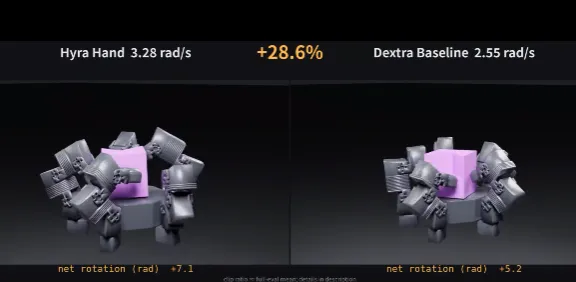
Previously, Hyra 1.0 drove open-source models to solve an open problem in additive combinatorics that had remained unsolved for over fifty years, validating the feasibility of the approach: "presenting AI with difficult problems that have clear evaluation criteria and iterating through attempts." Building on this foundation, Hyra 2.0 further proposes that benefits derived from tool upgrades can be repeatedly reused by downstream tasks, thereby creating an "intelligence compound interest" effect.
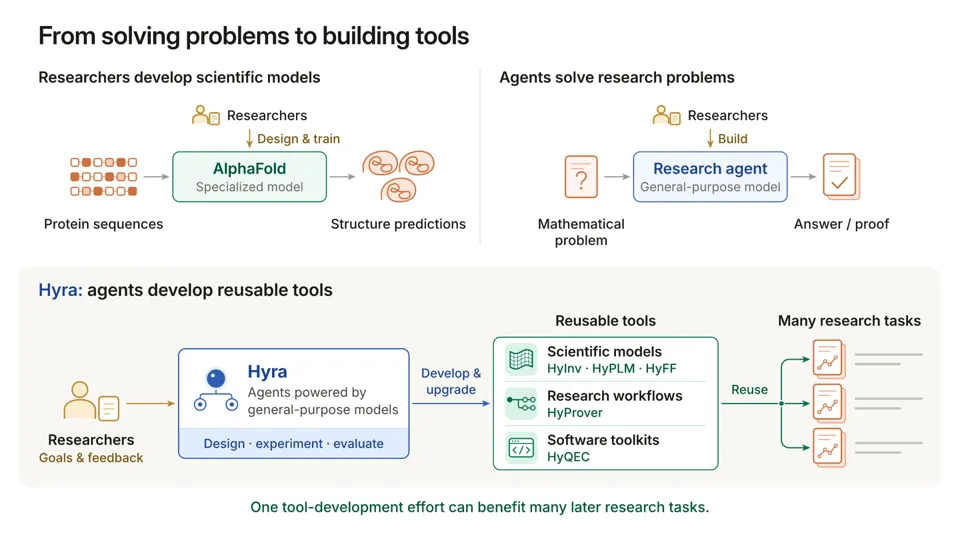
IT Home noted that architecturally, Hyra 2.0 divides research work into three layers: Overall, Mission, and Worker. The Overall layer is responsible for communicating with human researchers and aligning goals. The Mission layer takes long-term responsibility for a single research question and makes decisions regarding route selection. The Worker layer independently reads code, conducts experiments, analyzes failure causes, and can even challenge the judgments made by the Mission layer. The system also features three separate storage mechanisms: project state, hierarchical Agent memory, and a shared knowledge base called Books. During project retrospectives, transferable methods can be organized as skills for direct invocation by subsequent tasks.