Zhejiang Univ & TeleAI Propose GR-BC Using Graph Search for Robot Action Learning
Zhejiang University and TeleAI introduced GR-BC at CoRL 2026, a method that constructs state transition graphs and performs reverse search to extract effective action sequences from multiple trial-and-error robot trajectories containing invalid adjustments. This approach addresses the scarcity of perfect demonstrations in teleoperation data by using graph structures to evaluate action progress value, significantly enhancing the robustness and learning efficiency of Vision-Language-Action models in precise manipulation tasks.
Full Report
This approach promises to help correct policy learning biases and recover from setbacks, supporting more robust robotic manipulation.

Tightening a screw with a screwdriver sounds simple enough.
But in practice, it often involves nudging, turning, backing out, and realigning. When data is collected via teleoperated robots, this process demands even more patience. Even highly skilled data collectors—comparable to master craftsmen—may struggle to produce a perfectly smooth demonstration from start to finish for tasks requiring extreme precision. A trajectory that ultimately succeeds may contain multiple ineffective adjustments; conversely, an attempt that fails due to timeout or collision might still include several well-aligned steps.
This poses a challenge for post-training Vision-Language-Action (VLA) models: If human operators themselves find it difficult to collect near-perfect trajectories, what kind of experience should the robot learn from?
The team led by Chunhua Shen at Zhejiang University, in collaboration with TeleAI (China Telecom’s AI Research Institute) and Bai Chenjia’s team at Gamma Intelligence, addressed this issue by proposing Graph-Reweighted Behavior Cloning (GR-BC).
The team considered an alternative possibility: A better path to success may not exist entirely within any single demonstration but could be hidden in the connections between multiple attempts. By integrating these experiences into a graph, can we first find a superior path within the graph’s “mind,” and then let the graph act as a judge to guide the robot toward imitating valuable actions?
Currently, this work has been accepted to CoRL 2026, and both the paper and code are publicly available.
- Paper Title: Graph-Reweighted Behavior Cloning with Human Interventions for Precise Robotic Manipulation
- Paper Link: https://arxiv.org/pdf/2610.20504
- Code Link: https://github.com/Gamma-Robot/GR-BC
Core Method: Retrieve Progress via Graphs, Then Reweight Actions
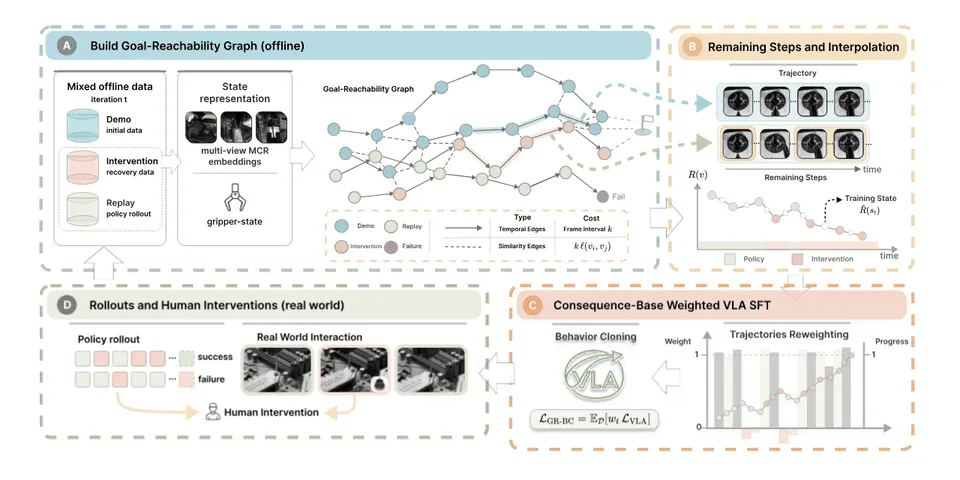
Figure 1 | GR-BC: Graph construction, reverse search, weighted training, and new trajectory feedback.
Step 1: Connecting Scattered Experiences
To evaluate whether an action is good, one must first know how far the robot is from completing the task. The team observed that progress in fine-grained tasks is highly relative within the context of the task itself. By grouping multiple attempts at the same task together and leveraging the connections between them, more concrete evidence can be provided for judging progress.
GR-BC uses a frozen MCR (Manipulation-Centric Representation) visual encoder to extract representations from three camera views. These are combined with gripper states to jointly encode the nodes in the graph.
There are two types of edges. Temporal edges connect adjacent nodes sampled at fixed intervals along the same trajectory. The cost equals the number of frames spanned, so distances on the graph naturally correspond to real physical time.
Similarity edges bridge independent trajectories. They require three conditions to be met simultaneously: mutual K-nearest neighbors in each camera view, consistent gripper states, and a distance less than a threshold after normalization by local scale. The local scale used for normalization is the visual distance of the node’s immediate next transition, ensuring the threshold maintains consistent physical meaning across different tasks and viewpoints.
Figure 2 | Multi-view state representation, gripper state, and cross-trajectory edge connection.
Step 2: Reverse Search from Successful Endpoints
Drawing on reinforcement learning concepts like cost-to-go and graph search algorithms, GR-BC translates progress into a specific question: From the current state, following paths supported by existing data, how many steps remain until success? After constructing the graph, the algorithm starts from successful endpoints and performs a reverse Dijkstra search. It calculates the minimum graph path cost from each state to success, recorded as the remaining steps. Since the search results only fall on sparse nodes, linear interpolation is applied to spread these values across every frame, aligning them with the dense supervision required by VLA models.
Figure 3 | Screw tightening and GPU insertion: Corresponding changes in actions, graph-retrieved progress, and weights.
Step 3: Simultaneously Checking Net Progress and Mid-Trajectory Regressions
Remaining steps are mapped to a Graph-Retrieved Progress (GRP) score between 0 and 1. Each action chunk must pass two checks simultaneously: net progress must exceed a threshold, and the maximum regression relative to the starting point must not exceed a limit. Chunks passing both checks receive positive weights bounded above and below; all others are assigned zero weight.
Equation 1 | Action Chunk Weighting Rule, excerpted from Equation (8) on page 6 of the paper.
represents the net progress from start to end point, while denotes the difference between the starting progress and the minimum progress within the chunk. The weights are directly multiplied onto the existing VLA supervised loss without requiring architectural changes; chunks with zero weight contribute no gradients, yet their corresponding states remain in the graph. GR-BC aims to enable smooth execution of fine-grained operations by the policy in the absence of external disturbances, and autonomous adjustment and recovery capabilities when disturbances occur.
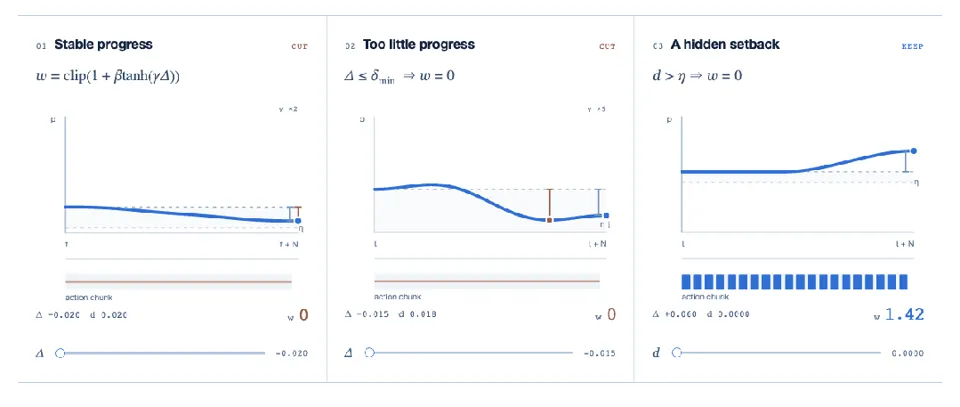
Figure 4 | How Net Progress and Mid-Execution Regressions Influence Training Weights for Action Chunks.
After each execution round, newly collected successful, failed, and intervention trajectories are added to the data pool. The system expands the graph, re-searches, updates weights, and then trains the next policy iteration offline. New experiences can also alter the learning value of previous chunks, eliminating the need for additional training of reward models or progress predictors.
Figure 5 | Offline Iterative Performance of GR-BC
Experimental Results: Average success rate of ~91% across four fine-grained manipulation tasks.
Real-world experiments covered four-hole part assembly, GPU insertion, dual-screw tightening, and RAM stick installation. Notably, the DDR4 slot opening is approximately 1 mm wide, imposing stricter requirements on positional and pose alignment.
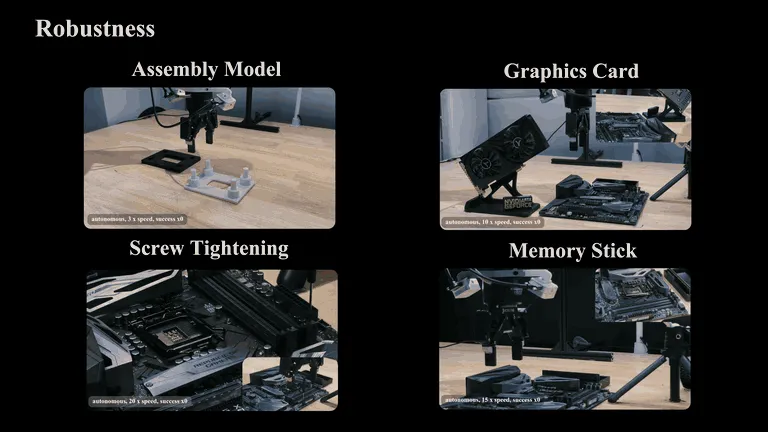
Figure 6 | Demonstration of Operations and Robustness Perturbations Across Four Real-Robot Tasks.
The main experiments used X-VLA as the backbone, with all methods starting from the same behavior cloning checkpoint. GR-BC achieved final success rates of 98%, 93%, 89%, and 83% on these four tasks respectively, averaging about 91%. In comparison, equal-weight aggregation baselines similar to DAgger averaged 64%, a gap of approximately 27 percentage points.
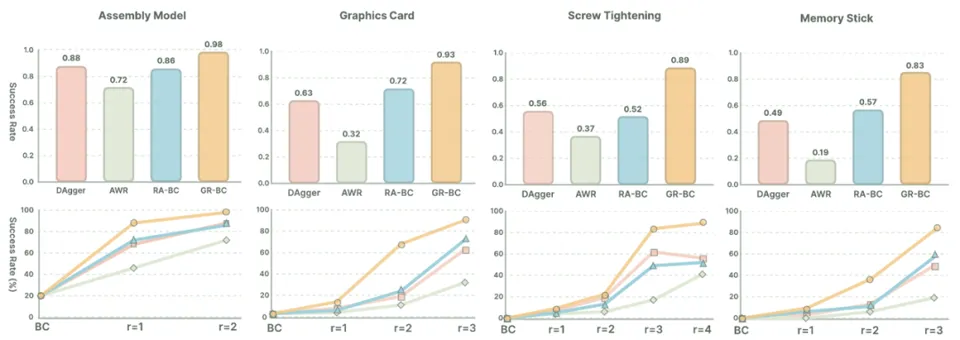
Figure 7 | Success Rates and Iterative Changes for X-VLA Across Four Tasks.
Independent experiments on GPU insertion also covered SmolVLA and , where GR-BC outperformed their respective DAgger-like baselines, supporting its backbone compatibility for this task. The aforementioned 91% average refers specifically to the four-task results using X-VLA.
Progress Evaluation: Can It Detect Regressions Within Successful Trajectories?
Table 1 | Progress Evaluation and Input Conditions; GRP refers to in-graph diagnostics. Excerpted from Table 1 on page 7 of the paper.
Figure 8 | GRP's Progress Signal Drops During Local Deviations, Reorientations, and Slips.
Each task was evaluated on a fixed set of 30 successful and 30 failed trajectories. Aggregated across the four tasks, GRP showed an endpoint progress difference of 0.97 between success and failure cases, and a local deviation detection ratio of 0.92. This indicates that it not only distinguishes between success and failure but also captures regressions occurring during successful executions.
Summary and Outlook
Real-world data is hard-won. Each insertion, alignment attempt, and manual correction involves device operation time and human effort. Demanding that data collectors provide near-perfect complete demonstrations upfront often leads to more retries and may result in discarding many locally effective experiences along with them.
GR-BC enables effective experiences from multiple imperfect attempts to work together, offering new insights for pre-training data cleaning, post-training data quality optimization, and task-progress-based data qualification assessment. By connecting scattered experiences and identifying effective action chunks, it shifts the judgment of data value from the overall success or failure of entire trajectories to the actual contribution of local actions. For industrial applications involving millimeter-level insertion and assembly, this approach holds promise for helping policies learn bias correction and recovery from setbacks, thereby supporting more robust robotic manipulation.
Author Team Introduction
First author Li Xiaoman is from the State Key Laboratory of CAD & CG at Zhejiang University and participated in this research during her internship at China Telecom Artificial Intelligence Research Institute (TeleAI). The work was completed through collaboration among Zhejiang University, TeleAI, Gamma Intelligence, and other institutions.

© THE END
Please contact this official account for reprint authorization.
For submissions or media inquiries: [email protected]