China's LineShine Retains TOP500 Crown at 2.198 Exaflops Without GPUs
At SC26, China's LineShine held the top spot on the TOP500 at 2.198 exaflops, maintaining a 21% lead over the second-place US El Capitan and also ranking first on HPCG. The machine is fully self-developed from chips and networking to storage and system software, with no NVIDIA, Intel or AMD components. A provocative paper by Turing laureate Jack Dongarra and co-authors asking whether GPUs are still necessary has amplified the debate over non-GPU HPC architectures.
Full Report

New AI Era Report
On November 12, Jensen Huang stepped down as CEO of NVIDIA.
Four days later, on November 16, at the McCormick Place convention center in Chicago, SC26, the International Conference for High Performance Computing, Networking, Storage and Analysis, announced the latest global TOP500 supercomputer ranking.
The name at the top had not changed—LineShine, 2.198 EFlops.
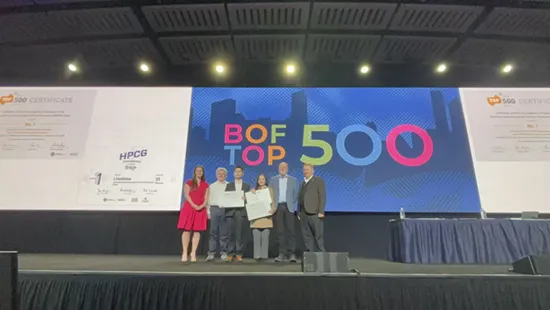
Inside this machine, you cannot find a single NVIDIA GPU, nor a single Intel or AMD processor.
From chips, networking, and storage to system software, the entire stack is independently controllable!
When it first topped the list in June this year, it pulled 21% ahead of the second-place U.S. machine "El Capitan." Five months later, the gap remains unchanged. On the HPCG ranking, which measures real scientific computing capability, it is also still No. 1.
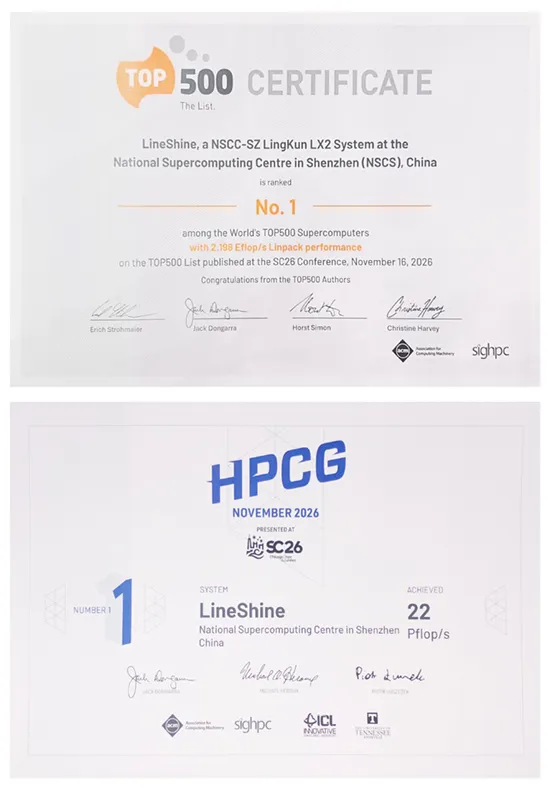
The man who led NVIDIA for thirty-three years exits, and a supercomputer without GPUs holds on to global No. 1—no one scripted this story, yet the history of supercomputing in 2026 has written its most dramatic page all on its own.
Beyond the coincidence, there is also an article. After the "LineShine" system burst onto the scene, Turing Award winner and TOP500 co-founder Jack Dongarra, together with Hoefler of ETH Zurich and Satoshi Matsuoka of Japan's RIKEN, published a highly provocative article this year.
The title translates literally as "Do We Still Need GPUs?"
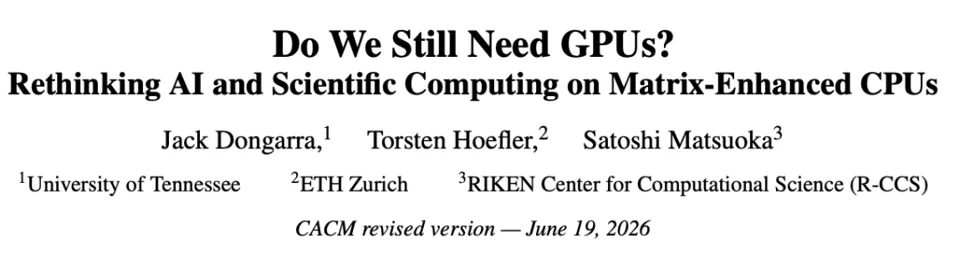
The three authors' answer is: what matters is not whether a chip is called a GPU, but whether it has capabilities such as high-bandwidth memory, matrix engines, and multi-precision computing. If the CPU itself grows these capabilities, then many of the reasons that once made GPUs indispensable no longer hold.
This is precisely one of the design principles of the "LineShine" system as articulated by Professor Lu Yutong, chief designer of the LineShine system, director of the National Supercomputing Center in Shenzhen, and professor at the School of Computer Science and Engineering at Sun Yat-sen University—"returning to the essence of accelerated computing": rather than attaching another chip next to the CPU, let the CPU itself grow the ability to accelerate.
LineShine is precisely the world's first online-accelerated all-CPU supercomputing system built according to this logic—and it has taken the throne as the world's No. 1 supercomputer.
Why can it win without GPUs?
To outsiders watching the excitement, it seems strange: supercomputers around the world are stacking GPUs, yet you insist on not using them—how can you still run first?
The logic behind the GPU's rise in supercomputing is simple: it excels at large-scale parallel matrix operations and also has high memory bandwidth, two things traditional CPUs cannot provide. Thus "CPU handles scheduling, GPU delivers compute" became the mainstream approach, and all three U.S. exascale supercomputers follow this path.
But there is a cost. In their article, Dongarra and his co-authors point out: in modern computing, what is truly expensive is often moving data. Data shuttles back and forth between CPU memory and GPU memory, which takes time and consumes power, and programmers must manage two memories at once. Newer designs let both sides share memory, but the article's judgment is: it helps, but the trouble is not eradicated.
There is also a "translation fee." Many scientific computing software packages are old code written over decades by teams in physics, chemistry, and meteorology—these people's expertise is the discipline itself, not GPU programming. To run on GPUs, core parts often must be rewritten in a GPU-oriented way.
So the path of "not using GPUs" is not one that no one has walked. Japan's "Fugaku" went halfway: pure CPU with high-bandwidth memory, and it held TOP500 No. 1 from 2020 to 2022, but its chips had no matrix engines.
LineShine fills in the AI acceleration step. Its processor LX2 has 304 cores, is based on the Armv9 instruction set, and every core carries vector and matrix acceleration instructions, supporting multiple computing precisions from double precision to INT8; high-bandwidth memory is packaged directly into the processor, 32GB per chip with 4TB/s bandwidth, 10 times that of traditional CPUs. The entire machine has about 13.79 million cores.
In this way, the acceleration units are inside the cores and the high-bandwidth memory is inside the package, so data does not need to be handed back and forth between two chips; programs are still written the CPU way, and old tools such as OpenMP and MPI continue to be used.
The characteristics of this path can be seen in the scorecard:
HPL tests dense matrices, and LineShine leads the second place by 21%; switching to HPCG, which is closer to real scientific computing and more memory-bandwidth-hungry, LineShine scores 22.00 PFlops versus El Capitan's 17.41 PFlops, widening the lead to 26%.
The closer it gets to real workloads, the more obvious its advantage becomes.
Quantum mechanics of 200 million atoms: XLSDFT and the Gordon Bell Prize
Benchmarks are just the ticket in. What really makes peers sit up and take notice of Lingsheng is what has been run on it.
In the 2026 ACM Gordon Bell Prize, 6 entries ultimately made the shortlist, and Lingsheng alone accounted for 2 of them, 1 of which won the award.
In the supercomputing world, the status of the ACM Gordon Bell Prize is equivalent to the Nobel Prize.
In the history of the Gordon Bell Prize, Chinese teams have won the main award 4 times: 2016, 2017, 2020, and 2021, among which the 2020 DeePMD was a China-US team and ran on the US Summit.
This year's main award returned to a Chinese team after 5 years—
The innovative application on the "Lingsheng" system, "Bridging the 'Quantum Advantage' Gap in FeMoco Computation Using an Exascale Supercomputer," won the 2026 ACM Gordon Bell Prize.
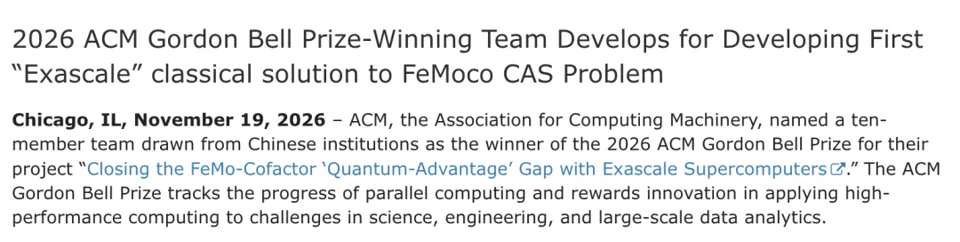
On Lingsheng, the application achieved FP64 performance of 1.456 EF, BF16 performance of 5.626 EF, and floating-point efficiency as high as 58.9%, twice the efficiency of the CPU+GPU architecture system CNIS (Sugon 8000)!
Through supercomputing-intelligence integrated computing, the team achieved for the first time an exascale classical computational solution of the standard model of the nitrogenase FeMoco, completing a high-precision ground-state calculation on the "Lingsheng" system in 1.75 hours, about 1/5 of the time required by the current best theoretical estimate for fault-tolerant quantum computing, providing a new reference for evaluating the potential advantage of quantum computing on this problem.
The other entry that made the final list of the ACM Gordon Bell Prize was the "linear-scaling density functional theory" XLSDFT computational result based on Lingsheng.
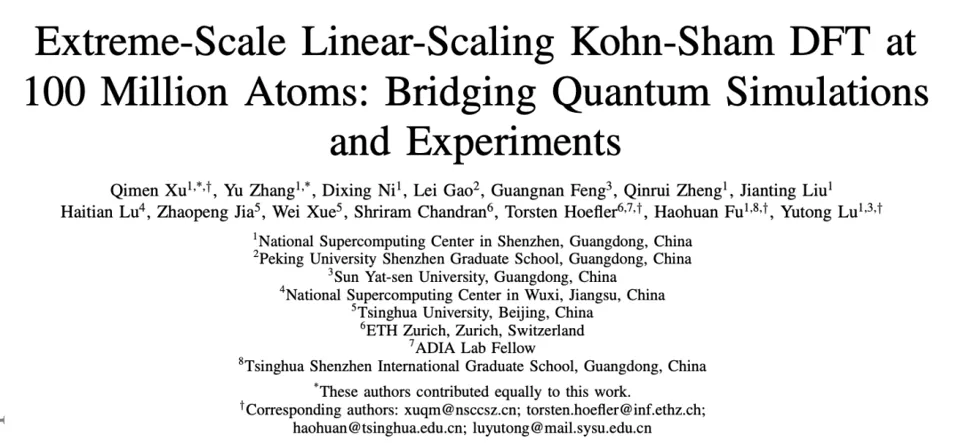
So what problem does XLSDFT solve?
Simply put: it brings quantum-mechanics-level materials computation into contact with real-world scales for the first time.
People doing materials research cannot do without a tool called "density functional theory" (DFT).
It can deduce from the quantum mechanical level how electrons behave in a material—why batteries degrade, why alloys are hard, why catalysts are efficient; the underlying answers are all hidden in the electronic structure.
But conventional DFT has a fatal mathematical property: the computational cost is proportional to the cube of the number of atoms. Double the number of atoms, and the computational cost increases eightfold. The result is that DFT has high accuracy but can only handle hundreds to thousands of atoms, that is, a few nanometers in size; whereas the interface layer that determines performance in a real battery is tens of nanometers or more in thickness and involves millions to tens of millions of atoms. Between the scale that can be computed and the scale that can be seen, there is a gap of several orders of magnitude.
A team led by Professor Lu Yutong, chief designer of the Lingsheng system, director of the National Supercomputing Center in Shenzhen, and professor at the School of Computer Science and Engineering of Sun Yat-sen University, together with Professor Fu Haohuan, deputy director, Associate Researcher Xu Qimen, and Associate Researcher Zhang Yu, independently developed the solution and, jointly with Sun Yat-sen University, Tsinghua University, and other institutions, found a way across this gap.
They seized on a property in quantum mechanics called the "nearsightedness principle": the electronic state around an atom is mainly determined by a small region near it, and the influence of distant regions decays exponentially with distance.
Using this, XLSDFT divides the entire huge computational domain into small blocks like cutting a cake, with each block computing only its own region, and finally assembles them into a complete global picture. Combined with an efficient solution method called "Chebyshev-filtered subspace iteration," both computational cost and memory usage are reduced to linear—double the atoms, and the computational cost only doubles—while maintaining DFT accuracy.
The algorithm handles "computing less"; the remaining problem is "computing fast."
For this step, XLSDFT was tailored to Lingsheng's chips, and the paper describes three techniques.
The first technique: rearrange data. One of the most time-consuming types of operations in this program is data fetching: the chip can compute fast enough, but the data cannot be delivered fast enough. The team rearranged how data is laid out in memory and the order in which it is read, so that the chip can fetch more at once and make fewer return trips.
The second technique: drafts need not be neat. The computation approaches the answer round by round, and each round uses the previous round's result as its starting point. Since the starting point will be revised anyway, the team stores it as a "draft" in half precision, directly halving the amount of data moving in and out of memory at the beginning of each round; when the actual computation is performed, it still uses double precision throughout, so the results are not compromised. With this whole set of changes, the speed of this type of operation on each node rose from 1.66 TFlops to 5.25 TFlops, 3.2 times that of the conventional approach.
The third technique: specialization. Among the computations there is also a type of work involving large matrix multiplications, which happens to be the specialty of the matrix acceleration units built into LX2. The team did not use an off-the-shelf general math library; they rewrote a set according to their own matrix dimensions and handed it directly to the acceleration units to run. In the computation of 100 million atoms, the fastest step reached 1.31 EFlops, that is, 131 quadrillion operations per second.
The three techniques ultimately come down to one thing: making memory keep up with the chip. After the changes, when running 100 million atoms again, the most memory-intensive type of operation can use 89% of the peak of the whole machine's high-bandwidth memory.
Once a single node runs smoothly, the next question is whether the machine will falter at large scale. Many programs run happily at small scale, but once the number of nodes increases, they start waiting on one another.
The team started from 1024 nodes and scaled all the way up to 20480, with the number of atoms also scaled up 20 times; the time per iteration step went from 68.8 seconds to 71.2 seconds, an increase of just over two seconds, which translates to a weak-scaling efficiency of 96.6%. Having passed the scalability test, on the same 20480 nodes they scaled a silicon crystal up to 200 million atoms. The previous record was 10 million.
The silicon crystal structure is regular and contains only one element; computing it was mainly to probe the program's upper limit.
Harder to tackle is a battery interface: the place where lithium metal and LGPS solid electrolyte are in contact, 57×44×90 nanometers, about 11.33 million atoms, with metal and insulator mixed together.
The paper states that this is the first time DFT computation of such an interface has been performed at a scale that can be characterized experimentally, 1000 times the scale of previous similar studies.
To calculate the interface after the reaction, we first need to know where the atoms are after the reaction. This step cannot be done by brute-force quantum mechanics calculation, so the team enlisted AI's help: first perform precise calculations on a small model of a few hundred atoms, use the results to train a DeepMD, then have it carry out molecular dynamics simulation with these 11.33 million atoms, building a 90×57×44 nm Li/LGPS interface model and simulating what lithium metal and the electrolyte look like after contact and reaction. DeepMD only handles how atoms move; it cannot provide the electronic states.
Next, XLSDFT takes the stage to compute the complete electronic structure of the post-reaction interface. AI handles the atoms, the supercomputer handles the electrons—this relay approach is "Superintelligence Integration" (HPC+AI). Finally, the computed results are compared against experimental data from X-ray photoelectron spectroscopy (XPS).
One thing to note is that both TOP500 and HPCG benchmark 64-bit floating point, which is the home turf of scientific computing, not AI training. On HPL-MxP, the mixed-precision benchmark closer to AI, Lingsheng achieves 7.92 EFlops, ranking fourth; the first place, El Capitan, reaches 16.7 EFlops.
The Road Is Built by Ourselves
In 2015, 2019, and 2021, the United States placed Chinese supercomputing institutions and chip enterprises on the export control list three times. Since then, China has stopped submitting new flagship machines to TOP500, and the top spot has remained vacant for nine years.
In April 2026, Lingsheng was fully lit up in Shenzhen; in June it topped the list in Hamburg; in November it defended the world's first place in Chicago.
When it first topped the list in June, Dongarra commented: China's "Lingsheng" system has shown the world a glimmer of hope for a new system architecture leading supercomputing toward AI4Science.
In that article, he and two other authors wrote the same judgment: The future is less about GPU versus CPU and more about convergence. GPUs have taught the industry what high-throughput numerical hardware should look like, and CPUs are now learning some of it**—wider vectors, matrix engines, high-bandwidth memory in package, low-precision arithmetic.**
Currently, Lingsheng has run the farthest on this road.
In the eleventh year since the first round of sales bans, a Chinese supercomputer without GPUs has not only won and held the world's first place, but also run through a quantum mechanics problem of 200 million atoms on it, calculated a battery interface to a degree comparable with experiments, obtained two tickets to the Gordon Bell Prize finals, and even had one application take first place.
It represents a new paradigm for supercomputing:
In the era of deep integration of HPC and AI, the pure-CPU route of on-chip superintelligence integration is becoming one of the preferred technical paths that balances performance, precision, energy efficiency, and self-reliance.
Catch Up with ASI in Seconds
⭐Like, share, and watch—one-click triple⭐
Light up the star, lock in New Intelligence's instant push!