Nvidia in Talks to Acquire Diffusion LLM Startup Inception for Over $500M
Nvidia is in advanced talks to acquire AI startup Inception at a valuation of at least $500 million, potentially with performance-based earnouts. Founded in 2024 by Stanford, UCLA and Cornell professors, Inception builds diffusion-based large language models; its Mercury model claims sub-300ms time-to-first-token and 5-7x throughput via parallel generation. If completed, the team could join Nvidia's Nemotron open model efforts and extend diffusion techniques to robotics and physical AI.
Related Entities
Full Report
IT之家 November 20 news: Tech media outlet The Information published a blog post today (November 20), reporting that NVIDIA plans to acquire AI startup Inception. The two parties are already in advanced negotiations, with the deal valued at at least over $500 million (IT之家 note: approximately 3.346 billion RMB at current exchange rates), and may include additional performance-linked bonuses.
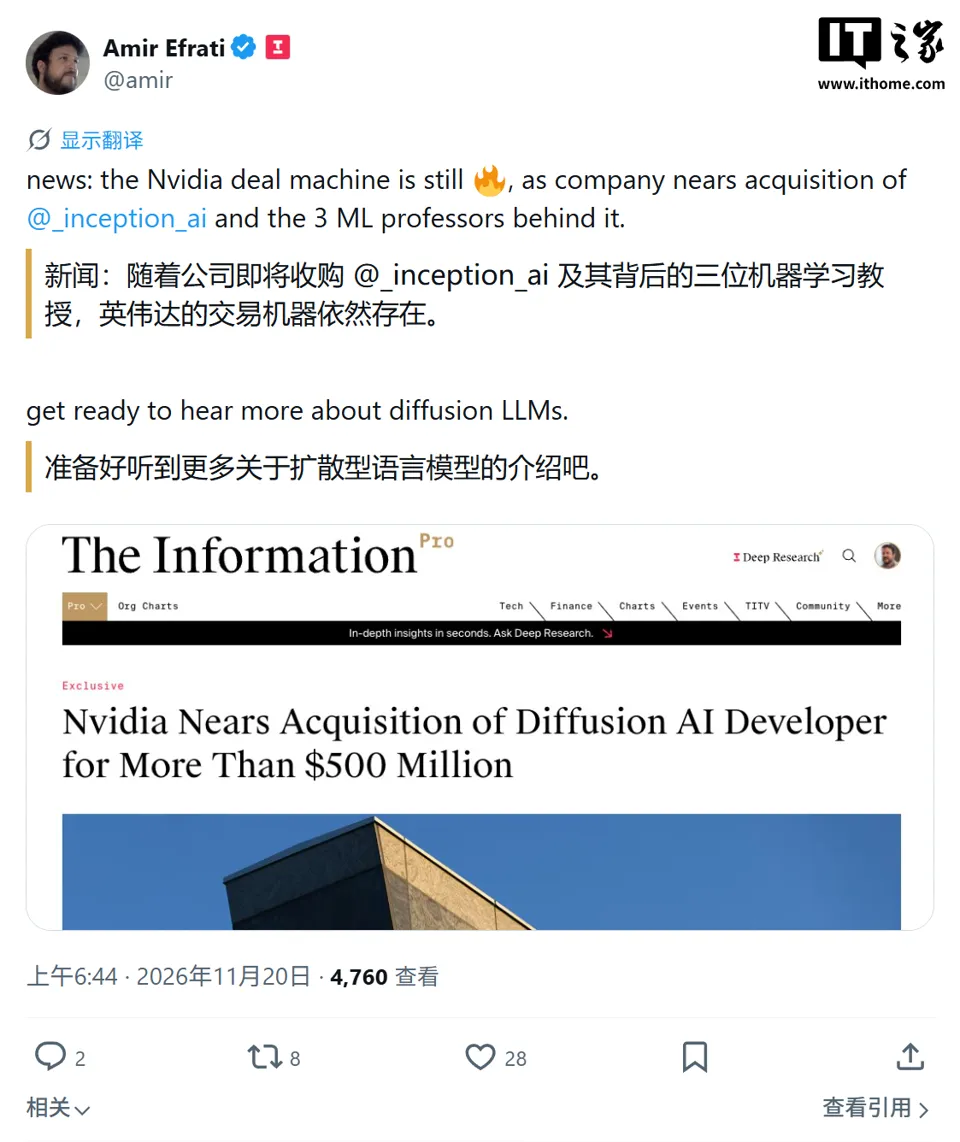
Amir Efrati is The Information's executive editor
According to public information consulted by IT之家, Inception was founded in 2024 and is headquartered in Palo Alto, California, USA. It was co-founded by Stanford University professor Stefano Ermon, UCLA professor Aditya Grover, and Cornell University professor Volodymyr Kuleshov.
The company primarily develops "diffusion large language models" (dLLM). In February 2025, it released Mercury, which it claims is the world's first commercially scaled diffusion large language model. Its products are already available to developers through its own API, Azure AI Foundry, OpenRouter, Baseten, and other channels.
The biggest highlight of the Mercury model is parallel generation. Unlike the "autoregressive" approach adopted by OpenAI's GPT series and Anthropic's Claude series, this model uses a diffusion architecture: it starts from a rough, "noise"-like piece of content, then goes through multiple rounds of denoising and refinement to generate multiple tokens in parallel.
In terms of cost-effectiveness, Inception claims that Mercury's time to first token can be under 300 milliseconds, its throughput is 5 to 7 times higher than traditional models, and the cost per task can be reduced by up to 70%. The media outlet calls it "an AI faster than ChatGPT."
Sources say that if the deal is completed, Inception's three co-founders are expected to join NVIDIA, and its team may also participate in building NVIDIA's Nemotron open-source model system and extend diffusion technology to "physical AI" fields such as robotics.
Currently, neither NVIDIA nor Inception has publicly commented; as negotiations have not yet been finalized, there remains uncertainty regarding the transaction price, closing timeline, and whether products such as Mercury will continue to operate independently in the future.