DeepSeek Opens Full Suite APIs Allowing 1:1 App Replication
DeepSeek has officially opened its full application API suite, splitting web search, deep-thinking search, file upload, link reading, and for the first time speech recognition and synthesis into independently callable, separately billed endpoints. The company says developers can replicate the complete DeepSeek App 1:1 and has open-sourced a lightweight chat frontend demo. Unlike the October Search/Fetch APIs that required manual tool orchestration, the new endpoints let the model autonomously decide when and what to search.
Full Report
Friday night mischief—D-laoshi is holding nothing back!
Just moments ago, DeepSeek announced that it is officially opening up the full suite of application APIs.
What does that mean?
The features everyone has been comfortably using in the DeepSeek App—web search, deep-thinking search, file upload, link reading, and more—are now all directly accessible to developers through APIs. And they don't have to be used as a bundled package: each has its own independent interface, supports standalone calls, and is billed separately.
Key point: voice capabilities are also joining the open lineup for the first time, including speech recognition, speech synthesis, and other interfaces.
The official announcement also included a rather interesting line:
Developers can even recreate a complete DeepSeek App 1.
Wait, seriously? They're allowing others to build an exact copy of their own product??

DeepSeek even kindly provided a reference implementation by open-sourcing a lightweight chat frontend demo that supports importing DeepSeek conversation history.
In other words, developers no longer need to struggle from scratch with basic features like search, file parsing, and speech recognition—they can quickly build a product with functionality close to the DeepSeek App.
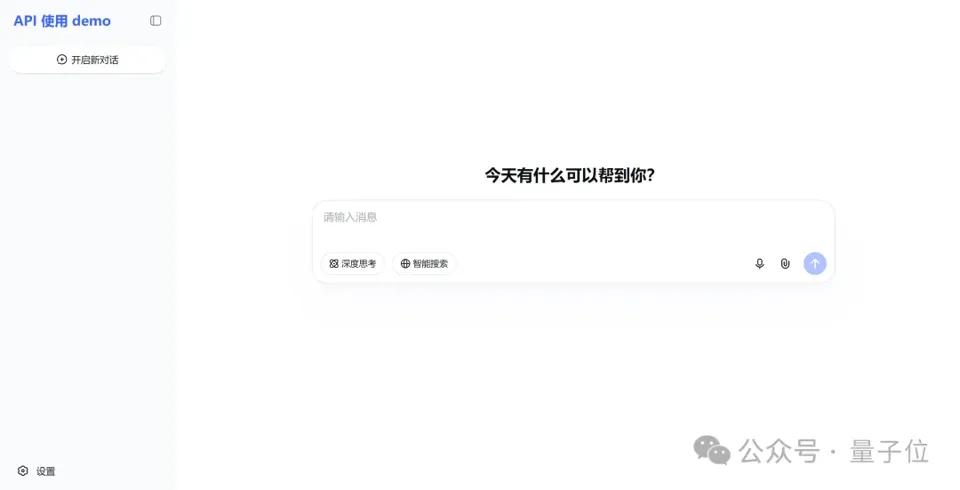
Once the news broke, the comments section got quite lively.
One netizen exclaimed:
What do you mean, recreate a complete DeepSeek App 1??? The light of AI!
Overview of the Full-Suite Application APIs
Specifically, DeepSeek opened up the following capabilities all at once:
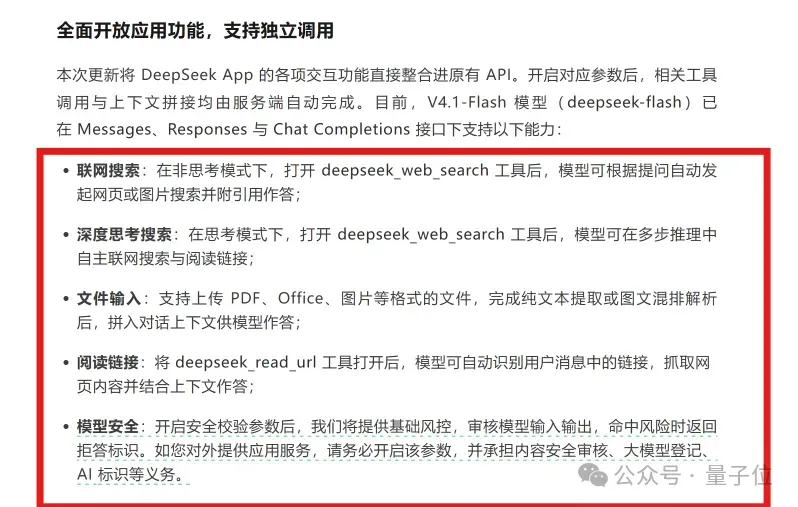
Two changes here are worth mentioning separately.
First, web search isn't actually being opened up for the first time. As early as October 17 this year, DeepSeek had already released its self-developed Search and Fetch interfaces.
But at the time, developers still had to handle a lot of the tool-calling and model-orchestration work themselves.
For example, if a user asks "What's been happening in the AI world recently?", the developer would need to first have the model decide whether to search, then call Search to find web pages, use Fetch to read the content, and finally feed the results back to the model for summarization.
This entire pipeline had to be wired together by the developer's own code.
Now it's much simpler.
Developers just need to enable web search for the model—DeepSeek will automatically handle when to search, what to search for, which pages to read, and how to continue answering based on the search results.
Second, voice finally has official standalone interfaces.
Previously, although the DeepSeek App already supported voice interaction, the publicly available model APIs did not offer the same complete voice capabilities.
Developers who wanted to build a DeepSeek assistant that can listen and speak usually had to integrate separate speech recognition and speech synthesis services.
Now, both ASR and TTS can be called through DeepSeek's official interfaces.

Moreover, the underlying capabilities described above don't have to be used as a bundled package.
DeepSeek also provides independent interfaces for Search, Fetch, OCR, ASR, TTS, and more, allowing developers to choose and combine them as needed.
Currently, the V4.1-Flash model supports the relevant conversation extension features under three types of interfaces: Messages, Responses, and Chat Completions.
In other words, D-laoshi has handed the entire set of foundational capabilities behind its own App to developers like building blocks.
So the question is:
With such comprehensive features on offer, what about the pricing?
Speech recognition under 0.4 yuan per hour—DeepSeek is offering 50% off this time
First, let's look at the tool API price list DeepSeek published:
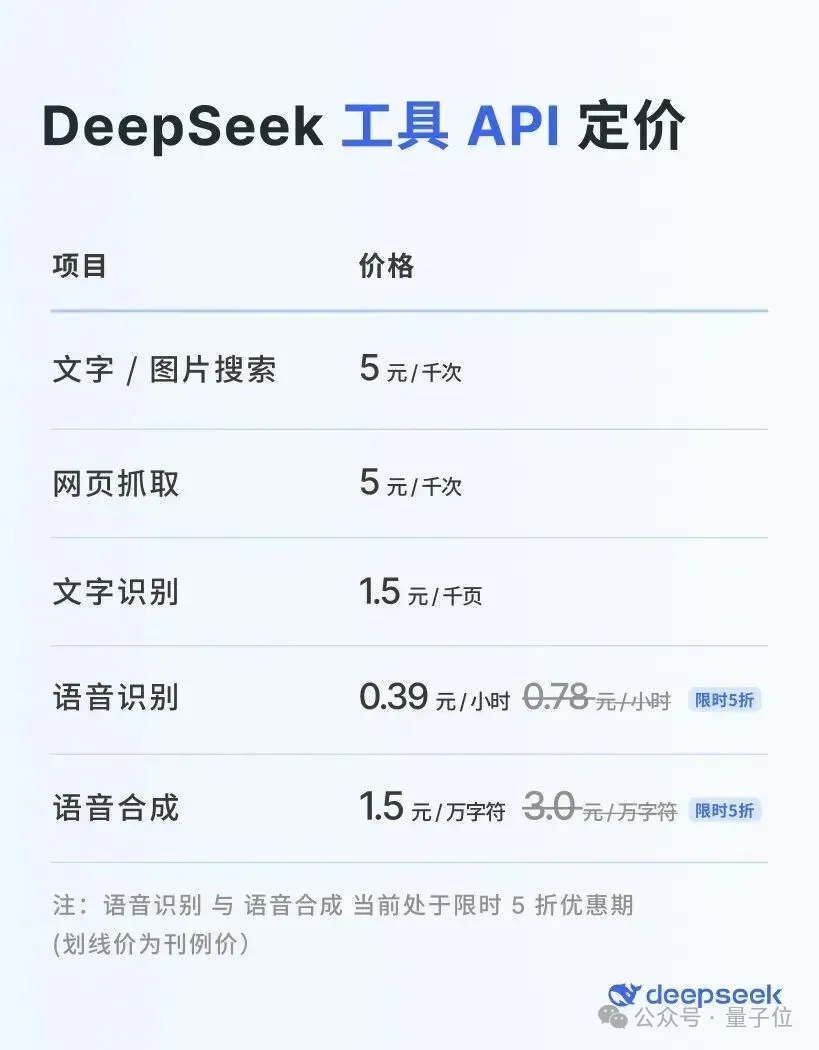
The most eye-catching item, of course, is voice.
Speech recognition is originally priced at 0.78 yuan/hour, but is currently 50% off—just 0.39 yuan.
That works out to about 0.0065 yuan per minute. Recognizing an hour of audio costs less than 0.4 yuan.
Speech synthesis is also 50% off: originally 3 yuan per 10,000 characters, now just 1.5 yuan.
What does that mean?
Compare it with the speech API pricing of major overseas providers:
OpenAI's GPT-Transcribe costs $0.27 to transcribe one hour of audio (about 1.81 yuan).
Even the cheaper GPT-4o mini Transcribe costs $0.18 (about 1.21 yuan).
Google Cloud's standard speech recognition service, at $0.016 per minute, costs $0.96 per hour (about 6.43 yuan).
By comparison, DeepSeek's current 0.39 yuan is only about 1/4.6, 1/3.1, and 1/16.5 of the prices of those three services, respectively.

As for search and web scraping, it remains at the previously announced 5 yuan per 1,000 successful calls.
OCR is priced at 1.5 yuan per 1,000 pages, averaging just 0.0015 yuan per page.
Looking at it this way, DeepSeek's pricing strategy this time is quite clear.
The existing search capabilities remain low-priced, while the newly opened voice interfaces use a 50% discount to lower the barrier to entry.
For developers looking to build voice assistants, meeting transcription, document processing, and similar applications, at least the cost of calling basic tools has been pushed to a fairly low level.
(D-laoshi is still your D-laoshi)
One More Thing
Finally, there's a rather interesting detail.
At the end of the announcement, DeepSeek wrote:
DeepSeek's existing conversational product is merely a relatively basic form.
That line is quite consistent with D-laoshi's usual style.
All along, compared to investing heavily in consumer-facing products, DeepSeek seems more willing to focus its energy on model research and development.
Although the DeepSeek App has accumulated a large number of consumer users, from a product perspective, it remains the familiar chat assistant.
Now, it has simply opened up all its capabilities—even preparing sample code for recreating its own app. It rather suggests:
I'll keep researching models; as for how to play with applications, I'll leave that for everyone to explore.
How to put it? This move is actually pretty clever...
Looking back at the mobile internet era, super apps like WeChat and Douyin almost completely reshaped the way people socialize, entertain themselves, and even access information.
Now in the AI era, large models have become increasingly powerful, yet the application forms seem to have not kept up.
From ChatGPT to DeepSeek, the most familiar interaction method for everyone is still opening a chat box, typing in a question, and waiting for an answer.
But will the next super app of AI really still be a chat box?
Right now, no one has the answer.
That being the case, rather than guessing behind closed doors, it would be better to lay out all the tools and let developers around the world experiment together.
What if someone actually comes up with the next blockbuster?
Truly, Teacher D's big stage — if you've got a wild idea, come on up. (doge)