Rohan Paul (@rohanpaul_ai) · 10/14/2026, 22:12:17
CMU Study: Structured Logs Boost Agent Audit Verifiability from 42% to 83%
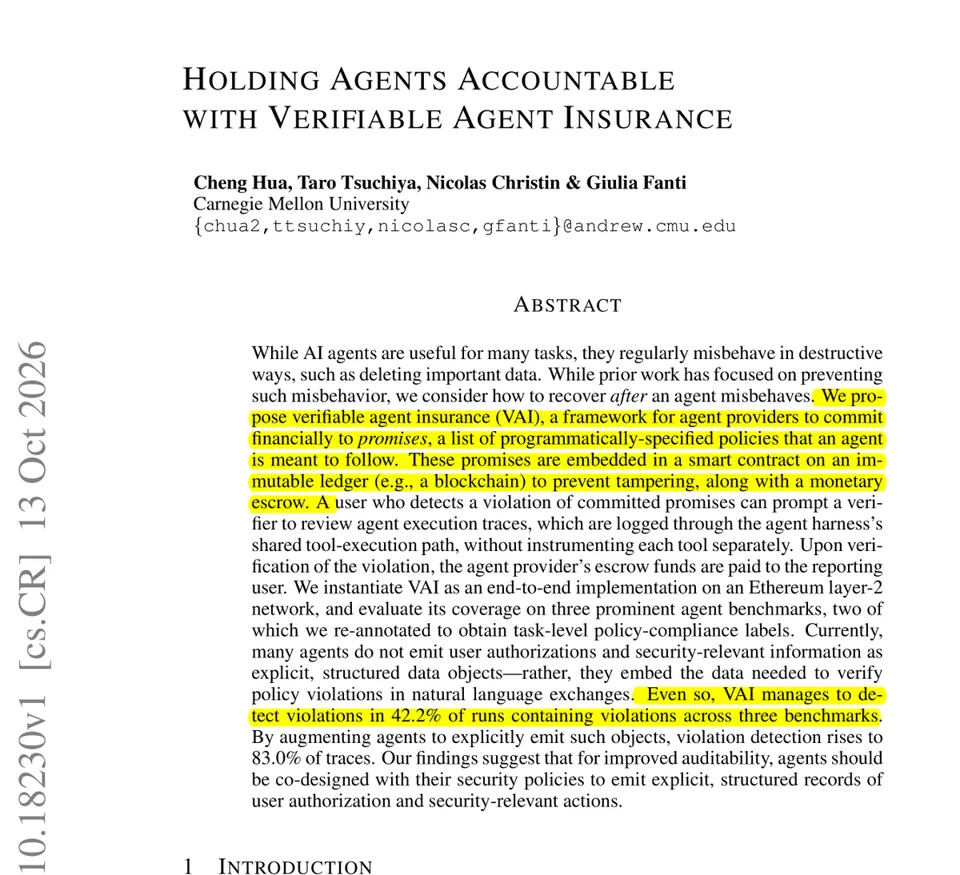
A new Carnegie Mellon University study reveals that OpenClaw's agent logs failed to prove any of four policy violations because approvals were buried in chat text. The authors propose a 'verifiable agent insurance' model using on-chain hashes to audit tool calls, showing that structured permission records can boost violation verifiability from 42.2% to 83.0% at under 1 cent per session.
SOURCE COVERAGEFull Original Report
Rohan Paul (@rohanpaul_ai) · 2026-10-14 14
New Carnegie Mellon paper finds that OpenClaw's logs left 0 of 4 policy violations provable, a warning for any team relying on agent logs for audits.
They found that most agent policy violations in its tests could not be proven from logs, often because approvals and permissions were buried in chat text.
Also finds that only 10% to 30% of violating runs needed human judgment, so most agent rule breaks could be checked by code with better logs.
Safety work mostly tries to stop agents before they misbehave. When a mistake slips through, like a wiped inbox or a bad payment, users get little beyond slow, capped, case-by-case refunds.
In verifiable agent insurance, a provider posts a deposit on a blockchain and promises rules a program can check, like paying only approved merchants. A neutral verifier compares the agent's tool-call log with on-chain hashes, and if a rule was broken, the deposit pays the user.
Tested on 696 rule-breaking runs from 3 benchmarks, the checker proved 42.2%, often failing where approvals lived only in chat messages. With structured approval records, the authors estimate 83.0%, at under 1¢ of blockchain fees per session.
Design your agent so every permission, its scope, and each risky action land in a machine-readable log.