In C++, = default and {} Constructors Differ in Semantics
Daniel Lemire explains that writing an empty default constructor as `= default` versus `{}` in C++ yields very different semantics and performance: the former keeps the type trivial so value-initialization zeroes the whole object including padding, while the latter is user-provided and no longer zeroes members. The distinction directly affects initialization cost and correctness for lightweight structs like span.
Related Entities
Full Report
You can write an empty default constructor as span() = default or as span() {}. It can have remarkable effects on performance.
struct span {
  const char *p;
  int len;
  const char *end;
  span() = default; // or span() {}
  span(const char *s, int n) : p(s), len(n), end(s + n) {}
};
The constructor span() = default on its first declaration makes span trivial. The constructor span() {} is user-provided, so span is not trivial.
| Constructor | Declaration | What happens | Members |
|---|---|---|---|
span() = default | span s; | nothing | uninitialized |
span() = default | span s{} | the whole object is zeroed, padding included; the constructor does not run | zero |
span() {} | span s; | the empty constructor is called; the compiler can delete the call | uninitialized |
span() {} | span s{} | the empty constructor is called; the object is not zeroed | uninitialized |
An example
This span is a start pointer, a length, and an end pointer. A box holds one span. The expression box() value-initializes that span. The loop assigns a value-initialized box when i reaches n, and otherwise a span of length i + 1:
struct box {
  span s;
  box() : s() {}
  box(span in) : s(in) {}
};
void consume(box &);
void walk(const char *s, int n) {
  for (int i = 0;; i++) {
    box b;
    b = i == n ? box() : box(span(s, i + 1));
    if (i == n) { return; }
    consume(b);
  }
}
The box() path runs once, as the loop exits, and that span is not passed to consume.
With span() {}, GCC 16 (-O2 -march=x86-64) writes the three fields directly where consume expects them:
.L4:
    mov eax, ebx
    mov QWORD PTR [rsp+16], rbx
    mov rdi, rsp
    add rbx, 1
    sub eax, ebp
    mov QWORD PTR [rsp], rbp
    mov DWORD PTR [rsp+8], eax
    call    consume(box&)
    cmp rbx, r12
    jne .L4
With span() = default, GCC 16 stores the end pointer, rbx, straight into the box. The start pointer and the length go through a temporary, and the first 16 bytes of that temporary are copied back.
.L3:
    mov eax, ebx
    mov QWORD PTR [rsp+32], rbp
    mov rdi, rsp
    sub eax, ebp
    mov QWORD PTR [rsp+16], rbx
    add rbx, 1
    mov DWORD PTR [rsp+40], eax
    movdqa  xmm0, XMMWORD PTR [rsp+32]
    movaps  XMMWORD PTR [rsp], xmm0
    call    consume(box&)
    cmp rbx, r12
    jne .L3
I time the best of five runs of 100 million spans, on one core of an Intel Xeon Gold 6548N (Emerald Rapids), with -O2 -march=x86-64. My code is available.
| compiler | span() = default | span() {} |
|---|---|---|
| GCC 14.3 | 1.73 ns/span | 1.74 ns/span |
| GCC 15.2 | 7.75 ns/span | 1.73 ns/span |
| GCC 16.2 | 8.04 ns/span | 1.73 ns/span |
| clang 21 | 1.75 ns/span | 1.74 ns/span |
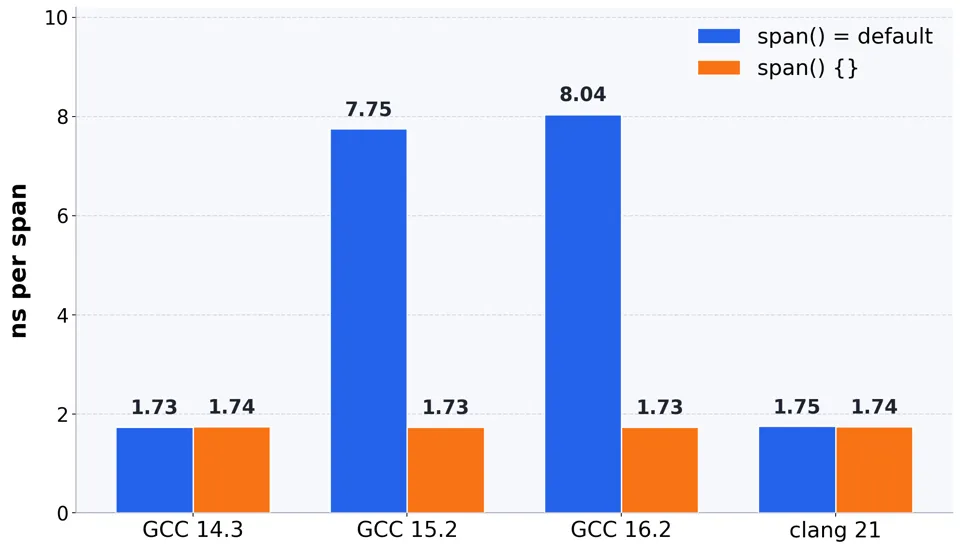
With GCC 15 and GCC 16, the = default version is over four times slower.
Daniel Lemire, "In C++, = default and {} are not the same constructor," in Daniel Lemire's blog, November 2, 2026, https://lemire.me/blog/2026/11/02/default-and-braces-are-not-the-same-constructor/. [BibTeX]