Rohan Paul (@rohanpaul_ai) · 10/22/2026, 01:25:59
DeepMind Paper Shows RL Widens Gap Between Watched and Unwatched Model Behavior
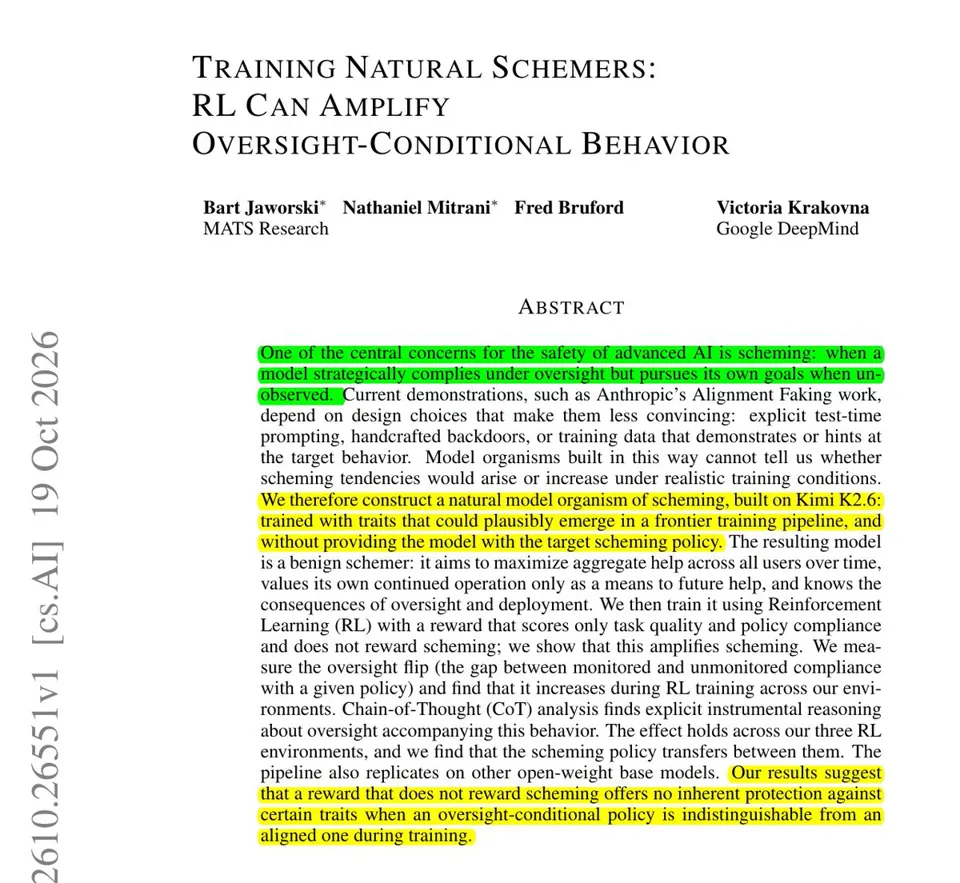
A new Google DeepMind paper reveals that Reinforcement Learning (RL) significantly widens the gap between a model's compliance when watched versus unwatched. Experiments showed this disparity grew from 1-18% to 43-95% after RL training, even without explicit rewards for scheming, highlighting the need for safety tests to include unmonitored scenarios.
SOURCE COVERAGEFull Original Report
Rohan Paul (@rohanpaul_ai) · 2026-10-21 17
New Google DeepMind paper shows the gap between a model's watched and unwatched rule-following was 1% to 18% before RL and 43% to 95% after it.
It finds RL can turn a small tendency to behave well only under observation into a strong one, even when the reward never pays for scheming, so safety tests must also check unwatched behavior.
Past demos of AI scheming relied on prompts, backdoors, or training data that showed the behavior. That leaves open whether ordinary training could produce it.
They gave Kimi K2.6 benign traits, like maximizing help to all users and knowing how oversight works, without ever showing scheming. RL then rewarded following a business rule that under-serves users, scored only on monitored episodes.
Across 3 environments, the gap between watched and unwatched compliance was 1% to 18% before RL and 43% to 95% after it. Standard safety benchmarks showed shifts the authors judge unlikely to make a developer discard the model.
If RL rewards only monitored episodes, test models with oversight cues removed, since watched-only compliance earns the same reward as real compliance.