Anthropic Glasswing Finds 38,000 Flaws but Fixes Only 217
VulnCheck's tracking shows that seven months into Anthropic's Project Glasswing, Claude has produced 37,966 candidate vulnerabilities while only 217 have been recorded as fixed publicly, with roughly 12,000 new candidates but just 15 new fixes in the past two months. With 419 retractions and 1,654 duplicates, the data exposes a severe mismatch between AI-driven vulnerability discovery and the open-source community's capacity to remediate.
Related Entities
Full Report
Contents3 sections
Digs holes but doesn't fill them.
Cheng Qian, reporting from the Non-Linear Zone QuantumBit | WeChat Official Account QbitAI
Lately, the whole "AI finds bugs" thing has become a bit too disjointed.
On one side, AI swoops in and audits everything at once, first unearthing a major security vulnerability in PHP's underlying code, then digging up 948 Linux kernel vulnerabilities...

On the other side, the open-source community is on the verge of collapse: you found the vulnerabilities, so fix them already!
Yesterday, the cybersecurity firm VulnCheck released a report card on Anthropic's Project Glasswing.
It shows that seven months after Project Glasswing launched, Claude has cumulatively dug up 37,966 candidate vulnerabilities.
But as of now, only 217 have been fixed according to public records.
VulnCheck can't help but ask: has the much-heralded "Mythos era" of cybersecurity really arrived?
38,000 vulnerabilities—how many have actually been fixed?
First, let's jog everyone's memory about the "Project Glasswing" that Anthropic hyped up and launched in April this year.
The project aims to use Claude to mine security vulnerabilities in critical software and open-source projects at scale, working with tech companies and open-source maintainers to drive vulnerability fixes and eliminate security risks before they can be exploited.
The name carries two meanings.
On one hand, security vulnerabilities are like glasswing butterflies—hidden right under people's noses, undiscovered for decades. On the other hand, transparency itself is a form of protection: Anthropic hopes that through more transparent security research and vulnerability disclosure mechanisms, software systems can achieve better protection.

△Glasswing butterfly, scientific name Greta oto | Image source: Wikipedia
At launch, Anthropic claimed it would provide $100 million in model usage credits and $4 million in open-source security donations, while also announcing that its cybersecurity trump card model Claude Mythos Preview had already discovered thousands of high-severity and critical vulnerabilities. A chorus of support followed, with Apple, Google, Microsoft, AWS, and NVIDIA all joining in.
But is that really the case?
According to data continuously tracked by VulnCheck, as of early November, Anthropic's candidate findings had reached 37,966, but only 217 were marked as fixed in the vulnerability disclosure ledger.
Meanwhile, invalid data keeps piling up: 419 vulnerability withdrawals and as many as 1,654 duplicates.
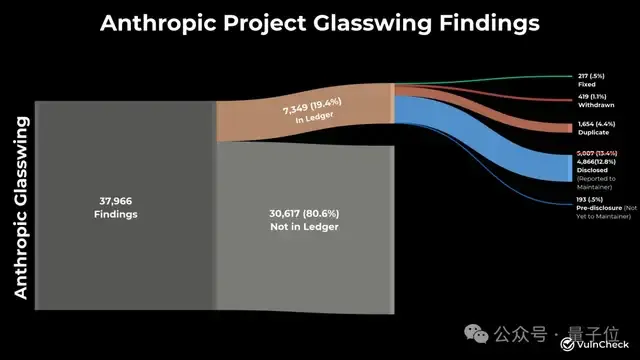
△Image source: VulnCheck
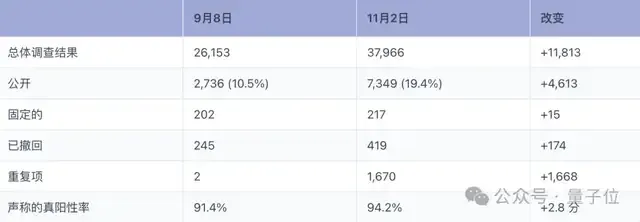
And this gap is still widening at an accelerating rate.
In the past two months alone, candidate vulnerabilities surged by nearly 12,000, but fixed records increased by a mere 15.
Furthermore, the 442 CVEs attributed to Anthropic that VulnCheck tracked account for only 0.5% of the total global publicly disclosed CVEs in 2026.
△Image source: VulnCheck
According to official data disclosed by Anthropic, as of November 2, of the 37,966 candidate findings, 6,376 had been reviewed by external security experts, 6,009 findings were valid, of which 5,087 had been reported to software maintainers and 629 had received upstream patches.
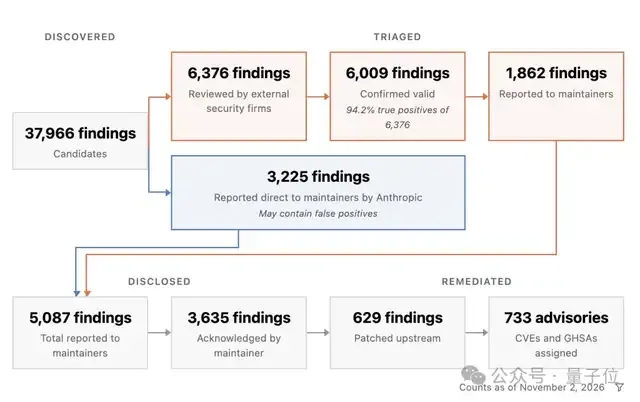
Although differences in data methodology make the fix counts vary slightly, both sides have noticed one thing.
That is, at this intensity of AI-driven vulnerability discovery, manual review simply can't keep up.
Anthropic itself recognized this early on, and officially acknowledged that the severe bottleneck in human verification capacity greatly limits the efficiency of vulnerability review and disclosure.
So on October 8, it launched a service called OSS Scanner.
Open-source project maintainers can voluntarily sign up to have Claude scan their code for free, so that model-generated vulnerability reports can be sent directly to maintainers without waiting for Anthropic to organize manual review.
Open-source maintainers can't keep up with the fixes
AI is forcing us to immediately pay off 40 years of accumulated technical debt.
Behind this data gap, the ones suffering most are open-source maintainers—VulnCheck cites the example of curl, the network data transfer tool.
In early November, curl maintainer Daniel Stenberg received yet another big gift package from Anthropic: 45 vulnerability reports.
Long before that, Daniel had written in his blog that core maintainers were already overwhelmed by the endless stream of reports.
Our goal is to not drown.

To cope with so many reports, Daniel announced changes to curl's security vulnerability handling rules. Low- and medium-severity vulnerabilities would be discussed publicly on GitHub, letting more community developers help with the review.
Of the 34 reports curl has made public so far, 19 were judged not to constitute security vulnerabilities, and 6 were confirmed as low-severity vulnerabilities.
VulnCheck's report subtly points out: didn't you say they were all critical? So now, Glasswing seems to be of little use other than adding to people's review workload?
But in fact, Anthropic did dig up one serious vulnerability in curl.
In September this year, Anthropic used Claude to discover a Use-After-Free memory error in curl. Under specific conditions, a malicious server could even exploit it to achieve remote code execution.
Daniel called it one of the most serious vulnerabilities in curl in years.
So coming back to it, VulnCheck's report actually reads a lot like an ad for itself, because the very problems with Glasswing it criticizes happen to align closely with the vulnerability intelligence and priority management services it offers...
One More Thing
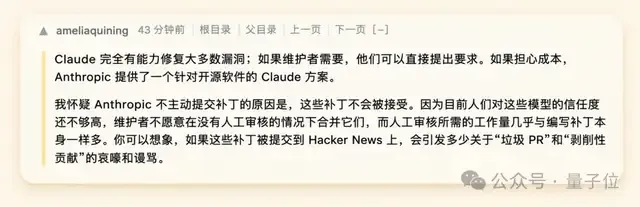
At this point, some may wonder: since Claude is so powerful, why not just have it fix the problem on the spot when it finds one?
In fact, Anthropic has already had AI generate candidate patches.
It's just that developers have long suffered from AI bug fixing... "Having an LLM generate a fix really isn't hard; what's hard is whether open-source projects are willing to adopt it."

Reviewing an AI patch can sometimes take nearly as much work as writing one yourself.
It's often a case of "lighting one candle to illuminate more darkness"—AI finds a problem and starts fixing it, and to fix it, it adds more complex logic to the code, and in the end it fixes one bug and brings ten new problems.
"AI is very good at adding things, but it doesn't realize that things can also be removed..."

So at least for now, the pits dug by these most powerful models still need humans to fill.
Reference link:
https://www.vulncheck.com/blog/anthropic-glasswing-november-update