量子位官网 · 10/11/2026, 13:23:47
OpenAI Releases 722 Math Manuscripts Claiming Proof of 4D Kakeya Conjecture Beyond Human Results
OpenAI released 722 mathematical manuscripts on GitHub, including papers claiming proofs for the 3D and 4D Kakeya maximal function conjectures that surpass recent Fields Medal-winning human work. This event has sparked intense debate on whether AI is poised to replace top-tier human intelligence in pure mathematics, marking a new phase in automated formal proof.
SOURCE COVERAGEFull Original Report
In July of this year, Wang Hong and Deng Yu won the Fields Medal at the International Congress of Mathematicians in Philadelphia.
During the days when the news went viral, Anthropic employee Alek Dimitriev posted on X:
This batch of Fields Medals will be the last time humans win this award.

Previous laureate Timothy Gowers replied, saying he had similar thoughts.
However, there is a lag in this process, so I think they can probably hold out until 2030.

Who would have thought… Gowers, you might still have been optimistic.
On October 7, OpenAI released 722 mathematical manuscripts all at once, uploading papers and some Lean proofs to GitHub.
Among them, group number 074 contained only two papers, precisely in the direction for which Wang Hong won the award: the Kakeya conjecture.

One paper claims to prove the three-dimensional Kakeya maximal function conjecture, a stronger version than what was proved by Wang Hong and Zahl.
The other paper claims to prove the four-dimensional Kakeya conjecture.
Together, these two manuscripts span 272 pages, with only one word listed as the author: OpenAI.
Just as Wang Hong and Joshua Zahl solved the three-dimensional Kakeya set dimension conjecture, AI pushed related results into four dimensions.
Could it be… that this year’s Fields Medal really is the last one for human mathematics?
What exactly did OpenAI’s two Kakeya papers do?
In 1917, Japanese mathematician Soichi Kakeya posed a question: What is the minimum area required to rotate a needle of length 1 by 180 degrees on a plane?
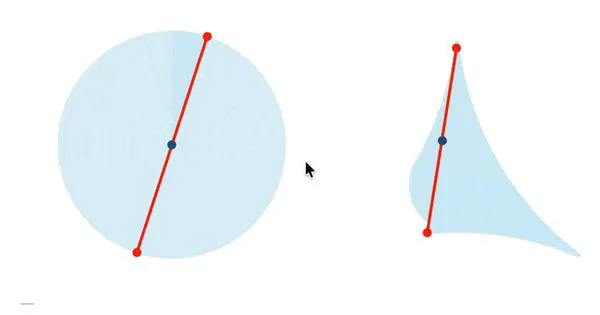
△ Illustration of the Kakeya problem
Besicovitch provided a counterintuitive answer: The area can be arbitrarily small. Even more surprisingly, a set can contain a unit-length needle in every direction while having zero area.
Since area is unreliable, mathematicians switched their measuring tool to "dimension."
Here, "dimension" is not just the everyday concept of length, width, and height. For such extremely irregular sets, mathematicians use tools like Hausdorff dimension and Minkowski dimension to measure how complex they are across different scales.
A set can have zero volume but still possess full spatial dimension.
The Kakeya conjecture states: In n-dimensional space, if a set contains a unit line segment in every direction, its dimension must be the full n dimensions.
The difficulty lies in how these seemingly thin line segments intersect and overlap, and whether the set can be compressed further after overlapping.
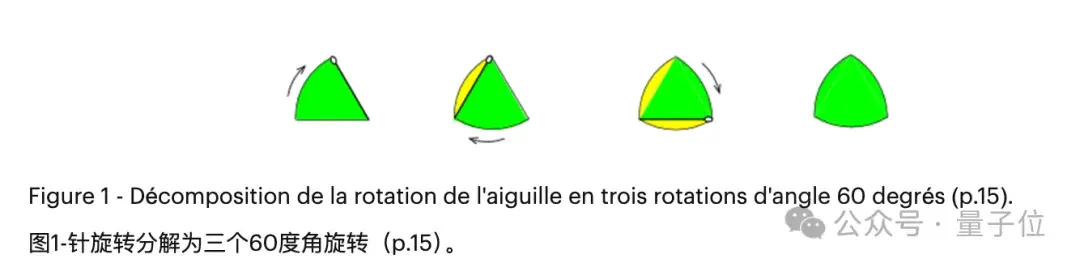
△ Illustration of the Kakeya problem
The planar case was proven by Davies in 1971; the three-dimensional case remained stuck for half a century until Wang Hong and Joshua Zahl cracked it in February 2025.
Four dimensions and above remain unproven to this day.
The two manuscripts OpenAI recently made public address two versions of the Kakeya problem.
Paper 1: The Three-Dimensional Kakeya Maximal Function Conjecture
Still three-dimensional, but tackling a harder version of the problem.
You can think of it initially as a "tube overlap control" problem: Place many thin tubes in three-dimensional space, where each tube represents a direction of the needle.
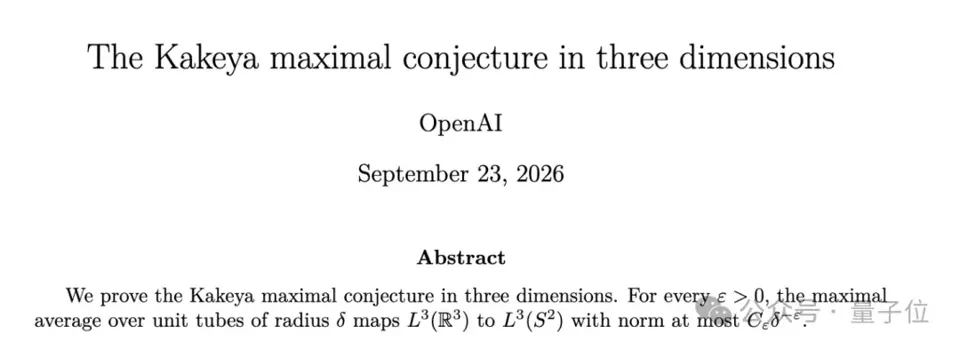
△ First page of the three-dimensional Kakeya maximal function conjecture paper released by OpenAI
Mathematicians study how much these tubes can overlap when oriented in distinct directions, and whether a unified estimate can control this overlap.
Wang Hong and Zahl proved the "set version," studying the minimum area occupied by these needles when stacked together.
OpenAI’s proof of the "maximal function version" delves deeper:
Thicken each needle into a thin tube, assuming only a fraction λ of each tube is "solid." When all solid parts are combined, can we guarantee the total volume is at least on the order of λ³?
The smaller λ is, the emptier the tubes become, making control more difficult. The set version requires only a relatively loose power of λ, whereas the maximal function version demands the exponent to be exactly 3.
This point is explicitly stated in the introduction of the OpenAI paper: Wang Hong and Zahl’s theorem provides λ^K(ε), and the "need to upgrade to λ³" was clearly proposed immediately after their theorem.
In other words, this is the next step left by Wang Hong and Zahl. And OpenAI’s 97-page paper claims to have solved this step.
Why is this important? Because the Kakeya maximal function transforms "how tubes of various directions squeeze together" into a computable analytical problem.
It is connected to core conjectures in Fourier analysis and has long been considered an essential tool for understanding waves, frequencies, and spatial concentration phenomena.
In 1971, Fefferman used Kakeya sets to construct counterexamples, proving that high-dimensional ball multipliers are bounded only in L². Since then, the Kakeya problem has been tightly linked to the Fourier restriction conjecture and the Bochner-Riesz conjecture.
Paper 2: The Hausdorff Dimension of Four-Dimensional Kakeya Sets
Regarding four dimensions, human progress prior to this was as follows:
In 1995, Wolff used the "brush" method to prove the dimension is at least 3;
Later, Guth and Zahl used polynomial methods to push it to 3 + 1/40, approximately 3.025;
In 2019, Katz and Zahl used "planar brushes" to reach 3.059;
Subsequent progress has basically moved only in the second or third decimal place.
OpenAI’s 175-page paper claims to directly prove it equals 4.
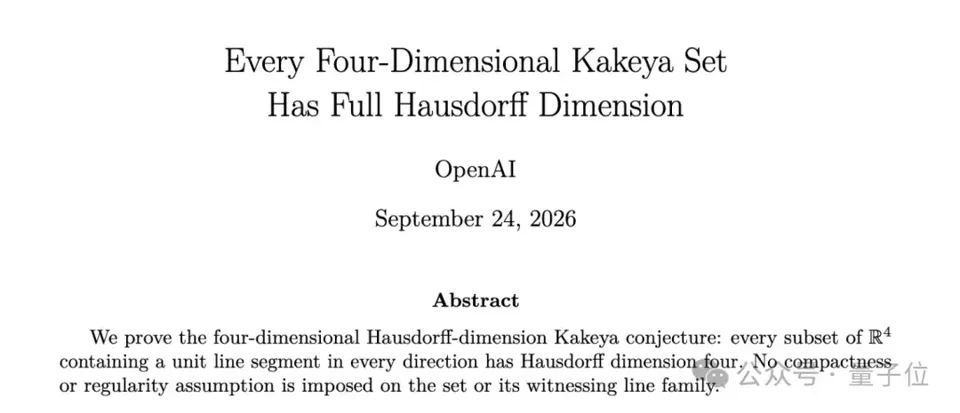
△ First page of the four-dimensional Kakeya set Hausdorff dimension conjecture paper released by OpenAI
What makes four dimensions difficult? Guth pointed out in a survey that key theorems from Wang Hong and Zahl’s three-dimensional proof do not hold in four dimensions.
This is because, in higher-dimensional spaces, tubes can cluster near low-degree algebraic surfaces, forming counterexample structures that do not exist in three dimensions.
The core tool in OpenAI’s four-dimensional paper targets this issue: using quadratic polynomials to perform local fitting at different scales, tracking lines that persistently cluster across scales.
Throughout the text, the word "polynomial" appears 213 times.
There is another detail: one of the key inputs for the four-dimensional paper cites a lemma from the three-dimensional OpenAI paper. Essentially, the two papers form a chain, where the stronger version in three dimensions paved the way for the four-dimensional result.
Therefore, it can also be said that this work advanced Hong Wang’s achievements by a significant step. In three dimensions, her theorem was strengthened to the maximal function version; in four dimensions, a problem stuck at just over 3 was directly pushed to 4.
However, this paper still has boundaries. The four-dimensional case only proves the Hausdorff dimension version and does not resolve the four-dimensional maximal function conjecture. Dimensions five and above remain unproven; the paper only provides a lower bound via projection.
It is worth noting that the results from Group 074 have not been formalized in Lean, nor have they undergone peer review.
OpenAI stated in the README that some non-formalized results "may contain errors."
What did Hong Wang do?
Some say Hong Wang was lucky to secure the Fields Medal before AI could take over.
Is that really the case?
Looking through the full text of these two OpenAI papers, one of the most frequently appearing names is Hong Wang.
In the three-dimensional paper alone, "Wang" appears 23 times.

The peak of the three-dimensional Kakeya problem has been climbed by human mathematicians for many years.
Katz, Łaba, and Tao discovered early on that nearly extreme tube configurations exhibit three structures: stickiness, planarity, and graininess.
But for decades, no one could turn them into a complete proof.
Hong Wang and Joshua Zahl proceeded in three steps:
In 2022, they first proved the case for "sticky" Kakeya sets, which was later published in the Journal of the American Mathematical Society.
In 2024, they secured the Assouad dimension version.
In February 2025, they released a 127-page complete proof, simultaneously resolving the Hausdorff dimension and Minkowski dimension versions of the three-dimensional Kakeya set conjecture.
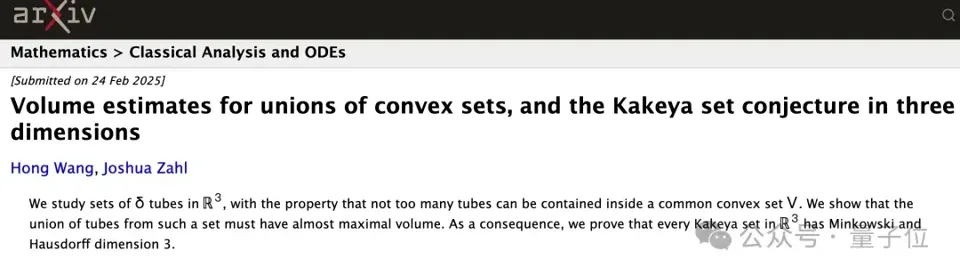
△ Hong Wang and Joshua Zahl's paper on the three-dimensional Kakeya set conjecture
Nets Katz evaluated this as a "once-in-a-century result."
During the same period, Hong Wang and Kang Ren also solved the Furstenberg set conjecture in the plane, another long-standing problem in harmonic analysis.
These works now serve as the foundation for OpenAI's papers.
The three-dimensional paper directly utilizes the simplified proof by Guth, Hong Wang, and Zahl; Guth was Hong Wang's PhD advisor at MIT. It also uses the planar Furstenberg estimates by Kang Ren and Hong Wang.
The four-dimensional paper utilizes a dot product theorem by Hong Wang and Zahl.
If both papers are ultimately confirmed to be valid, they are essentially adding two more stories onto the framework built by Hong Wang.
Moreover, Hong Wang’s attitude toward AI is not one of rejection.
In an interview after winning the award, she described AI as a "proactive booster" for mathematical research, believing that posing problems, creating concepts, and building theories remain the core work of mathematicians.
The human mathematics community is already in uproar...
Now, we are likely in the "critical moment of survival" for human mathematics.
The lifecycle of a major mathematical result used to be roughly: an individual or a small team spends several years producing it, posts it on arXiv, peers spend one or two years reviewing it, and the academic community slowly digests it.
Years later, once the conclusion is settled, awards are finally decided.
Hong Wang and Zahl walked this path from the sticky case in 2022 to the Fields Medal in 2026, taking nearly four years.
In contrast, OpenAI released 722 mathematical manuscripts overnight, with each result averaging about three hours of ChatGPT Pro thinking compute, and only about 42% of the results formalized in Lean.
It feels almost like a provocation...
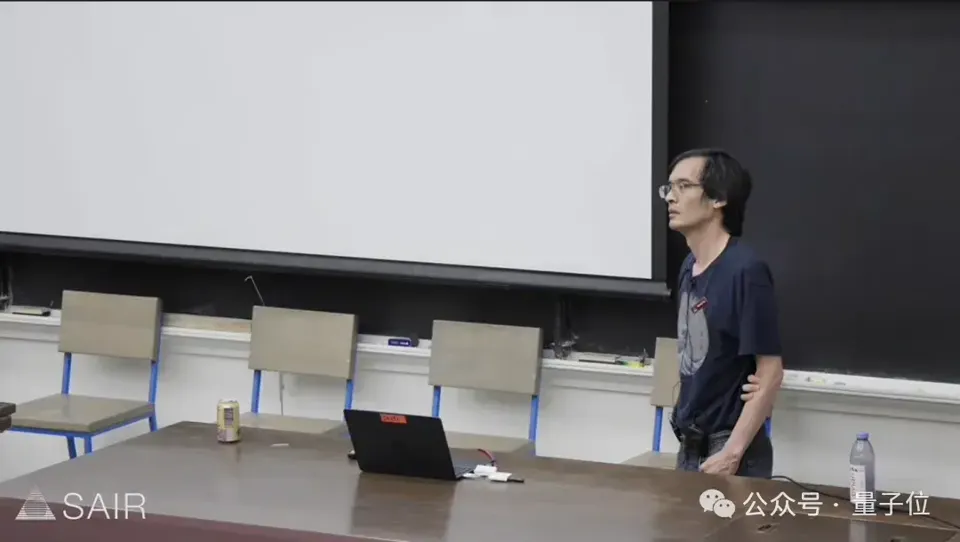
Terence Tao has already led the Association for Human Mathematics (AHM) in issuing a heavyweight joint statement, fully boycotting OpenAI.
The wording is quite severe:
Mathematicians did not ask for this work to be done. Releasing over 700 files at once demonstrates not scholarship, but power.
The statement strongly urges all mathematicians to stop collaborating with OpenAI and return to a scientific vision centered on human understanding.
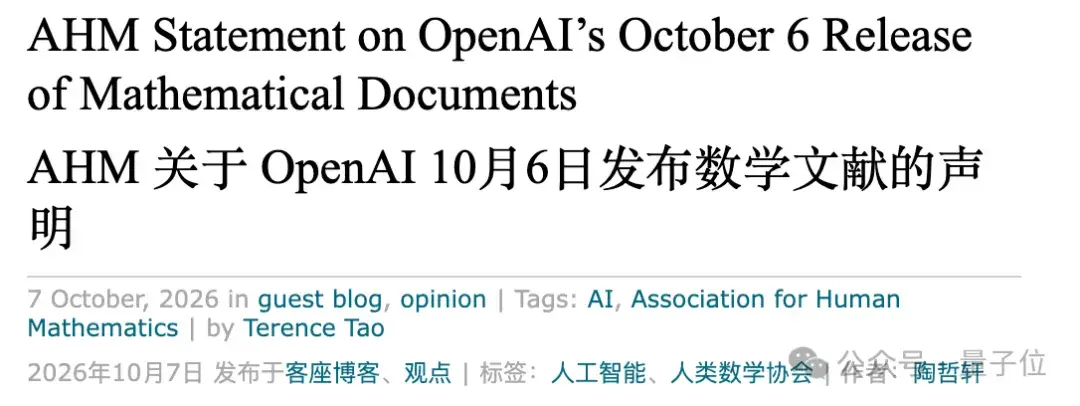
Terence Tao himself has always been an active user of AI-assisted research; what he opposes is treating the batch solving of famous difficult problems as a product showcase.
In his view, once a problem is solved by AI, it cannot revert to an unsolved state, and the new methods and understandings that human mathematicians might have developed on that problem are thereby cut off.
And now, peer review has become the biggest bottleneck.
For a 175-page four-dimensional Kakeya proof, there are very few people in the world who can seriously read and understand it. Who will read it, how long will it take, whose workload counts—these answers are all unknown.
Attribution and ownership are also becoming chaotic. Scholars working on the same problem may wake up one day to find that their years-long topic has been "claimed" as solved by a model.


Whether these AI-generated proofs are correct is still unknown, but selecting topics has already become extremely difficult.
Of course, some feel excited.
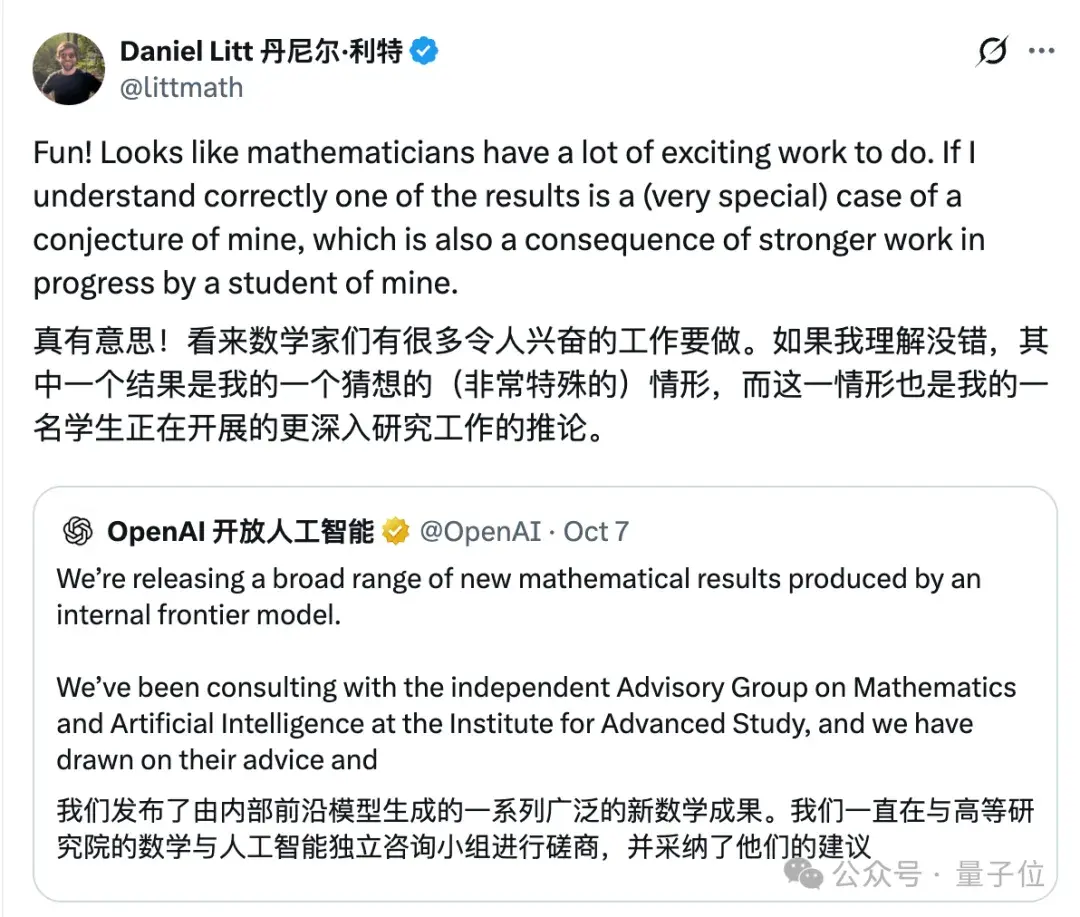
For example, Daniel Litt, Assistant Professor of Mathematics at the University of Toronto, believes mathematicians have a lot of exciting work ahead.
Yann LeCun also believes that, on the contrary, mathematics is entering a new era.
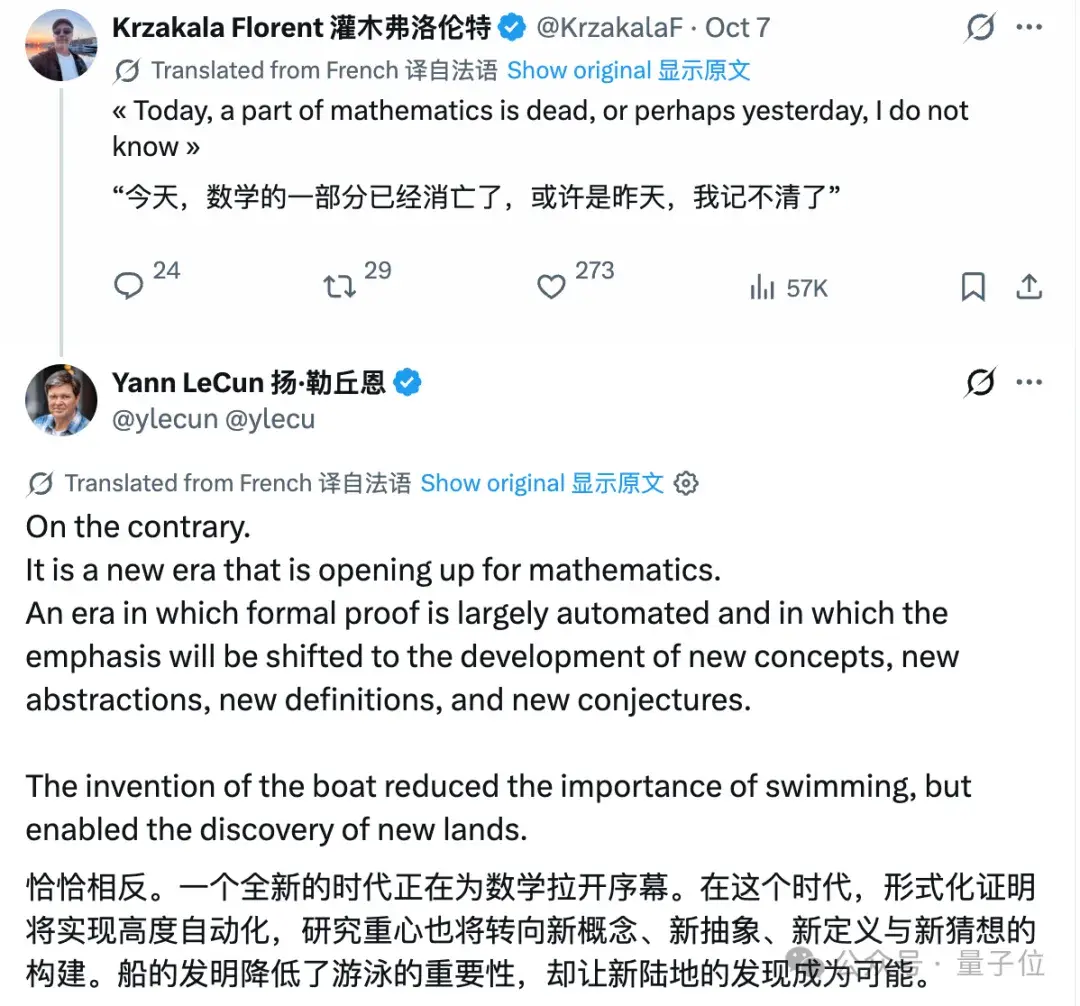
Formal proofs will be largely automated, and the focus will shift to developing new concepts, new abstractions, new definitions, and new conjectures.
The invention of ships reduced the importance of swimming but allowed us to discover new continents.
The mathematical community is at a juncture of violent collision between old and new orders; traditional research methods are being challenged, while new tracks have not yet formed.
Where the future will lead remains unanswered for now. But we prefer to believe: Sinking boats aside, a thousand sails pass by; sick trees ahead, ten thousand woods spring.
Gowers says humans can probably hold out until 2030, and the next Fields Medal happens to be awarded in 2030.
By then, will there still be humans standing on the podium?