IT之家 · 智能时代 · 10/14/2026, 06:47:26
Google Launches Gemini 4 Argon: 1M Token Output, Tops Vals Index, Refactors Chrome Codebase
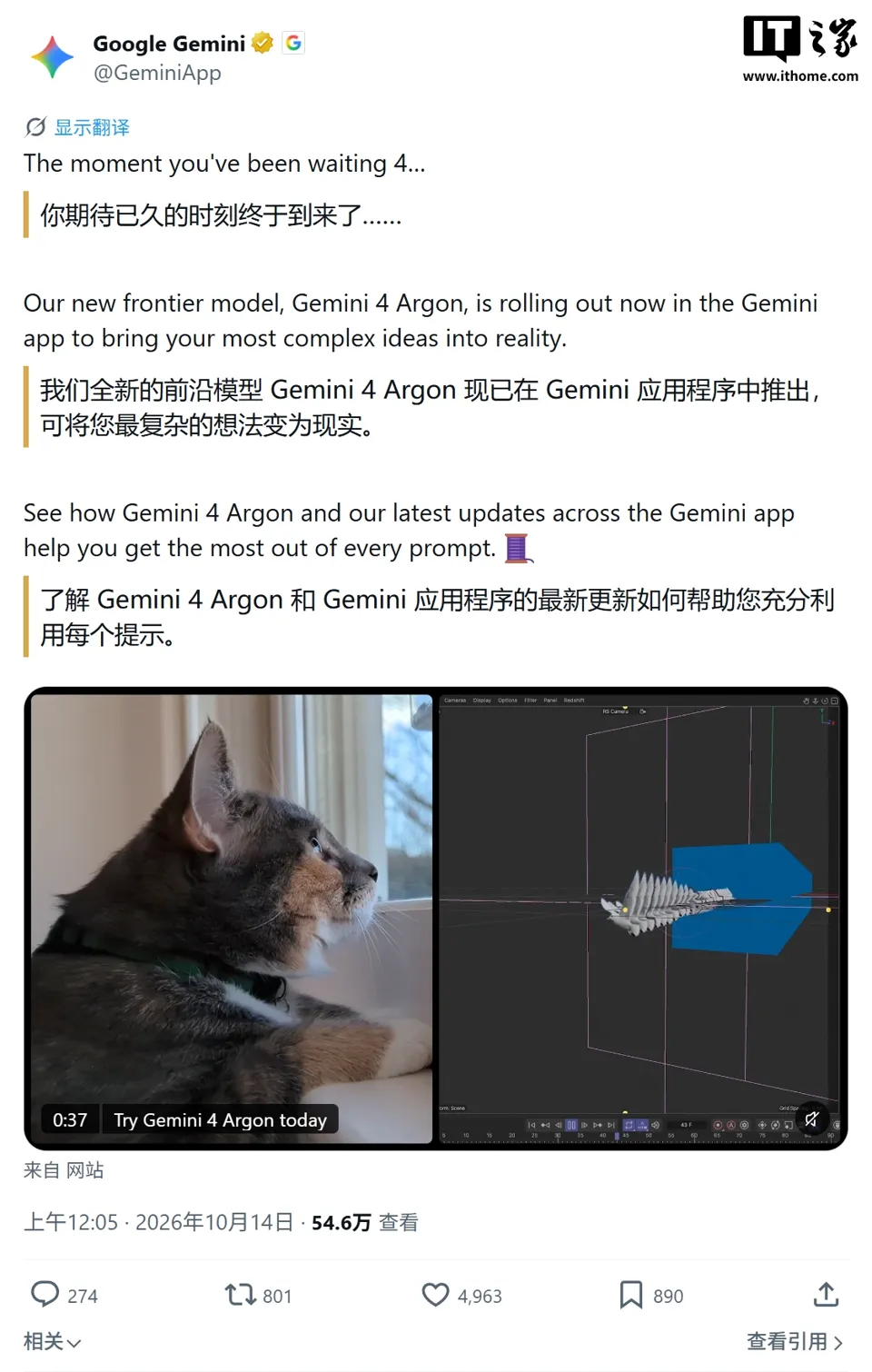
Google has released its flagship model, Gemini 4 Argon, optimized for complex real-world tasks and ultra-long context. It supports up to ~1 million tokens of output (sharing a single window with input and reasoning) and ranks first on the Vals Index across coding, finance, and legal benchmarks. The model has already demonstrated efficacy in large-scale engineering tasks, such as refactoring millions of lines of code for Chrome.
SOURCE COVERAGEFull Original Report
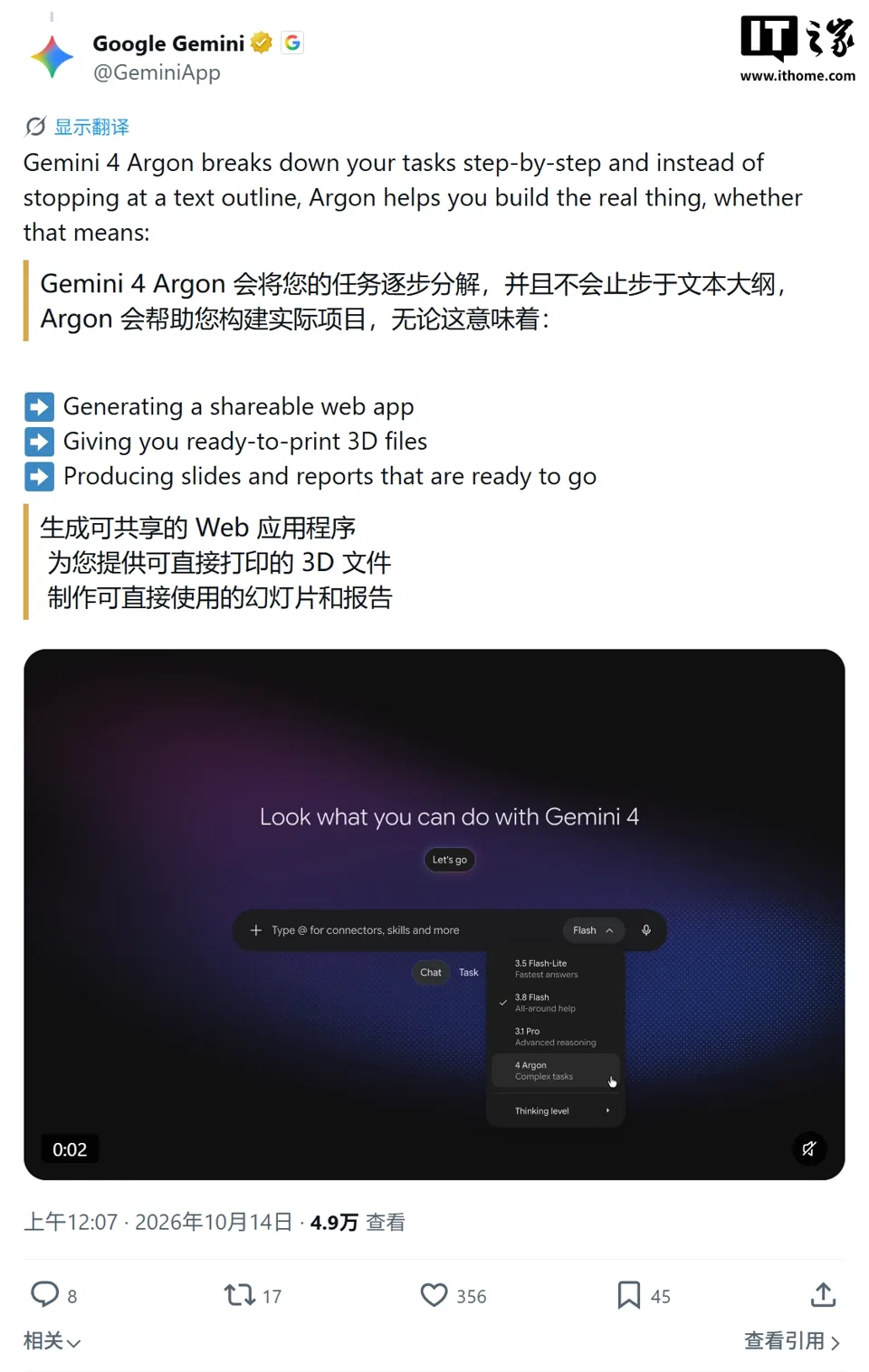
On October 14, it was announced that Gemini 4 Argon is now available to developers and enterprises worldwide. It can be accessed via AI Studio and the Gemini Platform API, as well as by Google AI Ultra subscribers on Google Antigravity, and Google AI Ultra and Pro subscribers using the Gemini app and Search AI mode.
The model currently offers limited-time introductory pricing (exchange rate as of October 14, 2026: 1 USD ≈ 6.6921 CNY):
- Input: $2 per million tokens (Note: approx. 13.4 CNY at current exchange rates)
- Output: $10 per million tokens (approx. 66.9 CNY at current exchange rates)
- Cached input: $0.1 per million tokens (approx. 0.7 CNY at current exchange rates)
After the introductory promotion ends on November 30, 2026, pricing will adjust to:
- Input: $4 per million tokens (approx. 26.8 CNY at current exchange rates)
- Output: $20 per million tokens (approx. 133.8 CNY at current exchange rates)
- Cached input: $0.2 per million tokens (approx. 1.3 CNY at current exchange rates)
Gemini 4 Argon excels at handling complex real-world tasks in fields such as coding, finance, law, cybersecurity, and science. Its depth and precision in multi-step tasks allow it to outperform other frontier models across various domain-specific benchmarks. It currently ranks first on the Vals Index, which measures model performance in key economic sectors including finance, coding, law, and tax.
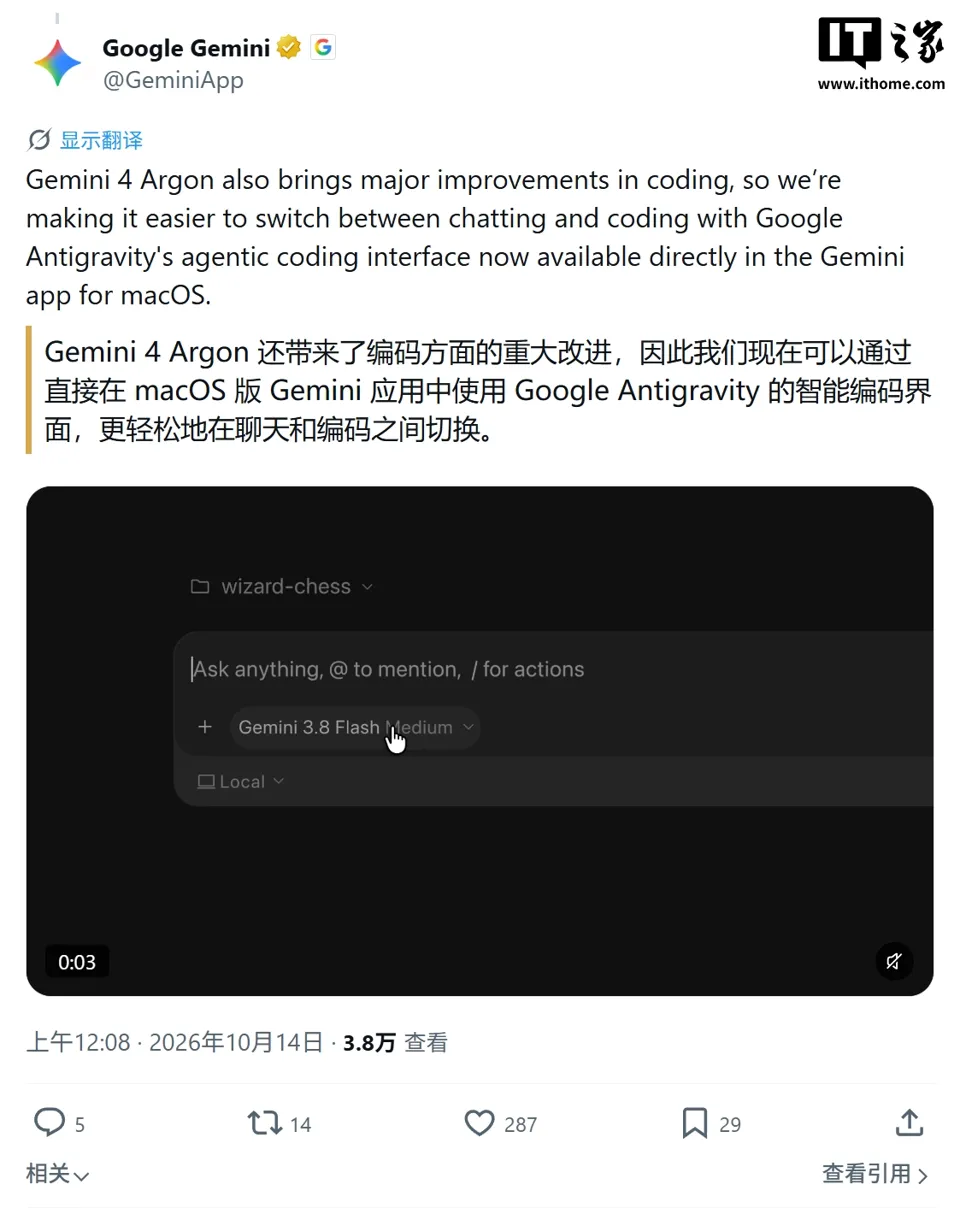
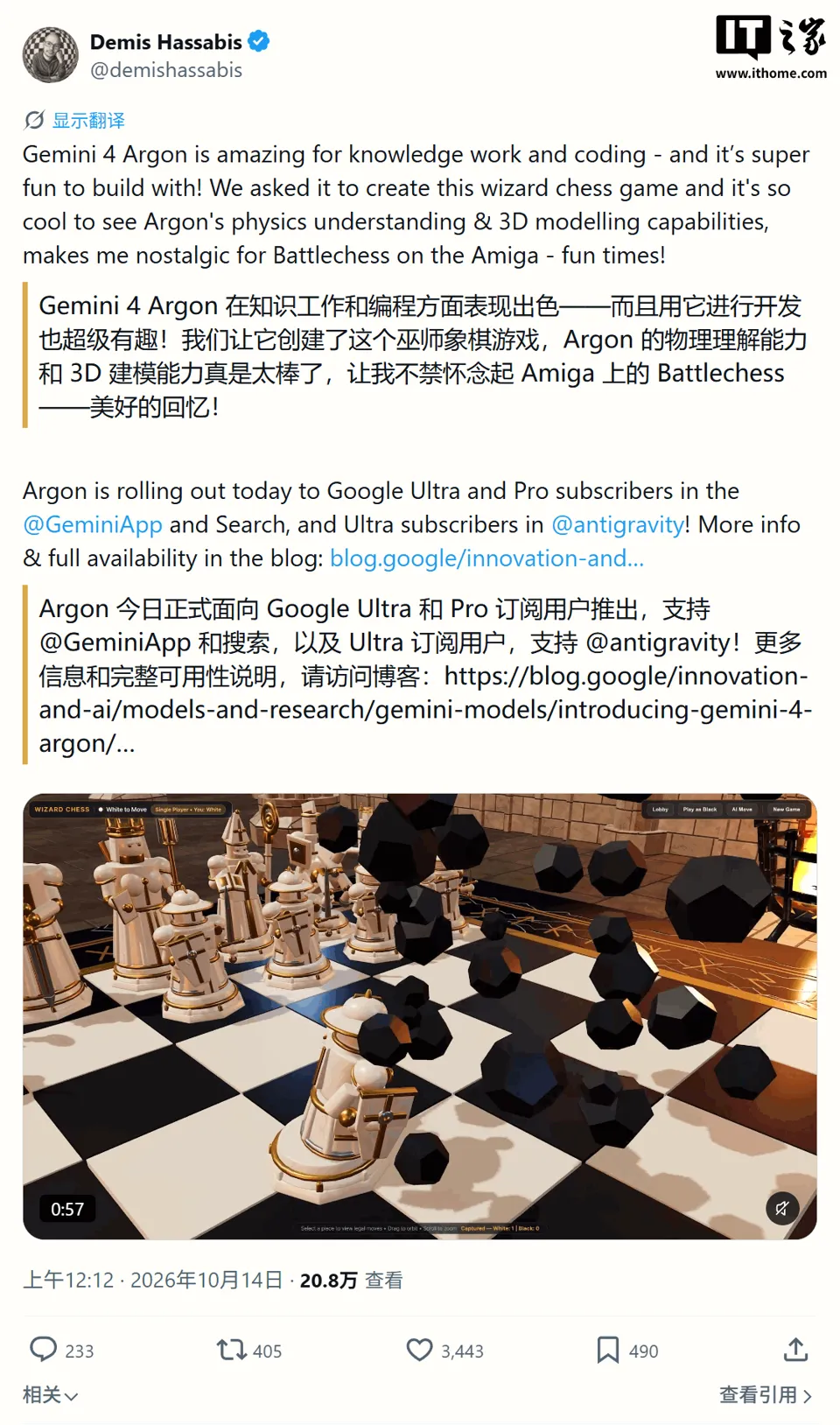
Internal teams at Google, along with external enterprises and research groups, have already begun using the model to solve diverse challenges. These include refactoring and optimizing large codebases, streamlining business workflows in legal and financial domains, identifying and fixing critical cybersecurity vulnerabilities, and driving breakthroughs in areas such as quantum computing, nuclear fusion, and life sciences.
In engineering, the model assisted the Chrome team in completing an architectural refactor of tens of millions of lines of code, reducing work that originally took months down to weeks. It also autonomously completed performance optimizations for an open-source project overnight, cutting memory session preparation time by 40% and improving cold import speed by 21%.
In scientific research, Google is offering 10,000 scientists free access to the highest usage tier of Google Antigravity for six months; applications are now open. In cybersecurity, Google has expanded its Fairwind initiative to help more security defenders identify and patch vulnerabilities.
Regarding safety, Google has implemented a multi-layered defense system for the model, significantly enhancing resistance to jailbreaks, prompt injection attacks, and agent alignment issues. The rate of harmful outputs violating safety guidelines has decreased by nearly half compared to previous Gemini models.
In terms of context and generation capabilities, the latest Gemini 4 Argon supports up to 1,048,576 tokens for long-context reasoning and output generation.
